




REDWAY BATTERY / KNOWLEDGE
How To Determine The Best Forklift Battery And Charger Sizes?
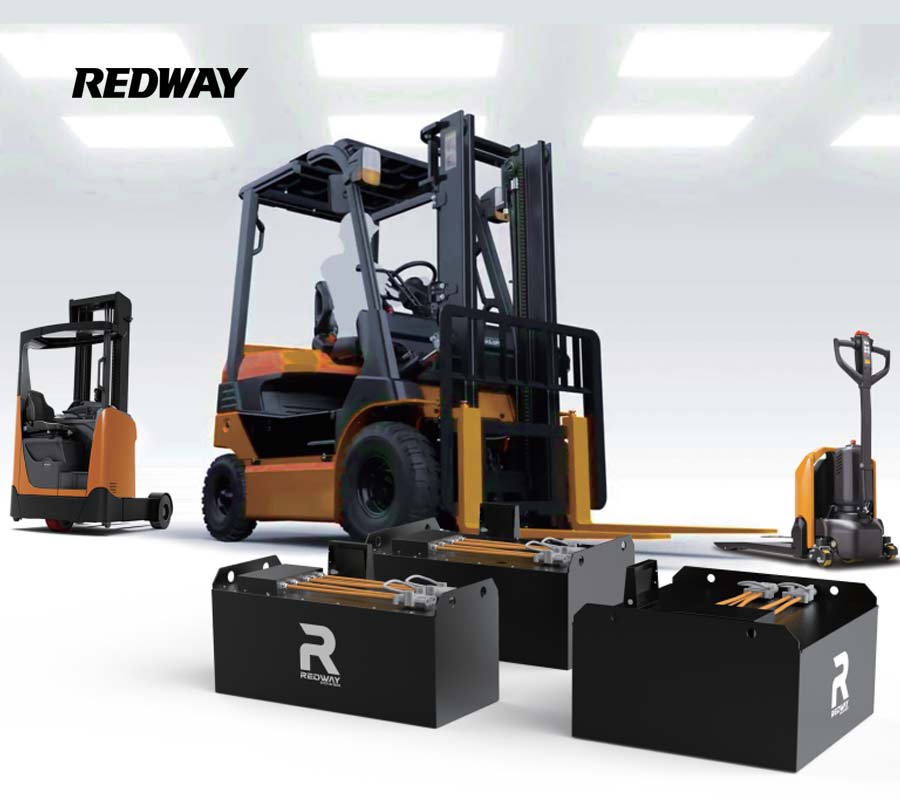
Choosing optimal forklift battery and charger sizes requires analyzing three factors: voltage (24V-80V), capacity (Ah), and operational duty cycles. Match battery voltage to forklift specs, calculate Ah based on shift hours/load weights, and select Li-ion chargers with 1C-2C rates for rapid replenishment without overheating. Lithium-ion batteries like LiFePO4 outperform lead-acid with 2,000+ cycles and 30% faster charging. Always cross-check manufacturer load charts against actual warehouse usage patterns.
48V 600Ah Lithium Forklift Battery
Why is voltage critical in forklift battery selection?
Forklift voltage (24V-80V) directly impacts lifting power and motor efficiency. Lower voltages (24V-36V) suit light pallet jacks; 48V-80V powers 5,000+ lb lifts. Mismatched voltages stall motors or overheat controllers. Pro Tip: Check OEM data plates—using 48V on a 36V system voids warranties.
Industrial forklifts generally follow voltage classifications: 24V for ≤3,000 lb loads (e.g., Toyota 8FGCU25), 48V for 5,000 lb warehouse models (Hyster H40FT), and 80V for heavy container handlers. Undervoltage batteries force motors to draw higher currents, accelerating brush wear. Ever wondered why some forklifts shudder under load? It’s often voltage-starved batteries. For example, a 48V system running at 44V due to aging cells will struggle with tier-3 rack retrievals. Transitioning to lithium batteries maintains consistent voltage curves—LiFePO4 retains 90% capacity even at 80% DoD versus lead-acid’s 50% voltage drop.
How do capacity (Ah) and duty cycles affect runtime?
Battery capacity determines operational uptime between charges. Calculate required Ah using amp-hour per shift formulas: (Motor kW × Duty Hours) ÷ Voltage × 1.2 buffer. Ex: 10kW motor @ 48V for 8hrs = (10×8)/48×1.2 = 200Ah.
Three-shift warehouses need high-capacity lithium packs (400-700Ah) supporting 16+ hours with opportunity charging. Compare lead-acid requiring 2X capacity for similar runtime due to 50% usable capacity. Pro Tip: Monitor Peukert’s effect—lead-acid loses 15% efficiency under high currents; lithium maintains 98%. Picture this: A 600Ah lead-acid battery actually delivers 300Ah safely, whereas lithium provides 570Ah+. Real-world example: Redway’s 48V 600Ah LiFePO4 powers Jungheinrich ETR 335 for 22 pallet cycles vs. 14 cycles with lead-acid. But what if your operation has variable loads? Implement IoT battery monitors tracking Ah consumption per lift—precisely size replacements without guesswork.
| Battery Type | Usable Ah | Recharge Time |
|---|---|---|
| Lead-Acid | 50% | 8-10h |
| LiFePO4 | 95% | 2-3h |
What charger specifications maximize lithium battery lifespan?
Select smart chargers with CC-CV profiles and temperature compensation. Lithium needs precise 3.65V/cell ±0.5% cutoff vs lead-acid’s bulk/float. 80% fast-charge in 1.5 hours requires 1C chargers (e.g., 200A for 200Ah battery).
Advanced chargers like Delta-Q IC650 automatically adjust voltage based on BMS feedback. Key specs: ≥95% efficiency, IP54 rating for dust/moisture, and CAN communication. Forgot derating factors? Chargers lose 20% output at 40°C—oversize by 25% in hot environments. Imagine a 48V 300Ah battery: A 100A charger takes 3h, but a 150A unit slashes it to 2h. Pro Tip: Use phased charging—80% at 1C, final 20% at 0.3C to prevent anode stress. Transitioning from overnight lead-acid charges? Lithium’s 2h replenishment enables mid-shift top-ups without memory effect risks.
24V 200Ah Lithium Forklift Battery
Redway Battery Expert Insight
FAQs
No—lithium requires higher voltage precision (±0.5% vs ±5%). Mismatched chargers trigger BMS disconnects or cause plating, reducing capacity 30% in 50 cycles.
How to retrofit lithium into older forklifts?
Verify controller compatibility—pre-2010 models may need voltage stabilizers. Redway offers plug-and-play kits with simulated lead-acid charge profiles for seamless integration.
For connected guidance and the next practical steps, use the Forklift Battery Chargers: Matching the Charger, the Stand and the Station.
