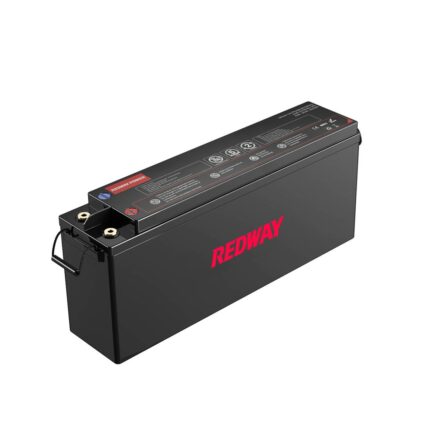
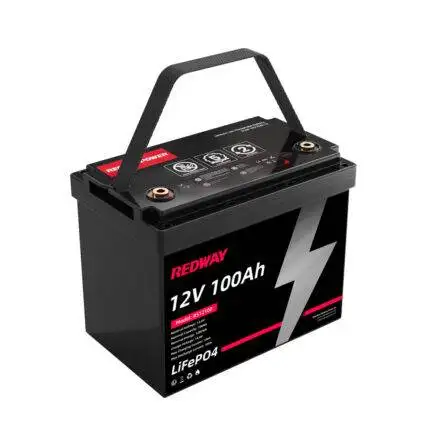
What is a 12V LiFePO4 battery?
A 12V LiFePO4 battery is a rechargeable lithium iron phosphate battery with a nominal voltage of 12.8V. Four 3.2V cells are connected in series, and a built-in battery management system (BMS) handles cell balancing, overcharge, over-discharge, short circuit, and temperature protection. It is a deep-cycle battery, so it can deliver most of its rated capacity without the voltage sag and watering requirements of a flooded or AGM battery. Common uses include RVs, campers, boats, trolling motors, fish finders, solar systems, and kayaks.
How is a 12V LiFePO4 battery different from lead-acid?
The main differences between a 12V LiFePO4 deep cycle battery and lead-acid are usable capacity, weight, cycle life, and maintenance. A 100Ah lead-acid battery should not be discharged below about 50% regularly, so it gives roughly 600Wh of usable energy. A 12V 100Ah LiFePO4 battery can typically use 80–100% of its capacity, giving about 1,000–1,280Wh, and it weighs much less. LiFePO4 also holds a steadier voltage, charges more efficiently, and does not need watering. It is a deep-cycle battery, not a starting battery, unless the manufacturer explicitly rates it for cranking.
How long does a 12V LiFePO4 battery last?
Most quality 12V LiFePO4 batteries are rated for 3,000–5,000 cycles at 80% depth of discharge. In daily cycling, that can mean several years of service; in a weekend RV or trolling-motor application, it can last longer. Actual life depends on cell quality, BMS design, charge voltage, temperature, and depth of discharge. Keeping daily cycles between roughly 20% and 80%, avoiding charging below freezing, and using a LiFePO4 charger will help the battery reach its expected service life.
What size 12V LiFePO4 battery do I need?
Start with daily energy use in watt-hours, then divide by 12.8V and the usable depth of discharge. For example, 1,000Wh per day at 80% usable capacity points to about 100Ah; 2,000Wh points to about 200Ah. A 12V 100Ah LiFePO4 battery suits a small camper, fish finder, kayak, or 12V trolling motor. A 12V 200Ah LiFePO4 battery fits larger RVs, travel trailers, and longer off-grid stays; a 12V 300Ah LiFePO4 battery is better for high-consumption cabins. When choosing a 12V lithium battery for trolling motor use, check the amp draw: a 100Ah battery runs a 50A load for about two hours at full throttle, longer at lower speeds.
Can I use a 12V LiFePO4 battery for an RV, camper, boat, or solar?
Yes. A 12V lithium battery for solar, RV house power, camper and travel-trailer systems, boat electronics, kayaks, fish finders, and UPS backup is a common fit if the charging system is compatible. RV converters, solar charge controllers, and marine chargers need a lithium or LiFePO4 profile, typically 14.2–14.6V absorption and 13.5–13.6V float. For alternator charging, use a DC-DC charger instead of connecting directly to the alternator. Check that the BMS current rating matches the inverter, motor, or load.
How do I charge a 12V LiFePO4 battery?
Use a charger with a dedicated LiFePO4 profile. A typical 12V LiFePO4 battery charger charges at 14.2–14.6V, holds absorption until current tapers, then floats at about 13.5–13.6V. Avoid equalization, desulfation, or lead-acid modes that cannot be set to lithium. For solar, use an MPPT controller with a lithium profile; for RV converters, confirm a lithium setting; for alternator charging, use a DC-DC charger. Charge above 0°C (32°F); if freezing conditions are possible, choose a heated model or a BMS with low-temperature charge cutoff.
Can I connect 12V LiFePO4 batteries in series or parallel?
Many 12V LiFePO4 batteries can be connected in series for 24V or 48V systems, or in parallel for more capacity, but the limits depend on the BMS and manufacturer. Use batteries of the same model, age, capacity, and state of charge, and charge them fully before connecting. Four 12V 100Ah batteries in series make a 48V 100Ah bank; four in parallel make a 12V 400Ah bank. Do not mix LiFePO4 with lead-acid, and confirm the maximum configuration in the datasheet.
What is the 12V LiFePO4 battery voltage chart?
A rested 12V LiFePO4 battery reads about 13.6V at 100% state of charge, 13.4V at 90%, 13.3V at 80%, 13.1V at 60%, 13.0V at 50%, 12.8V at 30%, 12.6V at 20%, 12.4V at 10%, and around 12.0V at 0%. These are approximate open-circuit values; voltage rises during charging and falls under load. Use the chart as a guide, not a fuel gauge, and rely on a shunt or BMS state-of-charge reading for planning.
Can I use a 12V LiFePO4 battery in cold weather?
Discharging is usually acceptable down to about -20°C (-4°F), but charging below 0°C (32°F) can damage the cells. Many batteries include a BMS that blocks charging at low temperature; heated models extend the operating range. If you camp or run a trolling motor in freezing weather, check the charge and discharge ratings, and warm the battery above freezing before charging. Do not charge a frozen battery.
What maintenance and safety features should I check?
Look for a BMS with overcharge, over-discharge, over-current, short-circuit, and temperature protection, plus cell balancing. Confirm certifications for your market, such as UN38.3 for transport, CE/RoHS where applicable, and IEC 62619 or UL standards for the intended application. Maintenance is minimal: keep terminals clean and dry, mount the battery securely, store it at 50–60% state of charge in a cool, dry place, and recharge every three to six months. Before connecting an inverter, charger, or motor, verify continuous and peak current ratings.