




Golf Cart Battery Basics
Half the golf cart battery questions on the internet are really fitment questions wearing a costume.
This is the basics page of the golf cart battery set: what kind of battery a cart actually uses, which pack fits which cart model, and what quietly destroys a pack over two seasons.
Three routes through the basics
Work out what the cart uses, find the pack that fits it, or understand what is killing the one you have.
What kind of battery a cart uses
Voltage, block count, form factor and the rating figures on the label.
Fitment by cart model
Named carts and utility vehicles, with what actually fits them.
What kills a pack and what lasts
The failure causes and the life-expectancy questions, answered together.
- What kills golf cart batteries?
- What kills a golf cart battery?
- What to do with old golf cart batteries?
- Can You Use Car Batteries in a Golf Cart?
Show remaining 1 articles
Reading a cart before you buy anything
Four pieces of information settle almost every fitment question, and all four are on the cart already.
Count the blocks and read the labels
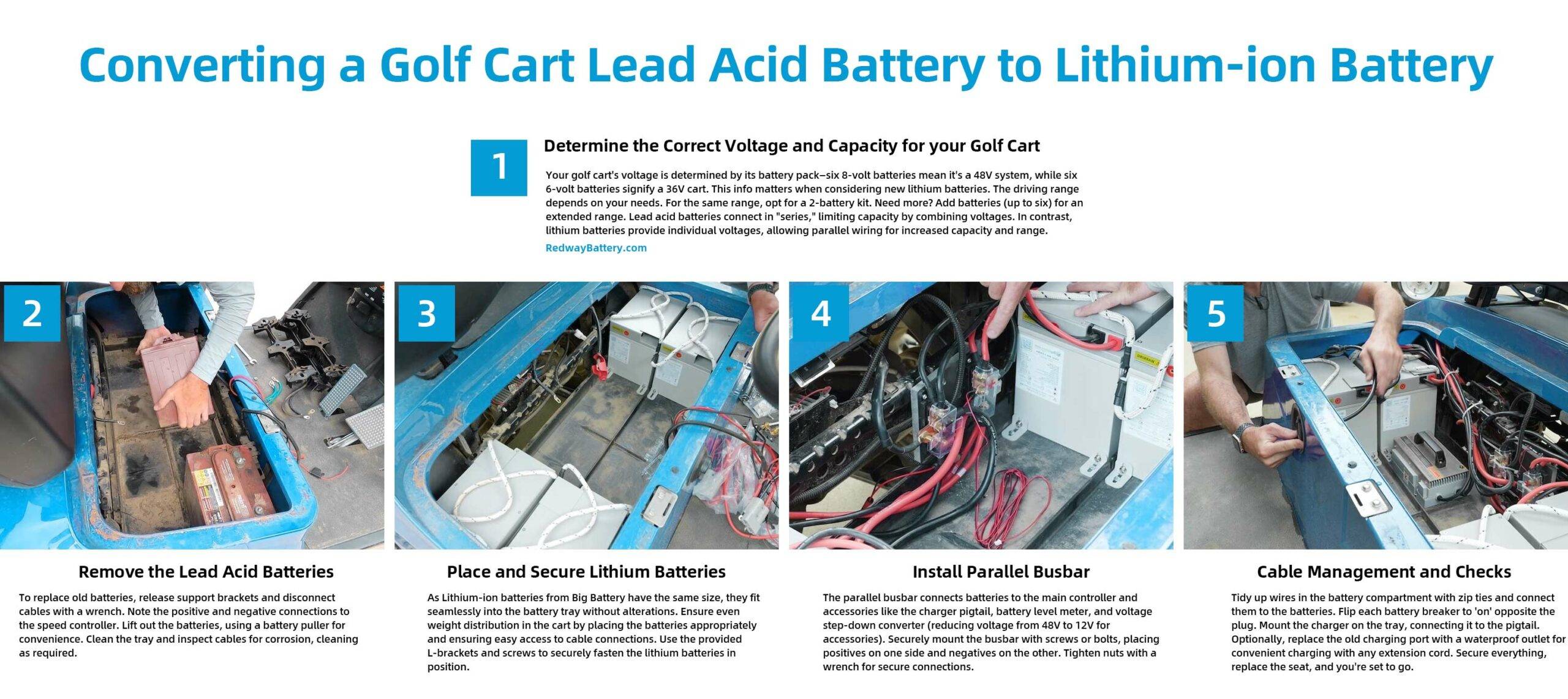
Six 6V blocks means 36V, eight means 48V, four 12V blocks means 48V, three 12V blocks means 36V. Write down the amp-hour figure from an existing label and the case dimensions, then measure the tray. With those four numbers you can buy a pack without guessing.
Form factor is a real constraint, not a detail
A GC2 block and a GC8 block are not the same size, and a 48V lithium pack that fits a Club Car tray may not fit an EZGO one. Terminal position matters too: reversing them means new cables. Check the footprint before the spec sheet.
What actually shortens pack life
Three behaviours, all avoidable, account for most premature pack deaths.
Parasitic drains while parked
A cart with an accessory left on, a failing voltage reducer or a stuck relay can flatten a pack in a week. That is why a pack that ran fine all season goes flat over winter. Measure the drain with everything off before blaming the batteries.
Sitting, discharging and heat
A flooded pack left discharged sulfates; heat accelerates every chemical reaction that ages a battery; and repeated deep discharge eats cycle life. None of these show up in a single season, which is why the failure always seems sudden when it arrives in year two.
The four numbers on the cart that decide the pack
System voltage
36V or 48V, read off the block count and the charger label. Everything else follows from this.
Tray footprint and height
The physical envelope. A pack that does not fit is not a cheaper option, it is a return.
Terminal layout
Which side the posts are on decides whether your existing cables reach. Reversing it means new cables.
Required amp-hours for the duty
Rounds per day, passengers and terrain. This is the number that decides the price, and the one people guess at.
Questions people ask before they buy
What kind of battery does a golf cart use?
A deep-cycle lead-acid or lithium pack, not a starting battery. Most carts run 36V or 48V. Flooded deep-cycle blocks in GC2 or GC8 cases are the traditional choice, and single 36V or 48V LiFePO4 packs are the modern replacement.
How do I know what battery my golf cart needs?
Count the existing blocks to get the voltage, read the amp-hour figure off a label, measure the tray and note the terminal positions. Those four numbers are enough to buy correctly. If there are no batteries to look at, the cart's make and model will identify the correct pack.
What is the average life of a golf cart battery?
Flooded sets run three to five years, AGM four to six, and lithium packs eight to twelve on recreational duty. Heat, depth of discharge and watering discipline move all three figures by years, more than brand or price do.
What kills golf cart batteries?
Sitting discharged, running dry, repeated deep discharges, mixing ages and heat. Parasitic drains while parked are the sneaky one: an accessory left on or a failing voltage reducer flattens a pack over winter and sulfates it beyond recovery.
What happens if I use car batteries in a golf cart?
The cart will move, for a while. Starting batteries have thin plates built for a brief high-current burst, so sustained deep discharge destroys them quickly, usually within a season. They also drag the rest of the string down as they fail.
Send the cart details and we will confirm what fits
Give us the cart make and model, the current block count and the tray measurements. We will confirm the voltage, the amp-hours the duty needs, and which pack physically fits before you order anything.
