




REDWAY BATTERY / KNOWLEDGE
What Are The Best Practices For Forklift Charging?
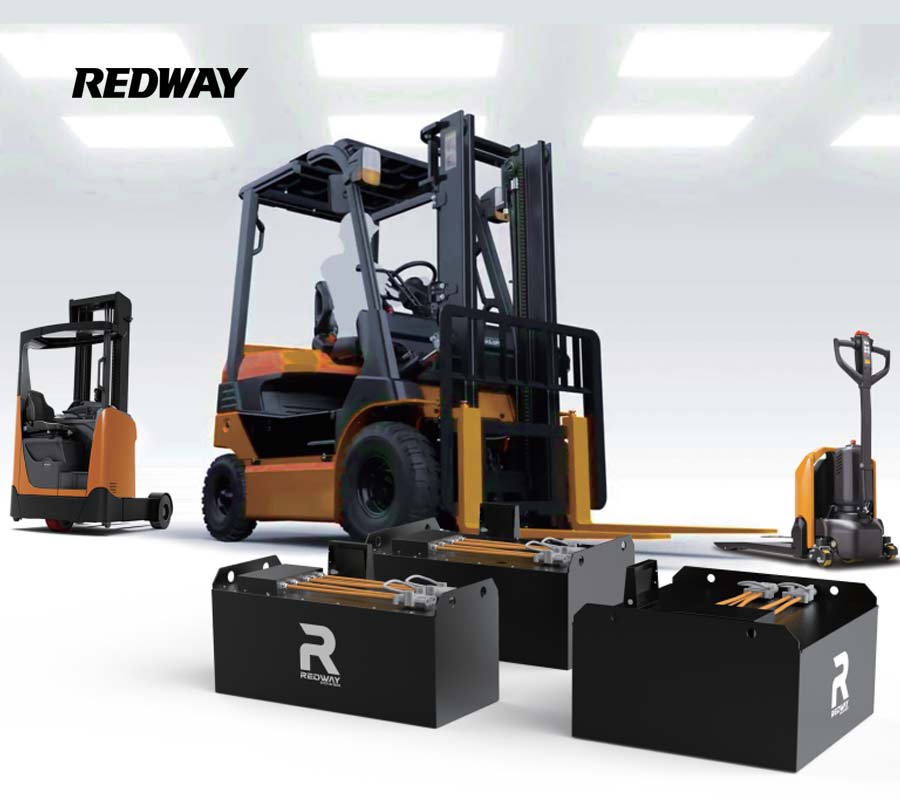
Optimal forklift charging combines partial-state charges (20-80% SOC), temperature-controlled environments (15-27°C), and voltage-matched chargers. Lithium-ion models benefit from opportunity charging without memory effect, while lead-acid requires full cycles to prevent sulfation. Always use manufacturer-certified equipment and prioritize cell balancing via BMS—key for lifespan exceeding 2,000 cycles.
48V 600Ah Lithium Forklift Battery
What charging cycles maximize forklift battery lifespan?
Forklift batteries thrive on partial-depth discharges (30-50%) and opportunity charging. Lithium-ion units tolerate 2-3 daily micro-cycles; lead-acid needs 8-hour cooling post-full charge. Pro Tip: Never discharge below 20%—deep cycles accelerate lithium cathode cracking and lead-acid sulfation.
Modern lithium forklift batteries use a 0.5C charge rate (e.g., 200A for 400Ah packs) to limit temperature rise below 45°C. For example, a 48V 600Ah LiFePO4 pack recharges from 30% to 80% in 1.2 hours using a 300A charger. Lead-acid requires 8-10 hours due to gassing phase limitations. Transitional charging phases (bulk, absorption, float) are critical—skip absorption, and sulfation reduces capacity by 15% annually. But what if shifts demand rapid charges? Active cooling systems can mitigate thermal stress, allowing 1C fast-charging for lithium without dendrite risks. However, pairing 2C chargers with standard cells risks warping terminals—always verify cell specs.
| Charger Type | Charge Time (0-100%) | Cycle Impact |
|---|---|---|
| Standard (0.5C) | 2 Hours | 3,000+ Cycles |
| Fast (1C) | 1 Hour | 2,200 Cycles |
| Opportunity (0.3C) | 3.3 Hours | 4,500 Cycles |
How does temperature affect charging efficiency?
Charging below 0°C risks lithium metal plating, while above 40°C accelerates SEI layer growth. Optimal range: 15-30°C. Pro Tip: Pre-heat batteries to 10°C in cold warehouses via BMS thermal pads.
Lithium-ion charging at -10°C can cause 40% capacity loss within 50 cycles due to metallic dendrites piercing separators. Conversely, 45°C environments increase internal resistance by 25%, reducing charge acceptance. For example, a 24V 280Ah forklift battery charged at 35°C completes in 2 hours but loses 8% capacity yearly versus 3% at 25°C. Thermal management systems (TMS) using glycol-cooled plates maintain ±2°C cell variation—critical for 80V 700Ah industrial packs. Transitional seasons often trick operators—spring mornings might start at 5°C, requiring delayed charging until midday. How to handle urgent charges? Phase-change materials in Redway's packs buffer extreme temps, allowing safe -20°C to 50°C operation.
Are fast chargers safe for daily use?
Fast charging (1C+) demands cell-grade monitoring and active cooling. Approved for lithium with ≤45°C pack temps; lead-acid risks plate corrosion. Pro Tip: Use adaptive CC-CV algorithms—static 1C charges overstress high-SOC cells.
UL-certified 80V fast chargers apply 1.5C current (e.g., 600A for 400Ah) but taper to 0.2C after 80% SOC. Real-world data: A 48V 300Ah lithium pack charged at 1C achieves 80% in 48 minutes but requires liquid cooling to stay under 50°C. Comparatively, traditional 0.3C charging takes 3.5 hours with passive air cooling. Fast charging's hidden cost? Connector wear—600A DC pins erode contact surfaces 3× faster, needing bimonthly inspection. Transitioning to wireless charging? Redway's 20kW Qi systems eliminate connector wear but add 15% energy loss. Still, what’s the break-even point? High-utilization warehouses logging 5+ charges daily save $1,200/year per forklift in connector maintenance.
80V 700Ah Forklift Lithium Battery
Redway Battery Expert Insight
FAQs
Only lithium-ion with BMS sleep mode—lead-acid overcharges beyond 12 hours, causing electrolyte dry-out. Redway's systems auto-sleep at 100% SOC.
Do all forklifts use the same charger connectors?
No—48V systems use DIN 43 A connectors; 80V models require HD 600A lugs. Mismatching melts terminals within minutes.
How often should I balance lithium forklift cells?
Automatically via BMS during charging. Manual balancing every 500 cycles—check cell voltage variance >50mV via diagnostic ports.
For the surrounding sizing, selection, installation and maintenance decisions, continue with the Forklift Battery Charging: Methods, Timing and the Charging Area.
