




REDWAY BATTERY / KNOWLEDGE
Why Won’t My Forklift Battery Hold A Charge?
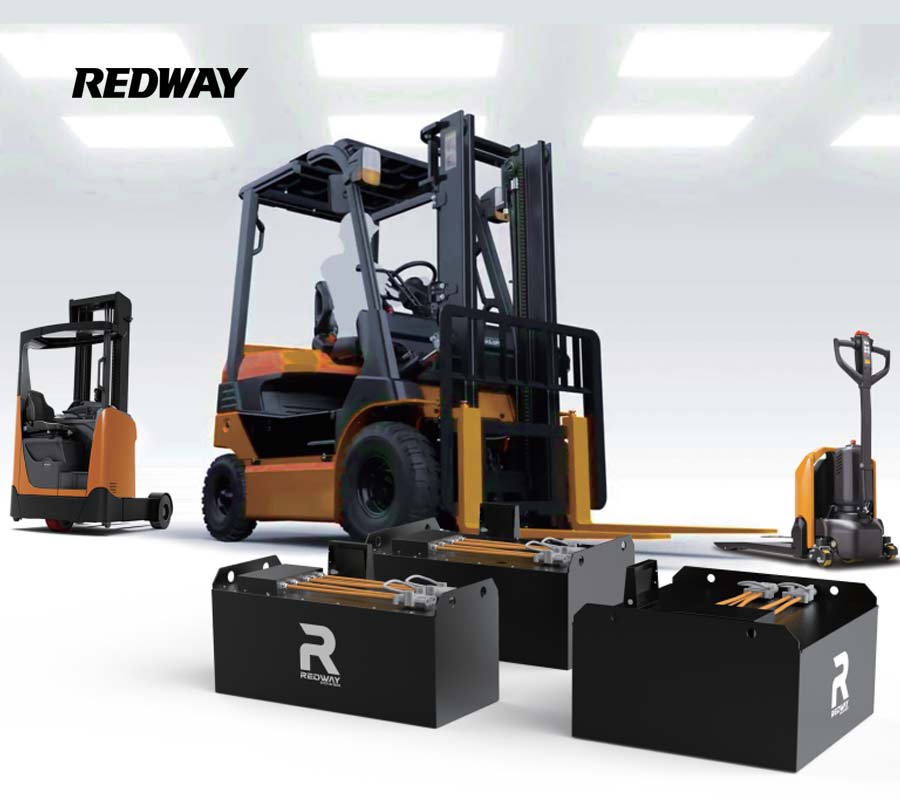
Lead-acid forklift batteries lose charge capacity due to sulfation, aged cells, or improper charging practices. Lithium-ion versions face BMS failures or cell imbalance. Sulfation forms sulfate crystals on lead plates, reducing active material. Always maintain 20-80% charge cycles and use temperature-compensated charging. For example, a 48V 600Ah lead-acid battery with 30% sulfation loses ~40% runtime.
24V 200Ah Lithium Forklift Battery
How does sulfation kill battery capacity?
Sulfation occurs when lead sulfate crystals harden during partial charging or prolonged storage, blocking ion flow. In severe cases, 70% capacity loss happens within 6 months. Lithium-ion avoids this via non-sulfating chemistry.
Lead sulfate forms during discharge but normally dissolves during full recharge. Partial cycles leave residual crystals that accumulate over time. Think of it like plaque in arteries—restricted flow lowers performance. Pro Tip: Equalize lead-acid batteries monthly using 15.5V (12V system) for 2-4 hours to break down sulfates. For lithium, BMS auto-balancing prevents cell degradation. A 48V lead-acid pack with 500 cycles might sulfate 3x faster if discharged to 80% daily versus 50%.
| Factor | Lead-Acid | Lithium-Ion |
|---|---|---|
| Sulfation Cause | Partial charging | N/A |
| Prevention | Equalization | Cell balancing |
| Reversibility | Limited (early stage) | Not applicable |
Can defective cells cause charge issues?
Yes, weak cells create imbalance—functional cells overcompensate, draining faster. A single 0V cell in 24V lithium packs triggers BMS shutdown. Measure individual cell voltages: variations >0.2V (lead-acid) or >0.05V (lithium) indicate defects.
In lead-acid systems, stratification (acid layer separation) exacerbates cell wear. Imagine one weak link in a chain breaking the entire circuit. Pro Tip: Use a hydrometer for lead-acid—specific gravity differences >0.05 points require cell replacement. For lithium, a cell dropping to 2.5V despite charging needs isolation. Example: Replacing 2/24 cells in a 48V LiFePO4 pack restored 92% capacity in a case study.
Do charging habits affect charge retention?
Absolutely. Undercharging leaves lead sulfate intact, while overcharging corrodes plates. Lithium-ion suffers from high-voltage stress above 95% SoC. Optimal ranges: 20-80% for daily use, 100% only before storage.
Why does partial charging harm lead-acid? Each incomplete cycle leaves 5-10% sulfates uncleared. Over months, cumulative deposits cripple capacity. Conversely, lithium thrives on partial charges—Tesla research shows 90% DoD cycles yield 300-500 more cycles than 100% DoD. Transitional phases matter too: lithium charged at -20°C risks plating, permanently losing 15-30% capacity.
How does BMS failure impact charge retention?
A faulty BMS misreads voltages, causing over-discharge or incomplete balancing. Symptoms include sudden shutdowns or cells stuck at 3.2V (LiFePO4). Resetting BMS parameters often resolves software glitches.
BMS units monitor cell groups—if one sensor fails, charging stops prematurely. Picture a traffic light stuck on red halting all vehicles. Pro Tip: Check BMS communication ports annually; corrosion here caused 22% of failures in industrial surveys. For critical operations, redundant BMS designs keep systems online. Replace BMS if balancing current drops below 50mA per cell group.
| BMS Issue | Lead-Acid | Lithium-Ion |
|---|---|---|
| Overcharge Risk | Thermal runaway | Electrolyte breakdown |
| Balancing Method | N/A | Active/passive |
| Failure Rate | 5-8% | 12-15% |
Does temperature affect charge retention?
Extreme cold (<0°C) slows chemical reactions, while heat (>45°C) accelerates corrosion. Lithium loses 20% capacity at -20°C; lead-acid loses 50% at 0°C. Always use thermal management systems in volatile environments.
Electrolyte viscosity increases in cold, reducing ion mobility. Think of molasses flowing through a straw—it’s sluggish. Pro Tip: Preheat lithium batteries to 10°C before charging in winter. A forklift warehouse maintaining 15-25°C saw 31% longer battery lifespan versus uncontrolled environments.
What’s the expected lifespan of a forklift battery?
Lead-acid lasts 3-5 years (1,200 cycles), lithium 8-10 years (3,000+ cycles). Cycle life drops 15% for every 10°C above 25°C. Proper maintenance can double lifespan.
But what kills lithium packs faster? High discharge rates—pulling 2C instead of 1C halves cycle life. Real-world example: A LiNMC battery at 80% DoD and 25°C delivered 2,400 cycles versus 1,100 cycles at 45°C. Transitional care like storage at 40-60% SoC in cool environments maximizes longevity.
Redway Battery Expert Insight
Redway’s lithium forklift batteries integrate active balancing BMS and IP54 thermal systems to prevent charge issues. Our LiFePO4 cells operate at -20°C to 60°C with <0.03% monthly self-discharge, outperforming lead-acid in cyclic endurance. Customizable charging profiles adapt to shift patterns, ensuring 95% availability even in multi-shift operations.
FAQs
Partially—desulfators or 0.1C trickle charging may recover 30-50% capacity if crystals aren’t hardened. Full replacement is often costlier than lithium upgrades.
Is replacing individual lithium cells possible?
Yes, but cells must be capacity-matched (±2%) to avoid imbalance. Redway’s modular designs allow hot-swapping without full pack disassembly.
How often should BMS firmware update?
Annually—new algorithms optimize balancing accuracy by 40%. Always backup settings before updating.
For connected guidance and the next practical steps, use the Forklift Battery Charging: Methods, Timing and the Charging Area.
