




REDWAY BATTERY / KNOWLEDGE
What Are 48V Forklift Batteries?
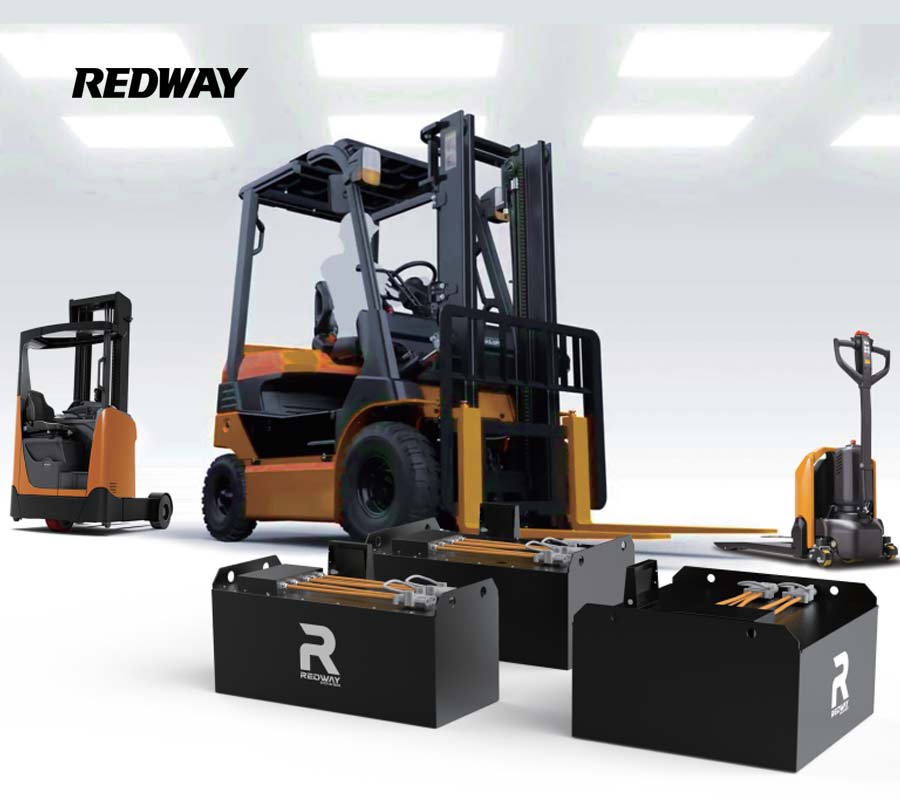
48V forklift batteries are high-capacity energy systems designed for industrial material handling, providing extended runtime and torque for Class I-III electric forklifts. Using lead-acid or lithium-ion (LiFePO4) chemistries, they support 18–30 kWh capacities. Lithium variants offer 2,000–5,000 cycles with 80% depth of discharge (DoD), while lead-acid lasts 1,500 cycles at 50% DoD. Integrated battery management systems (BMS) optimize charge/discharge safety.
Forklift Battery Watering Systems Explained
How do 48V forklift batteries differ in composition?
48V forklift batteries use either lead-acid or lithium-ion cells. Lead-acid relies on sulfuric acid and lead plates, while lithium variants employ LiFePO4 for thermal stability. Lithium packs weigh 40% less and tolerate deeper discharges. Pro Tip: Always verify charger compatibility—lead-acid requires equalizing charges, whereas lithium uses constant-current protocols.
Structurally, lead-acid batteries contain 24 cells (2V each) connected in series, totaling 48V. They demand regular watering to prevent sulfation. In contrast, lithium-ion batteries consolidate cells into modular packs with a built-in BMS to prevent overcharging. For example, a lithium 48V 600Ah battery delivers 28.8 kWh—enough for two full shifts in a 4,000 lb capacity forklift. However, mixing chemistries in fleets complicates charging infrastructure. Wondering which is cheaper upfront? Lead-acid wins, but lithium saves 30% in long-term maintenance.
| Parameter | Lead-Acid | Lithium-Ion |
|---|---|---|
| Weight | 1,200–1,800 lbs | 700–1,100 lbs |
| Cycle Life | 1,200–1,500 | 2,500–5,000 |
| Maintenance | Monthly watering | None |
Why choose 48V over 24V or 36V forklift batteries?
Higher voltage minimizes current draw for equivalent power, reducing heat and voltage drop. 48V systems support heavier lifts (up to 20,000 lbs) and faster acceleration. Pro Tip: Upgrade to 48V lithium if refueling time cuts into productivity—it recharges in 1–2 hours vs. 8–10 for lead-acid.
Higher voltage allows thinner copper wiring, lowering vehicle weight. For instance, a 48V 800A motor delivers 38.4 kW, while a 36V system needs 1,066A for the same power—a 33% thicker cable. But what about smaller warehouses? 36V suffices for <6,000 lb lifts, but 48V future-proofs operations. Transitional phrase: Beyond voltage, lithium’s 95% efficiency outperforms lead-acid’s 75%, reducing energy costs by 20%. Real-world example: Taylor Machine Works’ 48V EV Series forklifts achieve 8-hour runtime with 30-minute fast charging.
What determines the lifespan of 48V forklift batteries?
Cycle life depends on chemistry, depth of discharge (DoD), and temperature. Lithium lasts 2,500–5,000 cycles at 80% DoD; lead-acid degrades after 1,200 cycles at 50% DoD. Pro Tip: Avoid discharging below 20% for lithium or 50% for lead-acid to prevent capacity loss.
Lead-acid lifespan hinges on proper watering—dry cells sulfate, losing 15% capacity annually. Lithium batteries degrade faster above 113°F (45°C). Transitional phrase: Moreover, charging practices matter. Equalizing charges every 10 cycles for lead-acid balances cell voltage. In contrast, lithium’s BMS ensures cell harmony. For example, a Crown SP 48V lithium pack maintains 80% capacity after 4,000 cycles even with partial charges. Always store batteries at 50% charge in cool environments.
How do charging protocols differ for 48V batteries?
Lead-acid uses three-stage charging (bulk, absorption, float), while lithium employs CC-CV (constant current-constant voltage). Lithium skips equalization, reducing charge time by 40%. Pro Tip: Use temperature-compensated chargers for lead-acid—0.28V/cell adjustment per 10°F change.
Lead-acid chargers apply 57.6–60V (2.4–2.5V/cell), whereas lithium chargers deliver 54–58.4V (3.6–3.65V/cell). Transitional phrase: Practically speaking, opportunity charging (short charges during breaks) works for lithium but damages lead-acid by causing stratification. Example: A Hyster ChargerX 48V lithium system restores 80% charge in 60 minutes.
| Type | Charge Voltage | Time (0–100%) |
|---|---|---|
| Lead-Acid | 57.6–60V | 8–10 hrs |
| Lithium-Ion | 54–58.4V | 1–3 hrs |
What maintenance ensures 48V battery longevity?
Lead-acid needs monthly watering, terminal cleaning, and equalization. Lithium requires state-of-charge (SoC) monitoring and ambient temperature control. Pro Tip: Inspect battery straps every 500 cycles—loose connections cause arcing and voltage fluctuations.
For lead-acid, use deionized water to refill cells, avoiding overfilling above the plates. Transitional phrase: On the flip side, lithium’s BMS automates cell balancing, but firmware updates are crucial. Ever wonder what kills lithium packs fastest? Deep discharges below 10% SoC. Example: Yale’s 48V Li-ion batteries include self-discharge protection, limiting drain to 3% monthly. Store lithium at 40–60% SoC if idle for >30 days.
When should you upgrade to a 48V lithium forklift battery?
When lead-acid runtime falls below 70% of original capacity or maintenance costs exceed $500/year. Lithium suits multi-shift operations needing fast charging. Pro Tip: Calculate ROI—lithium saves $2,000/year in energy and labor vs. lead-acid.
Transitional phrase: Beyond cost, lithium’s weight reduction improves forklift maneuverability. For example, switching a 48V 600Ah lead-acid (1,800 lbs) to lithium (1,000 lbs) increases payload capacity by 800 lbs. But what about cold storage? Lithium performs better in sub-32°F environments but requires preheating below -4°F. Always consult OEM guidelines—retrofitting may need controller reprogramming.
Redway Battery Expert Insight
FAQs
Check weekly under heavy use. Add deionized water after charging, maintaining levels ¼” above plates.
Can lithium batteries fit existing 48V forklifts?
Yes, but ensure the compartment accommodates slight size variations and update charger firmware.
Do 48V batteries require cooling systems?
Only in high-ambient (>95°F) environments. Lithium’s built-in BMS throttles charging above 113°F.
For the surrounding sizing, selection, installation and maintenance decisions, continue with the Forklift Battery: Sizing, Voltage and Capacity — Part 3.
