




Golf Cart Battery Sizing
Almost every undersized golf cart battery was bought by matching the label on the old one instead of the duty cycle.
This is the sizing branch of the golf cart battery set. It answers the amp-hour and voltage questions first, because everything else, price included, is downstream of them.
Three routes through sizing
Capacity first, then voltage, then the charger. Work down whichever one is already settled.
How many amp-hours do I need
Start here if you know the voltage but not the capacity, or you are staring at a 50Ah and a 100Ah pack and cannot tell which one your round needs.
Which voltage, and how many batteries
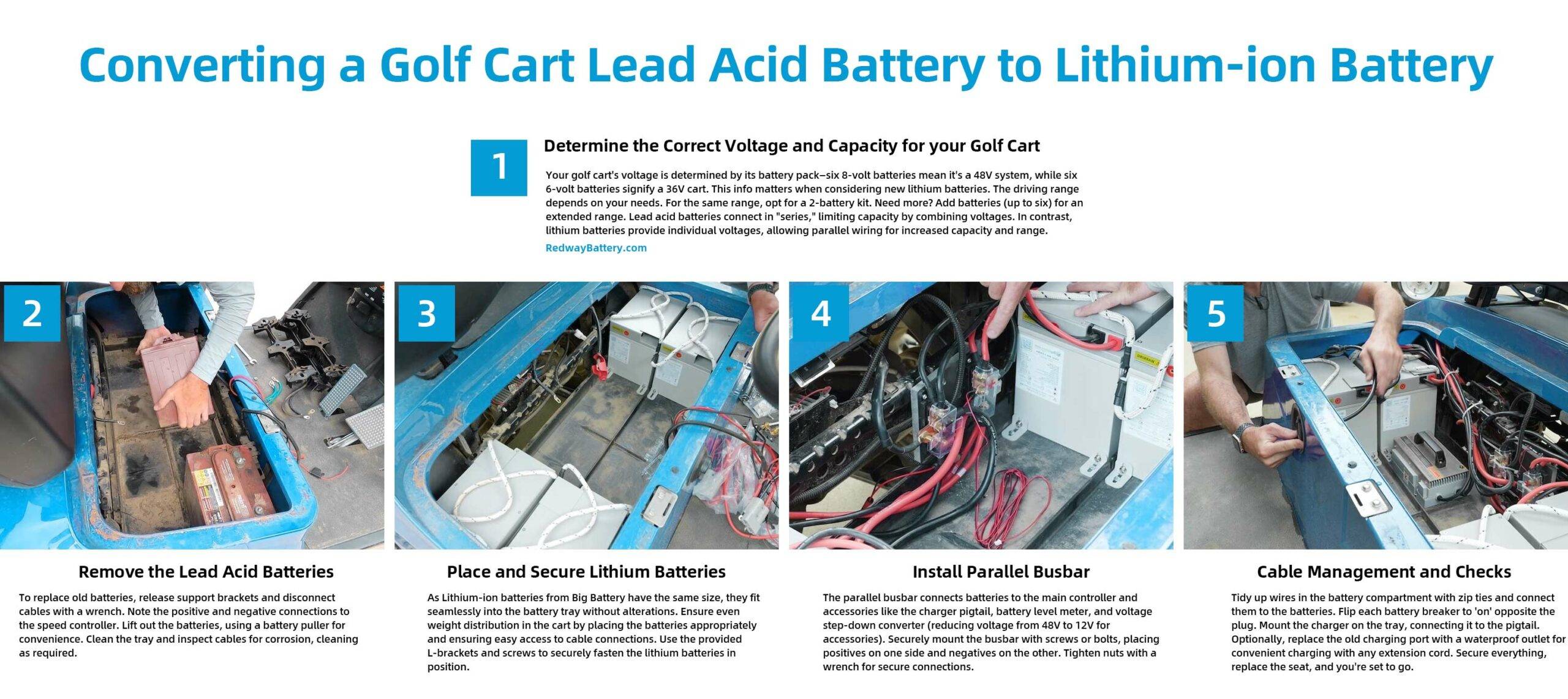
This is the structural question: 36V, 48V or 72V, and how many blocks that means in the tray.
Matching the charger and the accessories
The pack is only half the system. These are the charger, maintainer and accessory decisions that follow from the size you picked.
- How to Choose Golf Cart Batteries in Arizona's Climate?
- How to Choose and Maintain an EZGO 48V Golf Cart Charger for RXV Models?
- How to Choose the Best 36 Volt Golf Cart Battery Charger for Sale?
- How to Choose the Best Golf Cart Battery Charger for Your Needs?
Show remaining 12 articles
- How to Choose and Maintain an EZGO Golf Cart Battery Charger?
- How to Choose the Best 48 Volt Yamaha Golf Cart Battery Charger?
- How to Choose the Best Battery-Powered Golf Cart Heater?
- How to Choose and Maintain Golf Cart Battery Fillers?
- How to Choose and Maintain a 36-Volt Golf Cart Battery Maintainer?
- How to Choose the Best 36V Golf Cart Battery Charger for Club Car?
- How to Choose the Best Golf Cart Battery Distributor?
- How to Choose the Best 72V Lithium Golf Cart Battery?
- How to Choose the Best Lithium Golf Cart Batteries?
- How to choose the best battery size for your EZGO model?
- How to Choose the Best 60V 100Ah Lithium Battery for Golf Carts and EVs from Redway Battery
- How to choose the right lithium battery solution for EZ‑GO and Yamaha golf carts?
Size from the round, not from the old label
A golf cart does not consume amp-hours. It consumes watt-hours over a distance, with hills and passengers added on top.
Work out watt-hours, then divide by your voltage
A round of 18 holes with two adults on a flat course takes roughly 1.2 to 1.6 kWh at the pack. Divide by nominal voltage and you get the amp-hours: about 25 to 33Ah at 48V, about 33 to 45Ah at 36V. Add 40% headroom for hills, guests and pack ageing, and a 48V cart wants a 50Ah pack minimum, 100Ah if it runs two rounds a day.
The old pack's label is a floor, not a target
Lead-acid packs were usually specified with only half their capacity usable, so a 48V 170Ah flooded bank delivered about 85Ah of real range and was replaced with another 170Ah bank. A lithium pack at 100Ah delivers roughly 90Ah usable. That is why a smaller lithium label usually beats the bigger lead-acid number it replaces.
Where sizing goes wrong
Three failure modes account for most of the undersized packs we see, and none of them is about the battery itself.
Sizing to the average day and then running the worst day
A fleet that sizes to a normal Tuesday runs out of charge on tournament Saturdays. If your cart carries four players up a hill or tows a utility trailer, size to that, because the pack does not recover mid-round. Buying one step larger is far cheaper than buying the pack twice.
Forgetting that the BMS sets the current ceiling
Sizing is usually discussed in amp-hours, but acceleration is limited by continuous current. A pack with plenty of capacity and a 100A BMS will still cut out on a lifted cart drawing 250A. Match the BMS rating to the controller before you match the capacity to the range.
The four inputs that settle the sizing question
Energy per round
Holes, passengers, terrain and towing. One number, measured in kWh, that everything else divides into.
Nominal voltage of the cart
Fixes the amp-hour figure for that energy and decides cable gauge, controller and charger family.
How much of the pack you are allowed to use
Lead-acid gives you about half; lithium gives you about nine tenths. The same label means very different range.
Peak current the controller will ask for
Sets the BMS rating, which caps acceleration regardless of how much capacity you bought.
Questions people ask before they buy
How many amp-hours does a golf cart battery need?
For a standard 18-hole round with two adults on flat ground, about 1.2 to 1.6 kWh, which is 25 to 45Ah depending on voltage. Add 40% for hills, guests and ageing. In practice a 48V cart wants at least 50Ah, and 100Ah if it does two rounds a day.
Is 50Ah enough for a golf cart?
For one round of 18 holes on a level course with two players, yes, with little margin. It is not enough for four passengers, hilly terrain, towing or back-to-back rounds. If any of those apply, step up to 100Ah rather than charging twice a day.
How many batteries does an electric golf cart use?
A 36V cart typically uses six 6V blocks or three 12V blocks. A 48V cart uses eight 6V, six 8V or four 12V blocks. A 72V cart uses six 12V blocks. In lithium the answer is usually one pack, regardless of voltage.
Should I choose 48V or 72V?
48V covers almost every recreational cart and most light utility work. Go to 72V when the cart climbs long grades under load, tows, or needs to reach speed with four passengers, because higher voltage keeps current and heat down. The trade is a bigger charger and a costlier controller.
Does a bigger battery make a golf cart faster?
No. Capacity, measured in amp-hours, buys distance. Speed comes from the controller and motor, and torque from current. A larger pack keeps the cart from slowing as it drains, but it will not raise top speed on its own.
Give us the duty cycle and we will size it
Tell us the number of rounds a day, typical passengers, the terrain, whether the cart tows, and the cart's voltage. We will come back with a capacity, a BMS rating and the charger that fits.
