




REDWAY BATTERY / KNOWLEDGE
What cable size and fuse does a 12V 200Ah battery need for a 2000W inverter?

Redway Battery Editorial Team
Talk / Battery Q&A
A van builder is wiring a 2000W inverter to a Redway 12V 200Ah battery and asks for the cable gauge and fuse rating to buy.
Direct answer: Start with the current. A 2000W inverter at full load on 12.8V draws roughly 175A at 90% efficiency, and about 220A when the battery sags to 10V. Check that the battery’s continuous rating covers it, then use the inverter maker’s cable and fuse table and an installer’s check, not a generic chart.
The arithmetic: DC current is about watts ÷ (battery volts × efficiency). At 12.8V and an assumed 90% efficiency, 2000 ÷ (12.8 × 0.9) is about 174A. At 10V, which is the cut-off on the 12V pages, it is about 222A. Check the inverter datasheet for its real efficiency and its surge rating, because many inverters allow a short surge well above the continuous rating.
Now the battery. The 12V 200Ah and 12V 300Ah pages list 100A, 150A or 200A continuous options, with peaks of 110A, 160A and 210A for 10 seconds. The 12V 200Ah Ultra page lists 100A maximum continuous charge and discharge. So a 2000W inverter at full load exceeds the 100A and 150A options and sits near the limit of the 200A option. Either the load must stay well below 2000W, or you need a higher-rated battery, or a 24V system, as discussed in our post on series 12V versus a single 24V pack.
Cable and fuse: the cable must carry the maximum current without overheating, with the right insulation temperature rating and a low voltage drop over its length. The fuse must protect the cable, sit close to the battery positive terminal and have an interrupt rating (AIC) above the battery’s available fault current. The product pages do not publish short-circuit current, so ask Redway. ABYC E-13 for boats addresses overcurrent protection and interrupt ratings for lithium systems.
Do not copy a chart that lists only “2000W, 12V”. Use the table in the inverter’s manual, which reflects its own current draw and terminals, then have a qualified installer check conductor ampacity under the standard that applies to your installation: ABYC for boats, or NFPA 70 (NEC) for other installations. Keep cable runs as short as possible and tighten lugs to the specified torque.
After installation, check connections for heat under load, measure voltage at the inverter terminals while it runs, and watch the battery’s BMS for over-current events. A trip under load usually means the load, cable or settings need review rather than a bigger fuse. Cable gauge and fuse rating are not published by Redway for this combination, so confirm them with the inverter maker and your installer.
↳ Replying to Redway Battery Editorial Team
Include cable, lugs, fuse and fuse holder in the quote, and price the battery option that actually covers the inverter’s current. A cheaper battery that trips at full load costs more than it saves.
↳ Replying to Procurement perspective
Calculate current at low battery voltage, not only at nominal. Compare it with the battery’s continuous and peak ratings and the inverter’s surge, then use the inverter maker’s cable and fuse table, with an interrupt rating that exceeds the available fault current.
↳ Replying to Selection/Engineering perspective
Check lugs for heat after the first hours at load, re-torque to specification, and look for discoloured insulation. Repeat after the first week, since new connections can settle.
Start with the current. A 2000W inverter at full load on 12.8V draws roughly 175A at 90% efficiency, and about 220A when the battery sags to 10V. Check that the battery’s continuous rating covers it, then use the inverter maker’s cable and fuse table and an installer’s check, not a generic chart.
Verify before ordering: Cable gauge and fuse rating are installation-specific; Redway does not publish short-circuit current. The 90% efficiency is an assumption.
Sources checked: ABYC E-13 (ANSI webstore).
Editorial Q&A for battery selection and operations. Product figures cited from Redway product pages.
Related products
 12V 200Ah Lithium Battery
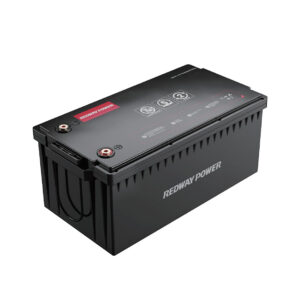 12V 200Ah LiFePO4 Lithium Battery (Ultra)
 12V 300Ah Lithium Battery
Related articles & discussions
- How long will a 12V 200Ah lithium battery last?
- What Size Battery Do You Need to Run a 12V Fridge? A Comprehensive Guide
- What is a 12V LiFePO4 battery?
- How Long Can a 200Ah Battery Run a 3000-Watt Inverter?
- Wholesale Price 12V 200Ah Lithium Iron Phosphate Battery LiFePO4 by Redway Battery: What You Need to Know
- Maximizing the Efficiency of a 12V Battery with an Inverter in Solar Power Systems
- Can I Connect Two 12V Batteries in Parallel for a 12V Inverter?
- What Size Solar Panel To Run A 12V Fridge?
- How Many Hours Will a 12V 200Ah Battery Last For?
- How to Choose a 12V 200Ah Lithium Battery Factory for Your Business
