




REDWAY BATTERY / KNOWLEDGE
How Do Forklift Batteries Improve Equipment Performance?
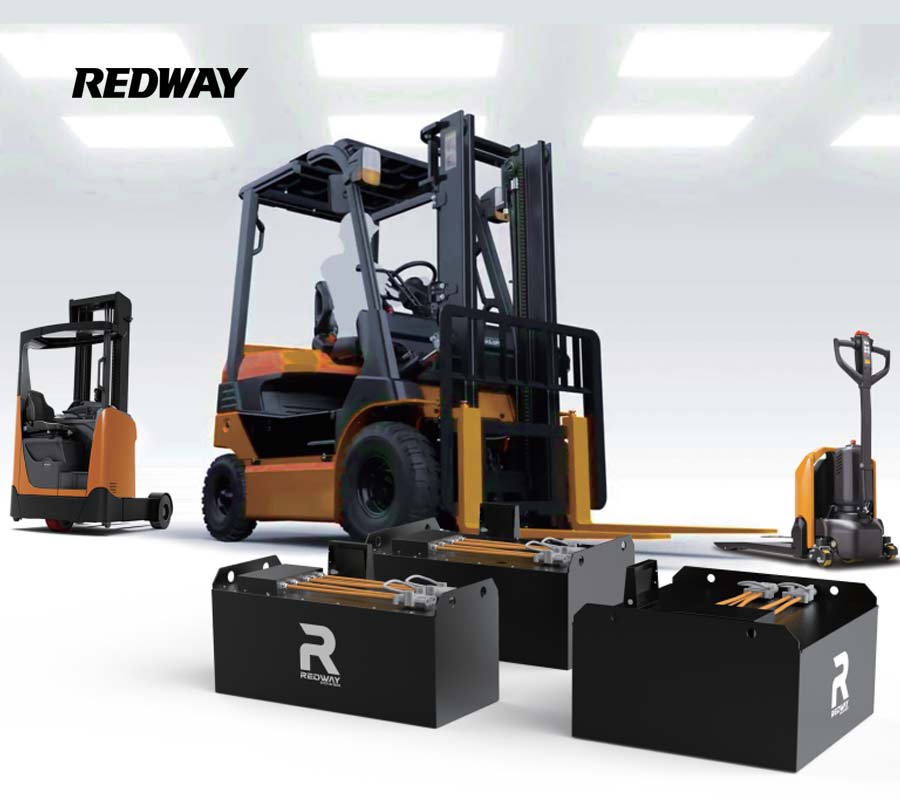
Forklift batteries enhance equipment performance by providing consistent power delivery, reduced downtime, and improved energy efficiency. Modern lithium-ion models (24V–80V) offer 2–3x longer runtime than lead-acid, faster charging (1–2 hours), and zero maintenance. Their stable voltage output ensures consistent lift speeds even at low charge, while advanced thermal management systems prevent overheating in demanding warehouse environments.
48V 300Ah Lithium Forklift Battery
What types of forklift batteries are most efficient?
Lithium-ion forklift batteries dominate efficiency with 95% energy usability vs. 75% for lead-acid. Key advantages include opportunity charging and weight reduction (30% lighter), allowing longer shifts without counterbalance adjustments.
Forklift batteries using LiFePO4 chemistry deliver 2,000–5,000 cycles, outperforming lead-acid’s 1,500-cycle ceiling. For example, Redway’s 48V 300Ah lithium pack powers 8-hour shifts with a 1.5-hour recharge—eliminating lead-acid’s 8-hour cooling mandates. Technical specs matter: 80V systems handle 4-ton loads at 15% slope gradients without voltage sag. Pro Tip: Always match battery capacity (Ah) to your forklift’s energy consumption (kWh/mile). Transitioning from lead-acid? Expect 20% faster acceleration—lithium’s low internal resistance prevents voltage drop under load. But how do you avoid overloading the system? Stick to the OEM’s recommended C-rate; exceeding 1C discharge on standard cells risks premature aging.
How does lithium compare to lead-acid in forklifts?
Lithium-ion forklift batteries offer 3x faster charging and 50% higher energy density than lead-acid. They operate at 95% efficiency across discharge cycles vs. lead-acid’s 80%–50% voltage decline.
Lead-acid batteries lose 30% capacity in cold storage (below 0°C), while lithium variants retain 85% at -20°C. Take a Toyota 8FGCU25 forklift: switching to a 36V 210Ah lithium pack cuts daily energy costs by 40% due to opportunity charging during breaks. Technically, lithium’s flat discharge curve (e.g., 36V±1V) maintains consistent motor torque, unlike lead-acid’s 10V+ droop. Pro Tip: Use lithium’s built-in telemetry (CAN Bus) to monitor State of Health (SOH)—replace at 80% capacity, not arbitrary voltage thresholds. What’s often overlooked? Lithium’s weight savings (e.g., 24V 280Ah at 75kg vs. lead-acid’s 120kg) reduce tire wear by 18%. Transitional benefits compound: faster charging means smaller battery buffers, optimizing warehouse space.
| Parameter | Lithium | Lead-Acid |
|---|---|---|
| Cycle Life | 3,000 | 1,200 |
| Charge Time | 1.5h | 8h |
| Energy Density | 150 Wh/kg | 50 Wh/kg |
Why is thermal management crucial?
Effective thermal management prevents lithium battery degradation—operating beyond 45°C slashes cycle life by 60%. Integrated cooling loops and BMS-driven fan control stabilize cells at 25°C±5°C during heavy lifts.
Forklifts lifting 2+ tons generate 150–200A draws, heating cells rapidly. Redway’s 80V 700Ah system uses aluminum cooling plates between prismatic cells, limiting temperature spread to <3°C. Without this, hotspotting occurs—reducing capacity 15% annually. Real-world example: Amazon warehouses use liquid-cooled 48V packs to sustain 24/7 operations. Pro Tip: Avoid blocking battery vents; dust accumulation insulates heat, raising internal temps 8°C. Practically speaking, thermal stability also impacts safety—a single cell reaching 80°C can trigger thermal runaway. Ever seen a forklift battery shutdown mid-shift? That’s the BMS enforcing thermal limits, not a faulty charger.
What charging practices extend battery life?
Partial opportunity charging (20%–80% SOC) extends lithium lifespan by 50% vs. full cycles. Use smart chargers with temperature-compensated voltage to avoid overcharging in hot environments.
LiFePO4 batteries prefer 0.5C charging (e.g., 100A for 200Ah packs), completing 80% capacity in 45 minutes. Charging a 48V 600Ah forklift battery at 300A? Only with active cooling—cell temps must stay below 40°C. For example, Redway’s chargers auto-adjust current based on BMS data, preventing gassing during absorption phases. Pro Tip: Calibrate BMS SOC monthly with a full discharge/charge cycle—previfts “SOC drift” causing premature low-voltage cutoffs. But what if shifts are unpredictable? Prioritize charging during lunch breaks, keeping SOC between 40%–70% for optimal longevity. Transitional strategies work: 3 partial charges/day cause less stress than 1 full cycle.
| Charging Method | Cycle Life | Time per Charge |
|---|---|---|
| Full (0–100%) | 2,000 | 2h |
| Partial (20–80%) | 3,500 | 1h |
How do battery capacities affect forklift operations?
Higher Ah ratings extend runtime but increase weight—balance using 150–300Ah packs for 6–8 hour shifts. Voltage stability (e.g., 80V±2V) ensures consistent hydraulic pump speeds under load.
A 24V 550Ah lithium battery delivers 13.2kWh—enough for 200 pallet moves/day in refrigerated warehouses. Undersizing capacity? Expect downtime: a 200Ah pack powering a 2kW motor depletes in 5 hours. Pro Tip: Calculate energy needs as (Motor kW × Hours) + 20% buffer. For instance, a 48V system running 3kW motors for 6 hours needs at least 3kW×6h×1.2 = 21.6kWh—requiring a 48V 450Ah battery. Transition planning is key: upgrading from 48V to 80V? Verify controller compatibility—higher voltage needs MOSFETs rated for 100V+.
Redway Battery Expert Insight
FAQs
Charge lithium batteries whenever idle—partial top-offs don’t harm lifespan. Avoid dropping below 20% SOC to prevent BMS hard shutdowns.
When to replace a forklift battery?
Replace when capacity hits 80% of original rating or voltage drops 25% under load—test annually with certified capacity analyzers.
For connected guidance and the next practical steps, use the Forklift Battery: Operation and Practical Guidance — Part 1.
