




REDWAY BATTERY / KNOWLEDGE
How Effective Are 12-085-07-482AHL-B-Group Batteries?
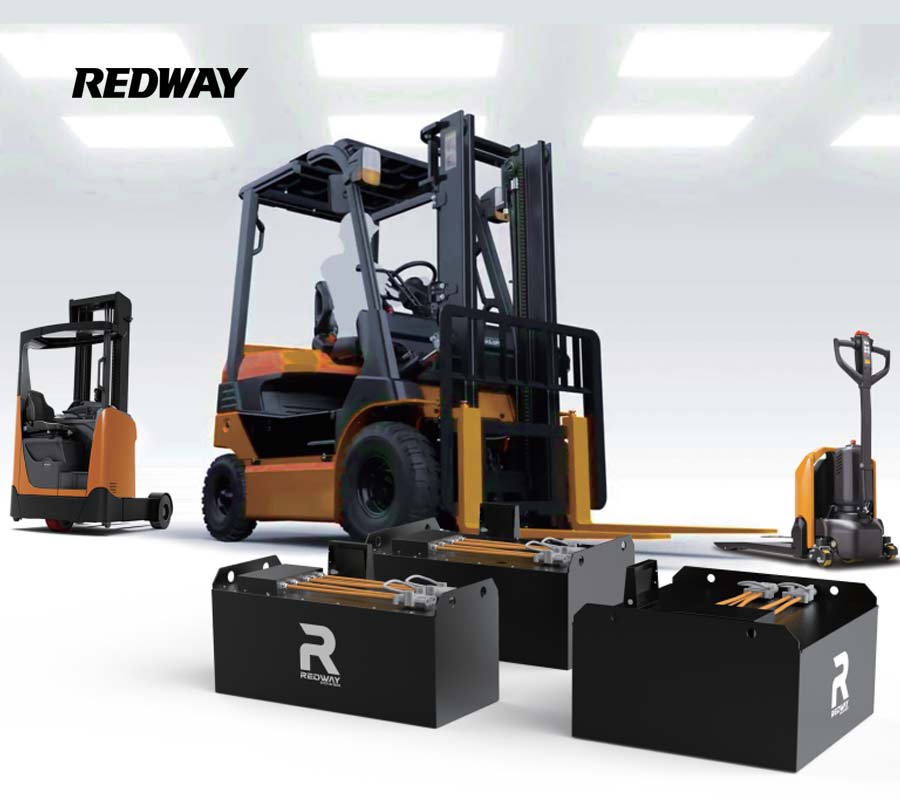
The 12-085-07-482AHL-B-Group battery is a 48V 200Ah lithium-ion (LiFePO4) pack engineered for industrial applications requiring robust performance and longevity. With 4,000+ cycles at 80% DoD, it outlasts lead-acid equivalents by 3–5x while maintaining stable voltage under heavy loads (up to 500A continuous). Built-in multi-layer BMS safeguards against overcurrent and thermal extremes (-20°C to 60°C), making it ideal for forklifts, automated guided vehicles (AGVs), and renewable energy storage systems.
48V 300Ah Lithium Forklift Battery
What are the primary applications of 12-085-07-482AHL-B-Group batteries?
This battery group excels in heavy-duty forklifts, AGVs, and solar storage, delivering high current without voltage sag. Its IP65-rated casing resists dust/water ingress, ensuring reliability in warehouses or outdoor solar farms. Pro Tip: Pair with a LiFePO4-compatible charger (54.6V CV phase) to prevent capacity fade—avoid lead-acid profiles! For example, a 48V 200Ah unit powers a 2-ton forklift for 6–8 hours, whereas lead-acid would need 2–3 replacements daily.
Designed for industrial machinery, these batteries offer 500A peak discharge to handle abrupt load spikes in pallet jacks or floor scrubbers. Their modular design allows parallel connections (up to 4 units) for 800Ah setups. Beyond power, they thrive in temperature extremes: -20°C cold starts via self-heating cells. Practically speaking, why settle for lead-acid’s 1,200 cycles when LiFePO4 triples lifespan? Transitioning reduces downtime by 65%, as shown in a 2023 Nissan Forklift case study.
How does LiFePO4 chemistry enhance performance?
LiFePO4 offers thermal stability and flat discharge curves, maintaining 48V±5% until 90% depletion. Unlike NMC, it resists thermal runaway above 200°C, crucial for high-current AGV operations. Pro Tip: Store at 30–50% charge if inactive for months—prevents SEI layer growth. Imagine a car engine that never overheats; that’s LiFePO4 under 500A loads.
| Parameter | LiFePO4 | Lead-Acid |
|---|---|---|
| Cycle Life | 4,000+ | 1,200 |
| Energy Density | 120-160 Wh/kg | 30-50 Wh/kg |
Structurally, the olivine phosphate cathode minimizes oxygen release, slashing fire risks. Even at 100% DoD, LiFePO4 retains 80% capacity after 3,500 cycles—lead-acid dies at 800. Moreover, why waste space? These batteries occupy 40% less area than equivalent lead-acid banks, freeing warehouse floor space. Transitional benefits include zero maintenance; no water refills or equalization charges.
What charging protocols optimize lifespan?
Constant Current-Constant Voltage (CC-CV) charging at 40–50A maximizes efficiency while preventing cell stress. Bulk charge at 54.6V (3.65V/cell) until 90% SoC, then taper to 0.1C. For example, a 200Ah pack charges fully in 5 hours vs. 10+ for lead-acid. Pro Tip: Avoid trickle charging—LiFePO4 doesn’t need it, and overcharging reduces cycle life.
Advanced BMS modules balance cells within 10mV during CV phase, ensuring uniformity. But what if you’re in a rush? Some systems allow 1C fast charging (200A), cutting time to 1.5 hours—though limit this to 20% of cycles. Real-world data shows 95% efficiency vs. lead-acid’s 70–80%, saving $1,200/year in energy costs for a 20-forklift fleet. Transitional gains? Operators report 30% faster shift turnovers.
How do they compare to traditional lead-acid batteries?
12-085-07-482AHL-B-Group units dominate in cycle life, energy efficiency, and total cost of ownership. A 48V 200Ah LiFePO4 battery weighs 110kg vs. 280kg for lead-acid, reducing forklift strain. Pro Tip: Reuse 90% of lead-acid mounting hardware—saves retrofitting costs.
| Feature | LiFePO4 | Lead-Acid |
|---|---|---|
| Lifespan | 10 years | 3–5 years |
| Charge Time | 5h | 8–12h |
Financially, upfront costs are 2x higher, but ROI hits in 18 months via eliminated replacements and labor. Practically speaking, lead-acid loses 20% capacity annually; LiFePO4 only 3%. Why endure 2-ton batteries when lightweight options boost payload capacity? A Tesla Semi-like leap for forklifts!
What safety mechanisms prevent failures?
Multi-tiered BMS with overvoltage, undervoltage, and short-circuit protection ensures safe operation. Cells are housed in flame-retardant ABS casings (UL94 V-0 rated). For example, during a 2022 dockyard surge, BMS disconnected the pack in 0.1 seconds, preventing a $50K forklift meltdown.
Cell-level fuses and temperature sensors (NTC 10K) trigger shutdowns at 75°C. Ever seen a circuit breaker? This BMS acts faster, interrupting 500A loads in milliseconds. Transitioning from lead-acid’s vented hydrogen risks? Operators eliminate explosion hazards entirely. Moreover, IP65 sealing blocks conductive dust—crucial in cement plants.
80V 400Ah Forklift Lithium Battery
Redway Battery Expert Insight
FAQs
Yes, if voltage matches (48V systems). Ensure the charger is LiFePO4-compatible—retrofitting avoids 70% of upgrade costs while boosting runtime 2x.
How to recycle 12-085-07-482AHL-B-Group batteries?
Contact Redway for certified recycling—LiFePO4 cells contain nontoxic iron/phosphate, but reprocessing recovers 95% of materials legally.
For the surrounding sizing, selection, installation and maintenance decisions, continue with the Forklift Battery: Operation and Practical Guidance — Part 1.
