




REDWAY BATTERY / KNOWLEDGE
How To Find The Ideal Battery For Your Forklift Truck?
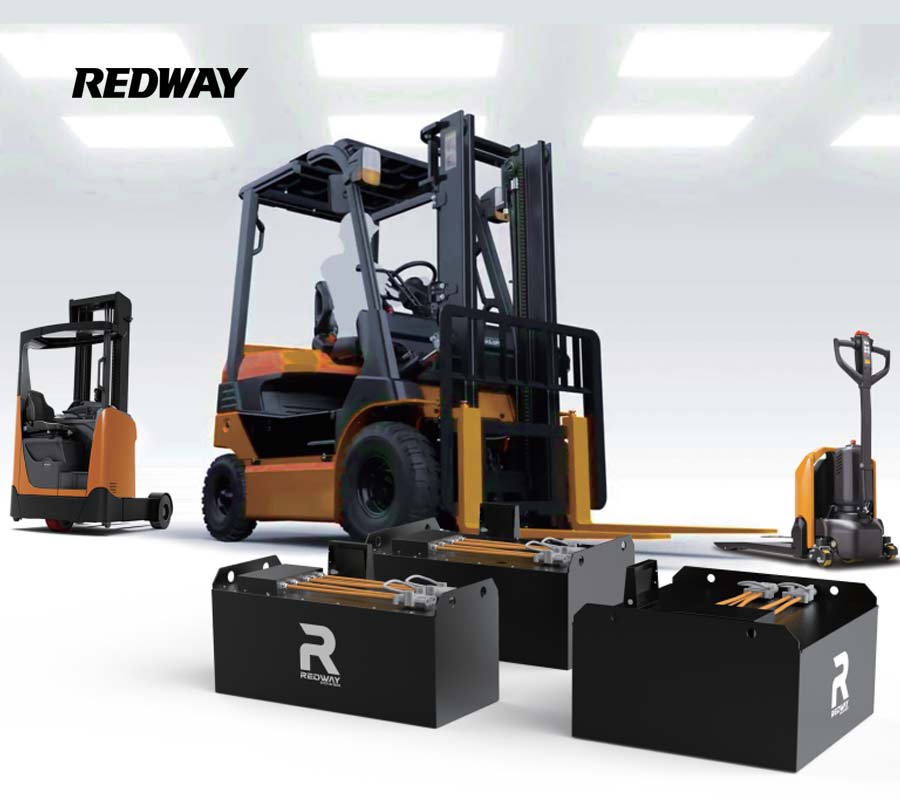
Choosing the ideal forklift battery hinges on balancing voltage, capacity, chemistry, and operational demands. Lithium-ion batteries offer longer lifespans (2,000–5,000 cycles) and faster charging than lead-acid, but upfront costs are higher. Key factors include daily runtime (Ah requirements), load weight, and charging infrastructure. Pro Tip: Match voltage (24V, 48V, 80V) to your forklift’s motor specs—mismatches cause inefficiency or damage.
48V 600Ah Lithium Forklift Battery
What factors determine forklift battery requirements?
Load capacity, shift duration, and voltage compatibility dictate battery needs. Heavy loads (3+ tons) and multi-shift operations demand high-capacity lithium packs (200–700Ah), while lighter duties may use lead-acid. Always cross-check OEM motor voltage (e.g., 48V for reach trucks) to avoid power mismatches.
Forklift batteries are sized based on ampere-hour (Ah) ratings, which determine runtime. For example, a 600Ah lithium battery running an 80V system can power a heavy-duty forklift for 8–10 hours. Pro Tip: Calculate daily energy needs by multiplying average current draw by operational hours. Add a 20% buffer to prevent deep discharges. Thermal management is critical—lithium batteries lose 15–20% capacity in sub-zero environments without heating systems. Transitioning from lead-acid? Remember, lithium’s weight is 40% less, improving maneuverability. Think of it like choosing a car engine: hauling heavy loads daily requires a V8 (high Ah), while lighter tasks need a four-cylinder (moderate Ah).
How to calculate the right battery capacity?
Runtime = (Battery Ah × Voltage) ÷ Average Power Draw. For instance, a 48V 400Ah lithium battery delivering 19.2kWh can sustain a 2kW forklift for ~9.6 hours. Adjust for efficiency losses (~85%) and peak loads.
Start by auditing your forklift’s energy consumption. If it draws 100A average at 48V, a 500Ah battery provides 5 hours of runtime. But what if your operation uses fast accelerations or lifts max loads frequently? Peak currents can spike to 200A, halving runtime. Pro Tip: Use data loggers to track real-world current fluctuations over a week. Lithium-ion handles deeper discharges (80–90% DoD) better than lead-acid (50% DoD), effectively doubling usable capacity. Imagine your battery as a water tank: lithium is a slim, deep reservoir, while lead-acid is wider but shallower. Transitional tip: Beyond Ah ratings, prioritize cycles—lithium’s 5,000 cycles outlast lead-acid’s 1,500, reducing replacements.
| Load (Ton) | Recommended Ah (8h Shift) | Chemistry |
|---|---|---|
| 1–2 | 200–300Ah | LiFePO4 |
| 3–5 | 400–600Ah | NMC/LiFePO4 |
| 5+ | 700Ah+ | NMC |
Lithium vs. lead-acid: which is better for forklifts?
Lithium-ion excels in lifespan and efficiency, but lead-acid suits budget-limited, low-use scenarios. Lithium charges in 2–3 hours vs. 8+ hours for lead-acid, minimizing downtime.
Lithium batteries operate at 95–98% energy efficiency, whereas lead-acid wastes 20–25% as heat. For multi-shift warehouses, this means lithium can recharge during breaks, eliminating battery swaps. However, lead-acid’s lower upfront cost ($3k–$5k vs. $10k–$20k for lithium) appeals to small operations. But is the savings worth it? Over five years, lithium’s 10,000-hour lifespan and zero maintenance often yield 30–50% lower TCO. Pro Tip: For cold storage, lithium with built-in heaters maintains performance, while lead-acid struggles below -20°C. It’s like comparing smartphones: lithium is the latest iPhone (premium, long-lasting), lead-acid a flip phone (basic, frequent charging).
| Factor | Lithium-ion | Lead-Acid |
|---|---|---|
| Cycle Life | 2,000–5,000 | 500–1,500 |
| Charge Time | 2–3h | 8–10h |
| Efficiency | 95% | 75% |
What voltage is needed for different forklifts?
Voltage scales with forklift class: 24V for pallet jacks, 48V for reach trucks, 80V for container handlers. Mismatched voltage strains motors and reduces torque.
Standard electric forklifts use 24V (1–3 tons), 48V (3–5 tons), or 80V (5–10+ tons). Diesel equivalents often require 12V starters. Pro Tip: Check the nameplate on your motor—exceeding rated voltage by 10% can overheat windings, while lower voltage causes sluggish performance. For example, an 80V, 700Ah lithium pack powers a 10-ton forklift for 6–7 hours, akin to a semi-truck needing a larger fuel tank. Transitionally, higher voltage doesn’t always mean better—it’s about matching the system’s “engine” needs.
How does charging infrastructure affect battery choice?
Fast charging demands lithium compatibility. Lead-acid requires 8-hour charges and cooldowns, while lithium supports opportunity charging (15–30 minute boosts) without memory effect.
If your facility has only overnight charging, lead-acid may suffice. But warehouses with 24/7 shifts need lithium’s rapid charging—3C rates can refill 80% in 30 minutes. However, what infrastructure is needed? Lithium requires high-current chargers (100A+ for 48V systems) and reinforced electrical circuits. Pro Tip: Install smart chargers with temperature monitoring to prevent overheating. It’s like gas stations: lead-acid is a slow pump for occasional use, lithium a high-speed pump for constant refueling. Transitioning phrase: Beyond chargers, consider space—lithium’s compact size frees up 30% floor space versus lead-acid.
What are the cost considerations over the battery’s lifespan?
Total cost of ownership (TCO) favors lithium despite higher initial investment. Over 10 years, lithium’s lower energy waste and zero maintenance offset 2–3x upfront cost.
A $15,000 lithium battery lasting 10 years costs $1,500 annually, while a $5,000 lead-acid battery replaced every 3 years totals $16,500+ with labor. Factor in energy savings: lithium’s 95% efficiency vs. lead-acid’s 75% cuts electricity bills by 20–30%. But what about disposal? Lead-acid recycling is cheaper ($50 per ton) but mandatory, whereas lithium has higher resale value due to reusable cells. Think of it as leasing vs. buying—lithium’s higher “rent” upfront saves long-term “mortgage” payments.
Redway Battery Expert Insight
FAQs
Yes, but ensure the motor and controller support lithium’s voltage profile. Upgrading a 36V lead-acid system to 48V lithium often requires component replacements.
How often should I perform battery maintenance?
Lithium needs none beyond terminal cleaning. Lead-acid requires monthly watering, equalization charges, and acid level checks—adding $200–$500/year in labor.
For the surrounding sizing, selection, installation and maintenance decisions, continue with the Forklift Battery: Operation and Practical Guidance — Part 2.
