




REDWAY BATTERY / KNOWLEDGE
What Are Advantages Of Lithium-Ion Batteries?
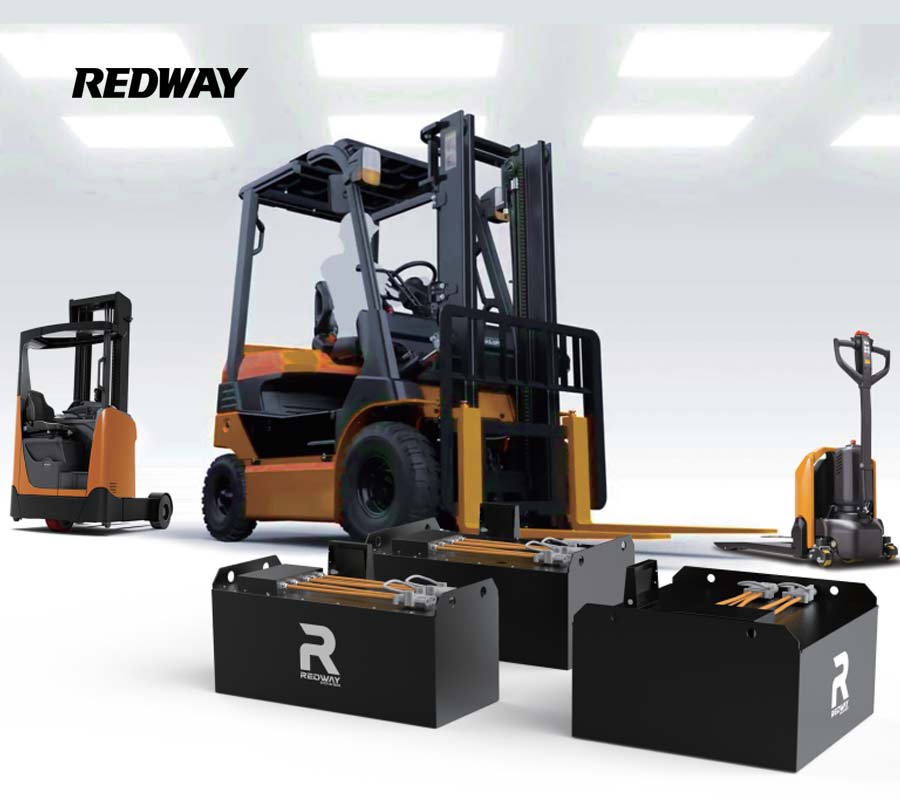
Lithium-ion (Li-ion) batteries offer multiple technical advantages that make them superior to traditional energy storage technologies. Their high energy density (460–600 Wh/kg in advanced models) surpasses lead-acid batteries by 6–7 times, enabling compact designs for portable electronics and electric vehicles. With cycle lives exceeding 2,000 charges in LiFePO4 variants, they outlast nickel-cadmium and nickel-metal hydride counterparts. Operating voltages of 3.2–3.7V per cell provide efficient power delivery, while self-discharge rates below 1% monthly ensure long-term energy retention.
48V 300Ah Lithium Forklift Battery
How do Li-ion batteries achieve high energy density?
Li-ion systems optimize electrode materials and electrolyte composition to store more energy per unit mass. Advanced cathodes like NMC811 increase lithium-ion mobility, while silicon-doped anodes enhance capacity by 30% compared to graphite.
The energy density advantage stems from lithium’s low atomic weight and high electrochemical potential. For context, a 20kg Li-ion pack for e-bikes delivers the same range as a 140kg lead-acid alternative. Pro Tip: Prioritize batteries with nickel-rich cathodes (NMC/NCA) when weight constraints exist—they achieve 250–300 Wh/kg versus LiFePO4’s 160–200 Wh/kg. However, what happens under extreme temperatures? Thermal management systems maintain stability between -20°C to 60°C, though energy output drops 15% at freezing points.
What drives Li-ion batteries’ long cycle life?
Cycle longevity results from stable solid-electrolyte interfaces and minimized side reactions. LiFePO4 chemistry exhibits 90% capacity retention after 2,000 cycles due to olivine structure stability.
Modern designs use electrolyte additives like vinylene carbonate to form protective cathode coatings, reducing degradation. Consider industrial forklift batteries: Li-ion units maintain 80% capacity after 5,000 cycles versus lead-acid replacements every 500 cycles. Transitionally, advanced battery management systems (BMS) balance cell voltages within 5mV, preventing premature aging. But how does this translate financially? A 100kWh EV battery losing 0.03% capacity per cycle would retain 94% functionality after 50,000 miles. Pro Tip: Partial (20–80%) charge cycles triple lifespan compared to full depth-of-discharge use.
| Chemistry | Cycle Life | Energy Density |
|---|---|---|
| LiFePO4 | 2,000–5,000 | 160 Wh/kg |
| NMC 811 | 1,000–2,000 | 300 Wh/kg |
Why do Li-ion batteries charge faster?
Rapid charging stems from low internal resistance (<10mΩ) and enhanced ionic conductivity. Silicon anode variants accept 4C rates—4X capacity in 15 minutes.
The charge speed advantage becomes apparent in EVs: Tesla Superchargers replenish 200 miles of range in 15 minutes through 250kW DC inputs. Comparatively, lead-acid batteries require 8+ hours for full charges. Transitionally, innovative cooling systems enable sustained fast charging by maintaining cell temperatures below 45°C. What limits exist? Most Li-ion chemistries degrade if charged beyond 1C without thermal controls. Pro Tip: Use CC-CV chargers with temperature feedback—they adjust currents dynamically to prevent lithium plating.
How do Li-ion batteries support wide temperature operation?
Specialized electrolytes with low freezing points (-40°C) and high thermal stability (>70°C) enable broad operational ranges.
Arctic-grade Li-ion batteries incorporate propylene carbonate-based electrolytes, delivering 80% capacity at -30°C. Contrast this with nickel-based batteries that fail below -10°C. Transitionally, phase-change materials in battery packs absorb heat during high-power discharges. For instance, drone batteries using paraffin wax thermal buffers sustain 20C discharge rates without exceeding 50°C. Pro Tip: Never discharge below -20°C—electrolyte viscosity increases ionic resistance, causing voltage collapse.
| Temperature | Capacity (%) | Power (%) |
|---|---|---|
| 25°C | 100 | 100 |
| -20°C | 75 | 60 |
Redway Battery Expert Insight
24V 280Ah Lithium Forklift Battery
FAQs
Can Li-ion batteries be recycled?
Yes, modern hydrometallurgical processes recover 95% lithium and cobalt. Redway’s closed-loop system ensures >98% material reuse.
Do Li-ion batteries require maintenance?
No—sealed designs eliminate electrolyte checks. However, monthly capacity verification through BMS diagnostics optimizes performance.
For connected guidance and the next practical steps, use the Forklift Battery: Technology and System Fundamentals — Part 3.
