




REDWAY BATTERY / KNOWLEDGE
What should be on a private-label lithium battery: logos, ratings and warnings?
Redway Battery Editorial Team
Talk / Battery Q&A
A distributor is launching its own battery brand and must send label artwork to the factory, but is unsure which fields are marketing choices and which are required.
Direct answer: Separate the label into three layers. Brand layer: your logo, model name and contact details. Technical layer: nominal voltage, rated capacity (Ah and Wh), chemistry, charge voltage limit, terminal polarity, serial number and date of manufacture. Compliance layer: warning symbols and text, and the marks the destination market requires. In the EU, Regulation (EU) 2023/1542 adds specific label content on a phased timetable. Your importer or compliance adviser should sign off the compliance layer for each market.
Brand fields. Product pages such as the 12V 100Ah, 48V 100Ah and PM-LV51100-3U rack module list silkscreen, label design and laser logo as available options, so agree the method, colour and position in the artwork file.
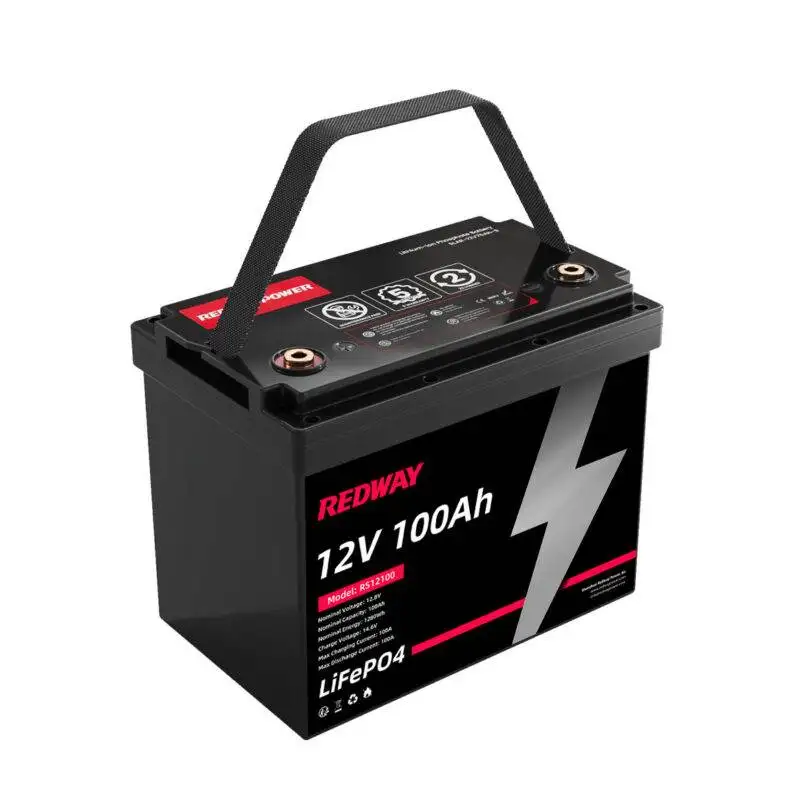
Technical ratings. Use the figures from the agreed datasheet, for example 12.8V/100Ah/1.28 kWh for the 12V 100Ah, and do not round up. If BMS settings or capacity are customised, the label must match the final specification, not the catalogue model.
EU labelling timeline. Under Regulation (EU) 2023/1542 Article 13, the separate collection (crossed-out bin) symbol applies from 18 August 2025. Label information listed in Annex VI Part A (manufacturer, category, place and date of manufacture, weight, capacity, chemistry, hazardous substances, extinguishing agent and certain critical raw materials) applies from 18 August 2026 or 18 months after the implementing act, whichever is later. A QR code applies from 18 February 2027. Check the current status before you finalise artwork; see EU battery passport timeline.
Other markets. North American and other markets have their own marking and listing rules. Do not print certification marks unless the specific product has the matching certificate in your name or the factory’s, with documents available on request.
Transport is separate. Carton labels such as the lithium battery mark and Class 9 label are shipping requirements, not product labels; see carton labels and marks.
Durability. Labels on golf, marine or forklift packs see heat, UV and cleaning. Ask for a material that survives the environment and place the label where it is visible after installation.
Approval loop. Approve a printed sample, not only a PDF, and keep the signed artwork version with the purchase order.
Warnings and pictograms. Typical warning content covers no short-circuit, no fire or crushing, charge only with a compatible charger, keep away from children and the operating temperature range. Keep the wording consistent with the user manual and SDS so a customer reading any of the three sees the same message.
↳ Replying to Redway Battery Editorial Team
Own the compliance layer: your importer of record is usually responsible for what the label says in your market.
↳ Replying to Procurement perspective
Ratings on the label must match the final datasheet, including any custom BMS or capacity change.
↳ Replying to Selection/Engineering perspective
Choose label materials for the real environment and check legibility after a season in service.
Separate the label into three layers. Brand layer: your logo, model name and contact details. Technical layer: nominal voltage, rated capacity (Ah and Wh), chemistry, charge voltage limit, terminal polarity, serial number and date of manufacture. Compliance layer: warning symbols and text, and the marks the destination market requires. In the EU, Regulation (EU) 2023/1542 adds specific label content on a phased timetable. Your importer or compliance adviser should sign off the compliance layer for each market.
Verify before ordering: Labelling obligations vary by market and change over time; confirm with your importer or compliance adviser. Certificates for a given model are available on request; do not print marks that the product does not hold.
Sources checked: Regulation (EU) 2023/1542 (EUR-Lex).
Editorial Q&A for battery selection and operations. Product figures cited from Redway product pages.
Related products
 12V 100Ah Lithium Battery (LiFePO4, Self-heating, OEM)
 48V 100Ah Lithium Battery
 51.2V 100Ah Server Rack Battery
Related articles & discussions
- How to Ensure Safety with Lithium-Ion Batteries: Risks and Regulations
- How to Understand the Maximum Continuous Discharge Rating of Lithium Batteries
- How to Safely Fly with Lithium Batteries: Regulations and Tips
- Are lithium forklift batteries the right choice for EU warehouses?
- Why Choose Redway Battery’s 12V 150Ah EU Lithium Iron Phosphate Battery?
- How Does the 12V 105Ah EU-Style LiFePO4 Battery by Redway Battery Work?
- Review of the 12V 120Ah Lithium Iron Phosphate (LiFePO4) Battery from Redway Battery: A Reliable Power Solution
- Why You Should Choose Lithium Iron Phosphate Batteries (LiFePO4) for Your Electric Vehicle
- How to Purchase Wholesale 24V 105Ah Lithium Iron Redway Batteries
- How to Travel with Lithium Batteries: Regulations for Flights and Shipping
