




REDWAY BATTERY / KNOWLEDGE
What Are Lithium-Ion Forklifts And Pallet Trucks?
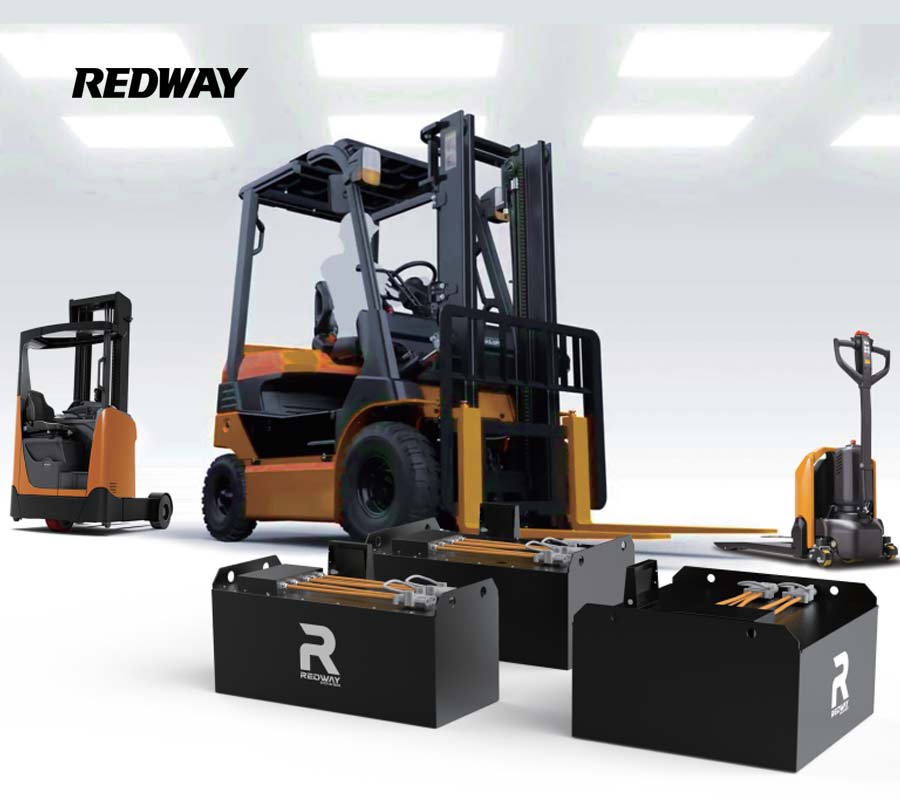
Lithium-ion forklifts and pallet trucks are electric material-handling vehicles powered by high-efficiency Li-ion batteries, replacing traditional lead-acid models. They offer faster charging (1–2 hours), zero maintenance, and 2–3x longer lifespan (2,000–4,000 cycles), ideal for multi-shift warehouses. Advanced BMS ensures safety, while 20–30% weight reduction improves maneuverability. Brands like Toyota and Hyster increasingly adopt Li-ion for logistics automation.
48V 600Ah Lithium Forklift Battery
How do lithium-ion forklifts differ from lead-acid models?
Li-ion forklifts eliminate acid refills and watering, using sealed battery packs with 80–90% energy efficiency vs. 60–70% for lead-acid. Opportunity charging enables partial top-ups without memory effect—critical for 24/7 operations.
Unlike lead-acid’s 8–10 hour full charge, Li-ion reaches 80% in 1 hour via 1C charging. Think of it like smartphone fast-charging versus overnight USB—no more battery change rooms. Technically, Li-ion operates at 25–45°C without sulfation risks. Pro Tip: Pair Li-ion with regenerative braking systems to recover 15–20% energy during deceleration. However, upfront costs are 30–50% higher—though TCO is lower due to 3x cycle life. For example, a 48V 600Ah Li-ion pack lasts 8–10 years vs. 3–5 years for lead-acid in a high-throughput DC.
What charging protocols optimize Li-ion forklift lifespan?
Partial state-of-charge (PSOC) cycling (20–80%) extends cycles by 40% vs. full discharges. Chargers with adaptive voltage control (3.6–3.9V per cell) prevent overvoltage dendrites.
Most Li-ion forklifts use CC-CV charging but with tighter voltage bands—±0.5% tolerance vs. lead-acid’s ±2%. Why does precision matter? Dendrite growth from overcharging can puncture separators, causing thermal runaway. Advanced BMS with per-cell monitoring balances discrepancies below 20mV. Pro Tip: Avoid charging below 0°C—lithium plating reduces capacity by 5% per 10 cycles. Real-world example: Redway’s 48V systems use CANbus-enabled chargers that auto-adjust current based on cell temperatures.
| Parameter | Li-ion | Lead-Acid |
|---|---|---|
| Energy Density (Wh/kg) | 150–200 | 30–50 |
| Cycle Life | 2,000–4,000 | 500–1,500 |
| Charging Time | 1–2 hours | 8–10 hours |
Are lithium pallet trucks suitable for cold storage?
Yes—Li-ion performs at -20°C to 60°C with <5% capacity loss, unlike lead-acid’s 50% drop below 0°C. Insulated battery compartments prevent condensation in sub-zero environments.
Cold storage applications require heaters for optimal charging—a 48V 300Ah pack may draw 50W to maintain cells at 5°C during charging. Practically speaking, this is cheaper than lead-acid’s equalization cycles. For example, Walmart’s frozen warehouses use Li-ion pallet trucks with built-in thermal jackets, cutting downtime by 70%. Pro Tip: Always preheat batteries to 10°C before charging if stored below freezing. But can all Li-ion chemistries handle this? Only LiFePO4 and NMC variants with electrolyte additives—avoid LCO in sub-zero settings.
How do safety standards differ for Li-ion forklifts?
UL 2580 and IEC 62133 certifications mandate short-circuit and crush tests—Li-ion packs must withstand 150% overcharge and 10mm nail penetration without fire.
Forklift-specific standards like ISO 3691 require flame-retardant casing (V-0 rating) and IP67 sealing against dust/liquids. A real-world analogy: Think of Li-ion batteries as aircraft black boxes—encased to survive impacts and thermal extremes. Redway’s designs include gas vent channels and ceramic separators to isolate thermal events. Pro Tip: Monthly BMS diagnostics are critical—monitor cell variance and internal resistance spikes.
| Risk Factor | Li-ion Mitigation | Lead-Acid Mitigation |
|---|---|---|
| Thermal Runaway | Phase-change materials | Ventilated charging rooms |
| Sulfation | Not applicable | Equalization charging |
| Acid Leaks | Sealed modules | Spill containment trays |
What maintenance maximizes Li-ion forklift uptime?
Zero watering but monthly SOC calibration (full discharge/charge) and connector cleaning prevent voltage drift. BMS software updates patch balancing algorithms.
Lithium forklifts don’t need equalization, but they do require occasional capacity testing. Imagine it like recalibrating a fuel gauge—without it, a 20% SOC might read as 5%. Technically, this involves cycling the battery to reset coulomb counters. Pro Tip: Keep firmware updated—2023 BMS revisions reduced cell imbalance by 60% via AI-driven balancing. Redway’s cloud-connected systems auto-flag anomalies like rising internal resistance.
Redway Battery Expert Insight
FAQs
8–10 hours per charge, extendable via 15-minute opportunity charges—ideal for 3-shift operations without battery swaps.
Can I retrofit lead-acid forklifts with Li-ion?
Yes, if voltage matches (24V/36V/48V) and the controller supports Li-ion’s higher discharge rates—upgrade wiring if exceeding 300A peaks.
For the surrounding sizing, selection, installation and maintenance decisions, continue with the Forklift Battery: Technology and System Fundamentals — Part 3.
