




REDWAY BATTERY / KNOWLEDGE
What Is A Forklift Battery?
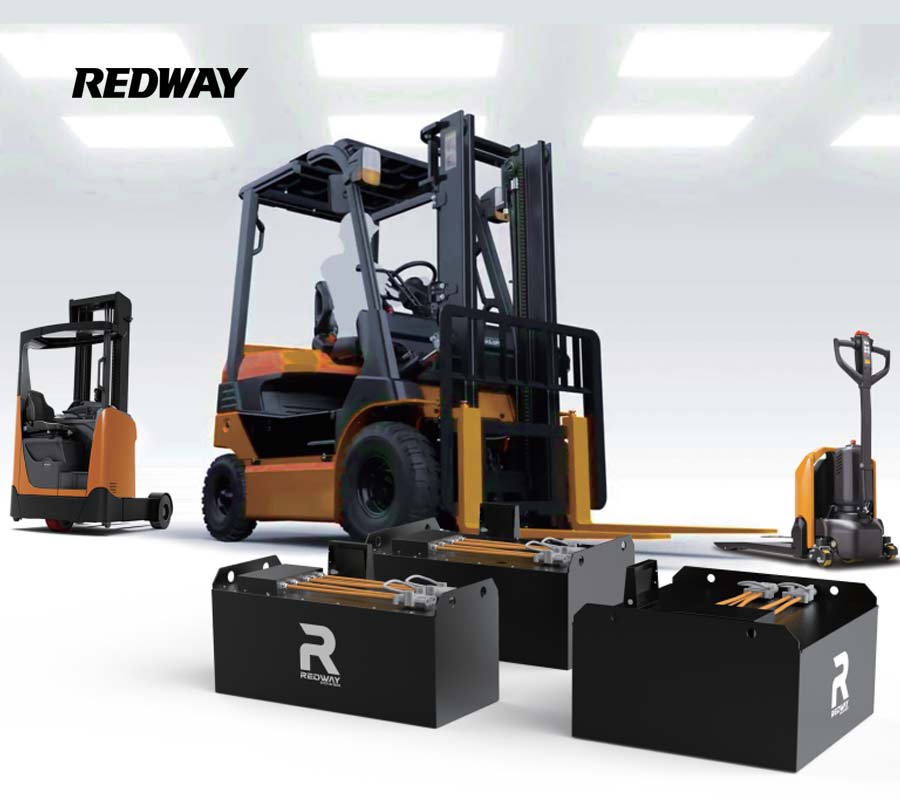
A forklift battery is the power unit providing energy to electric forklifts, typically using lead-acid or lithium-ion chemistries. Designed for deep cycling, these batteries deliver high currents to drive DC motors and lift heavy loads, with voltages ranging from 24V to 80V. Lithium-ion variants offer 2,000–5,000 cycles with fast charging, while lead-acid lasts 1,200–1,500 cycles but requires regular watering and equalization. Proper ventilation, temperature control, and BMS integration are critical for safe operation.
48V 300Ah Lithium Forklift Battery
What types of forklift batteries are commonly used?
The two primary types are lead-acid (flooded or VRLA) and lithium-ion (LiFePO4 or NMC). Lead-acid dominates due to lower upfront costs, while lithium-ion excels in energy density (150–200 Wh/kg vs. 30–50 Wh/kg) and maintenance-free operation. Specialty options like nickel-iron exist but are rare. Pro Tip: Calculate total ownership costs—lithium’s 3× higher initial price often offsets lead-acid’s replacement and watering labor.
Lead-acid batteries rely on sulfuric acid and lead plates, needing weekly watering to prevent sulfation. In contrast, lithium-ion packs use sealed cells with built-in Battery Management Systems (BMS) that balance voltage and temperature automatically. For example, a 48V 600Ah lithium battery can recharge in 1–2 hours during lunch breaks, whereas lead-acid requires 8 hours plus cooling. Beyond chemistry, consider application: lithium-ion suits multi-shift operations, while lead-acid fits budget-focused single shifts. But why choose one when some warehouses hybridize both? A distribution center might use lithium for high-use forklifts and lead-acid for reserve units.
| Feature | Lead-Acid | Lithium-Ion |
|---|---|---|
| Cycle Life | 1,200–1,500 | 2,000–5,000 |
| Charging Time | 8–10 hours | 1–3 hours |
| Maintenance | Weekly watering | None |
What voltage ranges do forklift batteries operate at?
Forklift batteries typically run on 24V, 36V, 48V, 72V, or 80V, with capacity from 200Ah to 1200Ah. Voltage selection depends on motor power and load capacity—48V systems handle 3,000–8,000 lbs, while 80V packs power heavy-duty lifts moving 15,000+ lbs. Pro Tip: Mismatched voltage can fry controllers; always check OEM specs before retrofitting.
Voltage directly impacts torque and lifting speed. A 24V 280Ah battery might power a walkie stacker lifting 2,500 lbs, whereas an 80V 700Ah unit runs a container handler. Practically speaking, higher voltage reduces current draw for the same power, minimizing heat in cables and connectors. For example, a 48V system drawing 400A delivers 19.2kW, while an 80V system needs only 240A for the same output. Transitioning to lithium-ion? Remember their flat discharge curve maintains voltage under load better than lead-acid’s 20% sag. But what if your warehouse uses older 36V lifts? Retrofit kits with DC-DC converters can bridge gaps, though efficiency drops 5–8%.
How does battery chemistry affect lifespan?
Lifespan hinges on depth of discharge (DoD), charging frequency, and temperature. Lead-acid degrades rapidly if cycled below 50% DoD, while lithium-ion tolerates 80–90% DoD. High temperatures above 45°C cut lead-acid life by half, whereas lithium-ion’s BMS throttles charging to protect cells.
Every 0.1V overcharge on lead-acid accelerates corrosion by 10%. Lithium-ion’s lifespan adheres to the 80/20 rule: keeping charge between 20–80% SOC (State of Charge) extends cycles by 25%. For example, a LiFePO4 battery cycled at 30–70% DoD might achieve 6,000 cycles vs. 4,000 at full DoD. Transitional practices matter too—opportunity charging lithium during breaks adds negligible wear, but lead-acid needs full charges to avoid sulfation. Pro Tip: Use telematics to track DoD patterns and adjust shift schedules. A refrigerated warehouse at 4°C could see lithium-ion cycle life increase 15% versus non-climate-controlled sites.
What are best practices for charging and maintenance?
Lead-acid requires equalization charging every 10 cycles to balance cell voltages, while lithium-ion needs no equalization. Always cool lead-acid to below 40°C before charging. For lithium, partial charges (20–80%) are optimal. Pro Tip: Install smart chargers with temperature probes to prevent thermal runaway.
Charging a lead-acid battery too quickly (above C/5 rate) causes gassing and plate corrosion. Lithium-ion accepts 1C rates—a 600Ah pack can handle 600A charging. Consider this: a forklift running two shifts daily would need three lead-acid packs (charge, cool, standby), but just one lithium pack charged during breaks.
| Practice | Lead-Acid | Lithium-Ion |
|---|---|---|
| Charging Temp | 5–40°C | 0–45°C |
| Optimal DoD | 50% | 80% |
| Water Refills | Weekly | Never |
Real-world example: A 48V 600Ah lithium battery in a three-shift operation cycles twice daily, charged during 30-minute breaks, lasting 5 years. The same usage with lead-acid demands two battery swaps in the same period.
What safety risks do forklift batteries pose?
Lead-acid risks include hydrogen gas emission during charging (explosive above 4% concentration) and sulfuric acid leaks. Lithium-ion poses thermal runaway risks if damaged or overcharged. Both require spill containment and Class D fire extinguishers nearby.
Ventilation is non-negotiable for lead-acid—hydrogen disperses at 1,200 cfm per 100 kWh. Lithium-ion installations need thermal sensors and battery cubicles with fire ratings. For example, a warehouse storing six 80V lithium packs should have 2-hour firewalls between charging stations. Transitioning between chemistries? Retrain staff: lead-acid PPE (face shields, aprons) differs from lithium’s focus on arc-flash protection. Did you know a single punctured lithium cell can reach 900°C in seconds? Redway’s UL-certified packs include flame-retardant casings and cell-level fuses to contain failures.
Redway Battery Expert Insight
FAQs
3–8 years, depending on cycles (2,000–5,000) and DoD. Properly maintained LiFePO4 often outlasts the forklift itself.
Can I replace lead-acid with lithium without modifications?
Sometimes—check charger compatibility and voltage. Most lithium kits include adapters, but controller reprogramming may be needed.
Are forklift batteries interchangeable between brands?
No. Terminals, dimensions, and communication protocols (CANBus) vary. Always match OEM specs or use certified third-party packs.
What’s the hydrogen risk with lead-acid?
Charging emits H₂ gas; 1 kg of lead-acid produces 0.42 cubic meters. Install gas detectors and enforce no-smoking zones within 10 meters.
For the surrounding sizing, selection, installation and maintenance decisions, continue with the Forklift Battery: Technology and System Fundamentals — Part 5.
