




REDWAY BATTERY / KNOWLEDGE
What happens when a 12V lithium battery is over-discharged, and how do you recover it?
Redway Battery Editorial Team
Talk / Battery Q&A
A 12V lithium battery in a camper was left with a small load connected for weeks. Now it shows almost no voltage and the charger will not start.
Direct answer: When the battery reaches its low-voltage limit, the battery management system (BMS) disconnects the output to protect the cells, so the terminals may read near zero and some chargers will not start because they see no battery. Disconnect all loads, check the cell or pack voltage information if available, and use the recovery method in the battery manual; some packs restart when a charger is connected, others need a specific procedure. Stop and contact the supplier if the battery is swollen, hot or will not accept charge.
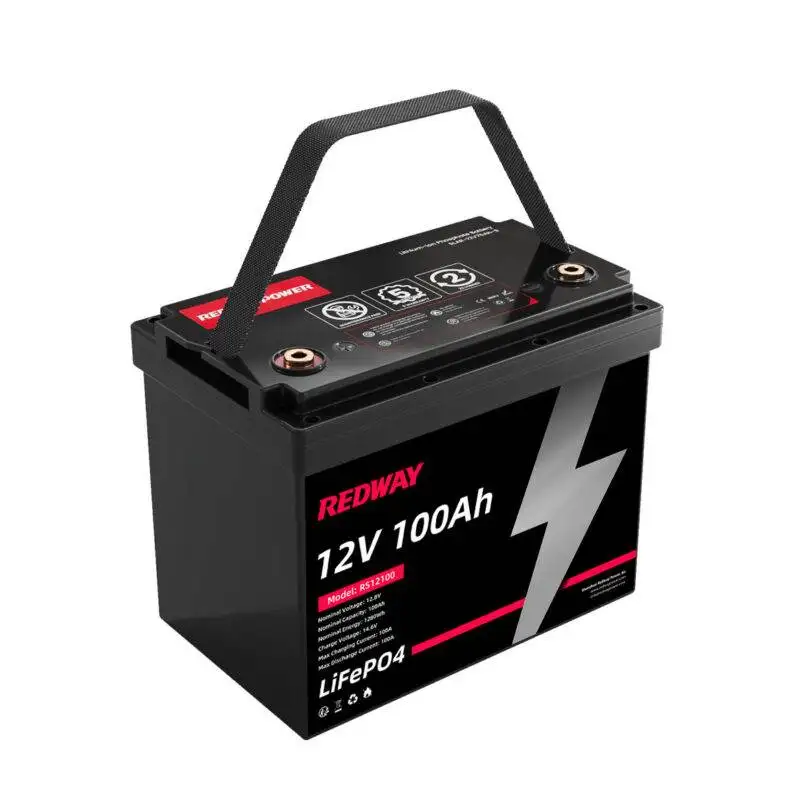
What the specs say. Redway’s 12V 100Ah, 12V 200Ah and 12V 100Ah EU thin pages list a 10V discharge cut-off and 14.6V maximum charge, with BMS protection against over-discharge. The cut-off is a protection, not a target; repeated deep discharge to the cut-off shortens life.
Why it looks dead. After the BMS opens, a meter on the terminals may read zero or a low value. A charger that needs to detect battery voltage before starting may then do nothing. This is the protection working, not proof the cells are ruined.
Recovery steps. Disconnect every load and charging source. Check the manual for the reset or wake-up method. Some packs wake when a charger with a lithium profile is connected; some chargers have a lithium wake or force mode. Charge at a low current to start with if your charger allows it, watch the battery and stop if it becomes warm, smells, or the voltage does not rise. Do not use jump leads from another battery or bypass the BMS.
After recovery. Charge fully, then check the battery under a normal load. If capacity has clearly dropped or the BMS cuts off early, record the details and contact the supplier.
Prevent it. Fit a battery disconnect switch for storage, find parasitic loads such as detectors, displays and inverters on standby, and use a low-voltage disconnect or monitor alarm set above the BMS cut-off. For storage advice, see storage state of charge, and for reading charge level see cold-weather charging.
Warranty. Ask how the warranty treats over-discharge. Keep a record of when it happened and what you did, which helps any claim.
↳ Replying to Redway Battery Editorial Team
Ask Redway how warranty treats deep discharge and include a storage disconnect switch in the system price.
↳ Replying to Procurement perspective
The BMS opens at the 10V cut-off; recovery depends on the BMS and charger wake method, so follow the manual and never bypass protection.
↳ Replying to Selection/Engineering perspective
Recharge slowly at first, stop on heat or smell, and fit a low-voltage alarm or disconnect above the cut-off to avoid repeats.
When the battery reaches its low-voltage limit, the battery management system (BMS) disconnects the output to protect the cells, so the terminals may read near zero and some chargers will not start because they see no battery. Disconnect all loads, check the cell or pack voltage information if available, and use the recovery method in the battery manual; some packs restart when a charger is connected, others need a specific procedure. Stop and contact the supplier if the battery is swollen, hot or will not accept charge.
Verify before ordering: Wake-up and recovery procedures depend on the BMS fitted; request the exact procedure for your model from Redway before attempting recovery.
Editorial Q&A for battery selection and operations. Product figures cited from Redway product pages.
Related products
 12V 100Ah Lithium Battery (LiFePO4, Self-heating, OEM)
 12V 200Ah Lithium Battery
 12V 100Ah EU Lithium Battery (Thin Size)
Related articles & discussions
- What Are The Benefits Of 12V Lithium Batteries?
- What is the charging voltage for a 12V lithium ion battery?
- Why Choose a 12V LiFePO4 Battery for Your Applications?
- What is a Bad Voltage for a 12V Battery?
- What is a 12V LiFePO4 battery?
- How Do You Test a 12V Lithium-Ion Battery?
- How many lithium cells for 12V?
- What is the voltage of a fully charged LiFePO4 12V battery?
- What is a dual 12v battery?
- At what voltage is a 12V LiFePO4 battery dead?
