




REDWAY BATTERY / KNOWLEDGE
12V 200Ah or a 24V 200Ah battery for an off-grid cabin?

Redway Battery Editorial Team
Talk / Battery Q&A
Someone planning a small off-grid cabin with solar panels, an inverter and a few DC lights sees a 12V 200Ah and a 24V 200Ah battery and assumes they are the same size because both say 200Ah.
Direct answer: They are not the same size in energy. The 12V 200Ah stores about 2.5 kWh and the 24V 200Ah about 5.12 kWh according to the pages, because energy is voltage × Ah. For a cabin with an inverter of more than about 1,000–1,500W, a 24V system usually means half the current for the same load, smaller cables and lower losses. Choose 12V if most loads are 12V DC and the inverter is small; choose 24V if the inverter is larger, cable runs are long, or you need more energy.
Page figures. 12V 200Ah: 12.8V, 200Ah, 2,500 Wh, 501 × 185 × 242 mm, 18 kg, 14.6V charge, 10V cut-off, versions at 100A, 150A or 200A continuous. 24V 200Ah: 25.6V, 200Ah, 5,120 Wh, 523 × 269 × 218 mm (BCI Group 8D), 40 kg, 29.2V charge, 20V cut-off, same current versions. The 24V 100Ah (Ultra) lists 2,560 Wh, about the same energy as the 12V 200Ah at twice the voltage.
Current and cable. Our arithmetic: a 1,500W load draws about 1,500 ÷ 12 ≈ 125A at 12V and about 62A at 24V, before inverter losses. Cable losses rise with the square of current, so for the same cable the 24V system loses roughly a quarter as much. That matters for long runs from a battery shed to the cabin. Conductor sizes and overcurrent protection must follow your electrical code (NFPA 70 in many US jurisdictions) and the inverter manual.
Equipment. The inverter and the solar charge controller must match the battery voltage: a 12V inverter will not run from 24V. If you have 12V DC loads such as lights or a pump on a 24V system, you need a 24V-to-12V converter. Check that the controller supports 24V lithium settings (29.2V maximum on the page).
Expansion. The 12V 200Ah lists up to four in series and four in parallel; the 24V 200Ah lists up to four in parallel and no series connection. Plan the final size first; mixing old and new units later needs care.
Rule of thumb, not a requirement: small cabins with mostly 12V loads and a small inverter can stay at 12V; anything with a larger inverter, induction cooking, a well pump on an inverter or long cable runs points toward 24V. For a related case, see two 12V batteries in series vs one 24V battery and, for the cable side, cable and fuse sizing at 12V.
↳ Replying to Redway Battery Editorial Team
Compare whole-system cost: battery, inverter, controller, cable, fuses and any 24V-to-12V converter. The 24V battery costs more per unit but stores twice the energy and can save copper.
↳ Replying to Procurement perspective
Work out the inverter’s input current at each voltage, the cable length and the allowed voltage drop, then size conductors and fuses to code. Choose the voltage before buying the inverter.
↳ Replying to Selection/Engineering perspective
Fit a battery monitor or use the BMS app where available, keep the battery inside its 0–60 °C charge range, and check terminal torque each season.
They are not the same size in energy. The 12V 200Ah stores about 2.5 kWh and the 24V 200Ah about 5.12 kWh according to the pages, because energy is voltage × Ah. For a cabin with an inverter of more than about 1,000–1,500W, a 24V system usually means half the current for the same load, smaller cables and lower losses. Choose 12V if most loads are 12V DC and the inverter is small; choose 24V if the inverter is larger, cable runs are long, or you need more energy.
Verify before ordering: Expansion rules (series/parallel counts) are as listed on the pages; confirm cabling, fusing and code requirements with a qualified electrician.
Sources checked: NFPA 70 (NFPA).
Editorial Q&A for battery selection and operations. Product figures cited from Redway product pages.
Related products
 12V 200Ah Lithium Battery
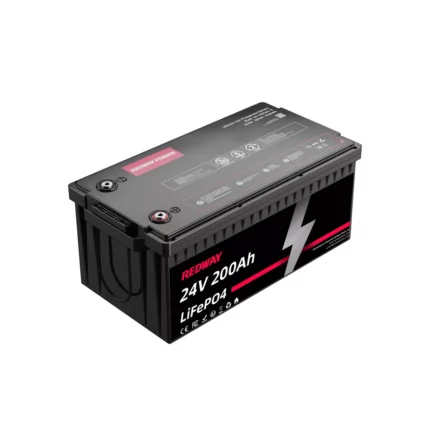 24V 200Ah Lithium Battery
 24V 100Ah LiFePO4 Lithium Battery (Ultra)
Related articles & discussions
- Where To Buy DIY Off-Grid Solar Kits Online?
- How to Make a 12V 200Ah Lithium-Ion Battery?
- Find Economical Lithium-Ion Battery Options for Off-Grid Power Needs
- What Are Affordable and Efficient Residential Solar Batteries for Off-Grid Living?
- How the 24V 200Ah Lithium Battery by Redway Battery Provides a Reliable Power Solution
- Why is 24V Better Than 12V?
- Can You Charge a 24V Battery with a 12V Charger?
- What Size Inverter Can I Run Off a 200Ah Lithium Battery?
- How long will a 12V 200Ah lithium battery last?
- What is the lifespan of a 200Ah lithium battery?
