REDWAY BATTERY / KNOWLEDGE
What can a 12V 12Ah, 18Ah or 24Ah lithium battery power?
Redway Battery Editorial Team
Talk / Battery Q&A
A distributor sells small 12V batteries for fish finders, ride-on toys, alarm panels and small backup supplies, and wants a simple way to match the right size to each customer.
Direct answer: Match by two checks. First, energy: watt-hours divided by the load’s watts gives a rough runtime. Second, current: the load’s highest current must be within the battery’s continuous rating. Redway’s 12V 12Ah, 18Ah and 24Ah list 153.6, 230.4 and 307.2 Wh with 15A, 15A and 30A maximum continuous discharge, which suits small electronics and light motors, not inverters or engine starting.
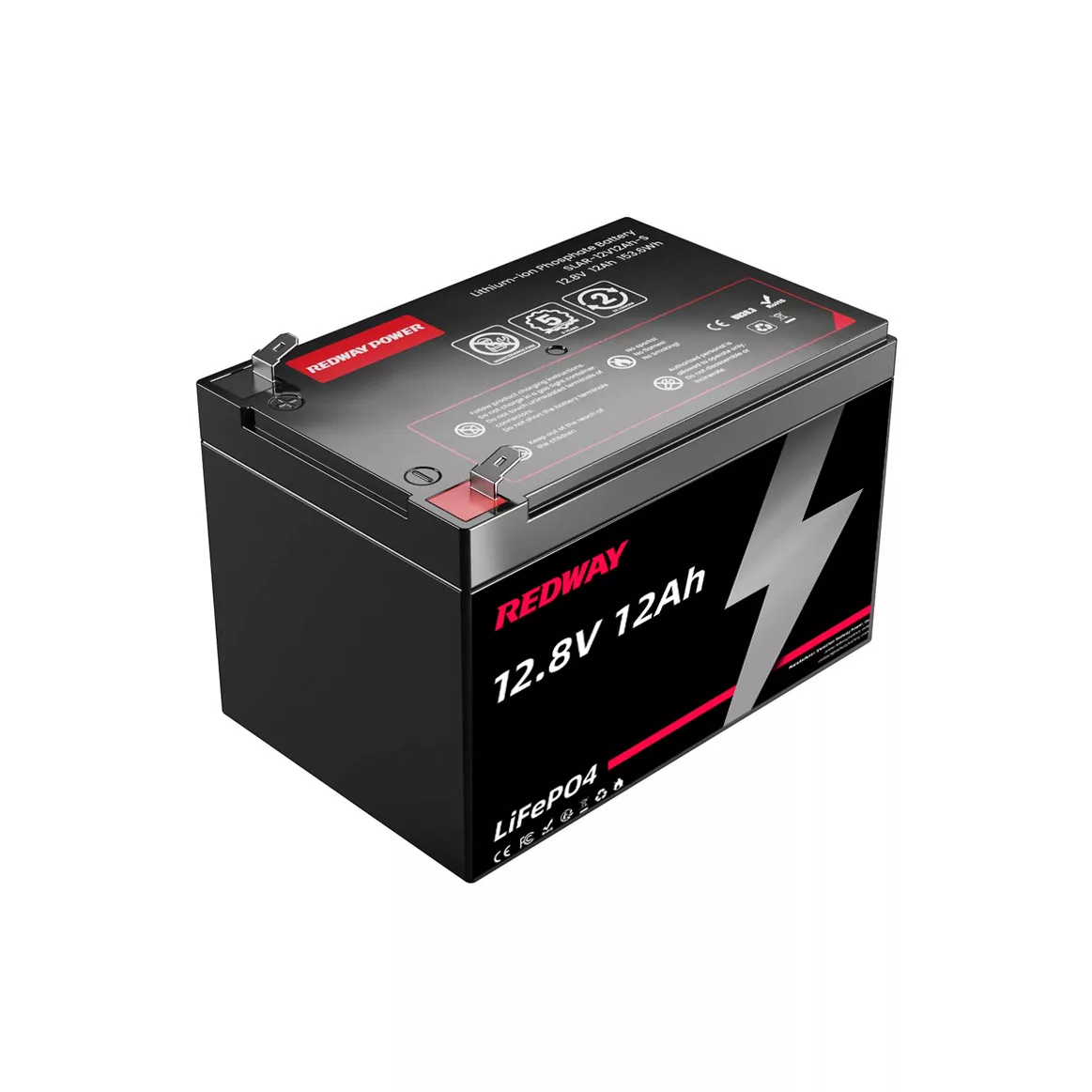
Page figures. 12V 12Ah: 12.8V, 153.6 Wh, 151 × 98 × 97 mm, 1.2 kg, 12A charge and 15A discharge continuous, T2 terminals, 14.6V 3A charger listed. 12V 18Ah: 230.4 Wh, 180 × 76 × 165 mm, 1.8 kg, 15A charge and discharge, M5 terminals, 14.6V 3A charger. 12V 24Ah: 307.2 Wh, 177 × 167 × 124 mm, 2.5 kg, 24A charge and 30A discharge, M5 terminals, 14.6V 4A charger, up to 4 in series and 6 in parallel. All list IP65, 10V cut-off and charging from 0°C.
Runtime examples, with stated assumptions. A fish finder drawing an assumed 1A at 12.8V (about 13W) would run for roughly 9 to 10 hours on the 12Ah after a 20% reserve. A 60W load would run about 2 hours on the 12Ah, 3 hours on the 18Ah and 4 hours on the 24Ah, again keeping 20% in reserve. Use the load’s real current.
Current check. A small motor or pump may start at several times its running current. If the running current is near 15A, the 12Ah and 18Ah leave little margin; the 24Ah’s 30A rating is safer. Small inverters can draw well over these limits and should be checked carefully.
Spec inconsistencies to confirm. The 18Ah page’s FAQ mentions a 20A peak for 10 seconds while its table shows no peak value; the 24Ah FAQ gives 2.4 kg and the table 2.5 kg; and the tables list more than 4,000 cycles at 80% depth of discharge while the FAQs mention more than 6,000. Ask Redway for the datasheet figures before quoting them.
Storage and charging. Use a 14.6V LiFePO4 charger at the listed current, store part-charged in a cool, dry place and top up periodically. For larger loads, see sizing a 12V battery for an RV, and for inverter loads see why a battery shuts off when an inverter starts.
↳ Replying to Redway Battery Editorial Team
Small packs sell in volume, so a quick watts-and-amps check per customer prevents returns from under-sized batteries.
↳ Replying to Procurement perspective
Check runtime from Wh ÷ W and current against 15A or 30A continuous; confirm peak ratings with the datasheet where the page is inconsistent.
↳ Replying to Selection/Engineering perspective
Charge with the listed 14.6V charger current, store part-charged and top up every few months; check terminals for looseness on vibrating equipment.
Match by two checks. First, energy: watt-hours divided by the load’s watts gives a rough runtime. Second, current: the load’s highest current must be within the battery’s continuous rating. Redway’s 12V 12Ah, 18Ah and 24Ah list 153.6, 230.4 and 307.2 Wh with 15A, 15A and 30A maximum continuous discharge, which suits small electronics and light motors, not inverters or engine starting.
Verify before ordering: Peak current, weight and cycle-life figures differ between the tables and FAQs on these pages; confirm with Redway’s datasheets.
Editorial Q&A for battery selection and operations. Product figures cited from Redway product pages.
Related products
 12V 12Ah Lithium Battery
 12V 18Ah Lithium Battery
 12V 24Ah Lithium Battery
Related articles & discussions
- How the 12V 120Ah Lithium Iron Phosphate Battery (LiFePO4) from Redway Battery Offers Reliable Power Solutions
- Power Industrial Equipment: 12V 100AH Batteries Reliability
- What Is the Best 12V Battery for Electric Cars?
- What Is the Difference Between Amp Hours and Watt Hours in a 12V 20Ah Battery?
- What Temperature Should a 12V Lithium Battery Be?
- How to Choose the Best 12V Lithium Ion Battery for Your Needs
- Can You Overcharge a 12V Lithium Battery?
- Can 12V LiFePO4 Batteries Be Customized? Unleashing the Potential of Tailored Power Solutions
- What You Need to Know About 12V LiFePO4 Batteries: Price and Performance
- Why You Should Choose a 12V Lithium Ion Battery: A Comprehensive Guide