




REDWAY BATTERY / KNOWLEDGE
Why does a forklift lose lift power under heavy load: battery limit or truck controller?
Redway Battery Editorial Team
Talk / Battery Q&A
After a lithium conversion, a counterbalance truck lifts normally with light pallets but slows or stops halfway up with the heaviest loads, especially late in the shift.
Direct answer: There are three usual suspects: the battery limiting current (BMS continuous or peak limit, low charge, temperature), the truck limiting current (controller settings, low-voltage or low-charge lift cut-out, motor or controller overheating), or a hydraulic issue. Check the truck’s fault log and the battery display or log at the moment it happens, and measure voltage at the battery and at the controller during a lift. Take the truck out of service until the cause is known.
Battery limits. The 48V 420Ah and 48V 550Ah pages list 300A maximum continuous discharge and 1000A peak for 5 seconds; the 80V 400Ah lists the same current figures. A heavy lift that needs high current for longer than the peak time, or a truck that combines lift and travel, can reach the limit. Discharge is listed at −20–60 °C; near either end, a BMS may reduce what it allows.
Late in the shift. Many trucks reduce or block lifting when the battery is low, as protection against deep discharge. After a lithium conversion, the truck’s battery gauge or lift cut-out may not be set for the lithium voltage curve, so it can trigger early or late. Ask the dealer to check the battery type setting on the truck.
Truck side. The controller has its own current limits and thermal derating; a hot pump motor or controller reduces power. A worn pump, relief valve set low, or hydraulic leak looks like “no power” but is not electrical. Read the truck’s fault codes first.
What to measure. With a qualified technician and the load secured, measure voltage at the battery terminals and at the controller input during the lift, and note state of charge and pack temperature. A large difference between the two points suggests cables, connectors or contactors; a steep drop at both points with a BMS event points at the battery; normal voltages with a controller fault code point at the truck.
Safety and records. OSHA requires that a truck found unsafe be taken out of service until restored to safe operating condition, and trucks must be examined at least daily. Log the time, load weight, lift height, state of charge, temperature and any codes. For sizing questions, see sizing from lead-acid Ah; for routine checks, the monthly maintenance checklist.
↳ Replying to Redway Battery Editorial Team
Settle before purchase who diagnoses a power problem after conversion: the truck dealer, the battery supplier or both. Without that, each side points at the other.
↳ Replying to Procurement perspective
Compare the truck’s maximum lift current and its duration with the pack’s 300A continuous and 1000A for 5s, and check that the truck’s battery-type and cut-out settings suit lithium.
↳ Replying to Selection/Engineering perspective
Measure at the battery and controller under load, log temperatures and state of charge, and check cables and connector pins for heat marks.
There are three usual suspects: the battery limiting current (BMS continuous or peak limit, low charge, temperature), the truck limiting current (controller settings, low-voltage or low-charge lift cut-out, motor or controller overheating), or a hydraulic issue. Check the truck’s fault log and the battery display or log at the moment it happens, and measure voltage at the battery and at the controller during a lift. Take the truck out of service until the cause is known.
Verify before ordering: BMS derating behaviour at temperature and low charge is not published; confirm with Redway and the truck maker.
Sources checked: OSHA 29 CFR 1910.178.
Editorial Q&A for battery selection and operations. Product figures cited from Redway product pages.
Related products
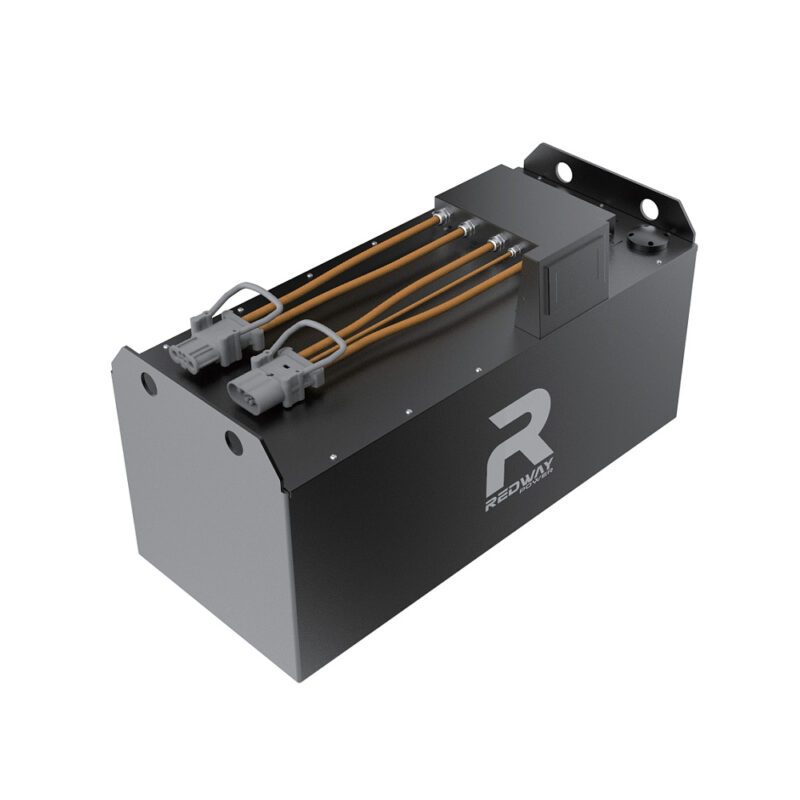
 48V 400Ah (51.2V 420Ah) Lithium Forklift Battery
 48V 550Ah (51.2V 560Ah) Lithium Forklift Battery
 80V 400Ah (83.2V 420Ah) Forklift Lithium Battery
Related articles & discussions
- What Does Forklift Free Lift Mean?
- How to Choose and Maintain Lift Truck Batteries for Optimal Performance?
- Do You Need a Special Controller for Lithium Batteries?
- What Are the Best Forklift Batteries for Heavy-Duty Use?
- How Does a Sit Down Forklift Counterbalanced Lift Truck Work?
- What Does an MPPT Controller Do? Understanding Maximum Power Point Tracking Technology
- How Do I Choose a Battery Charge Controller?
- Which MPPT Controller Do I Need?
- Can I Use MPPT Controller with Lithium Battery?
- What Are the Disadvantages of MPPT Controllers?
