




REDWAY BATTERY / KNOWLEDGE
How does proper forklift battery charging maximize efficiency?
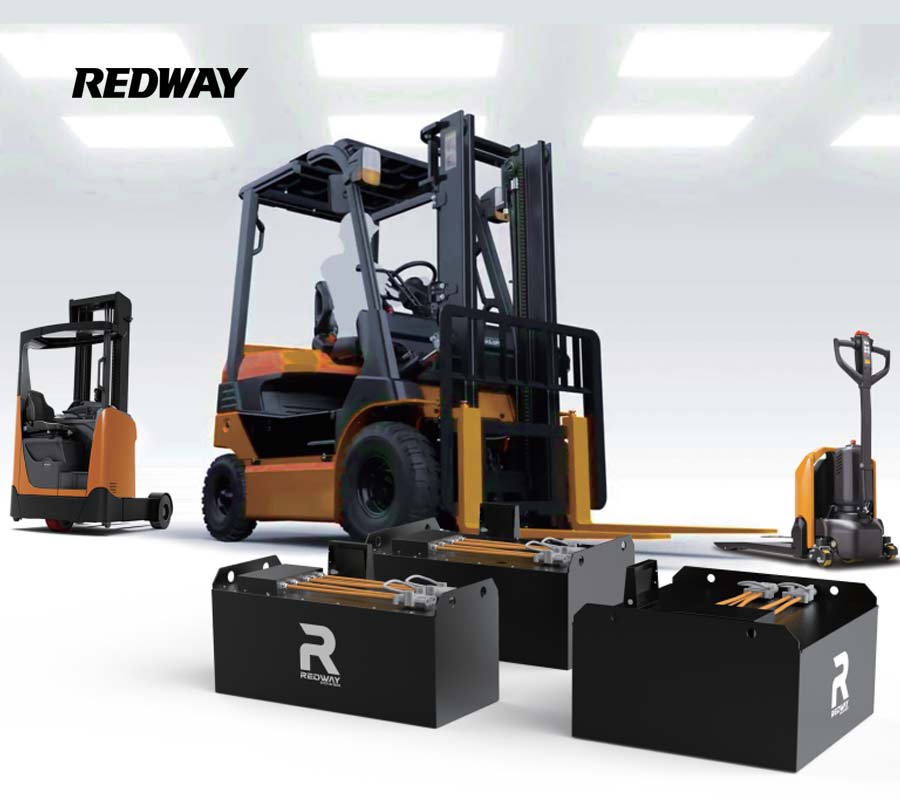
Proper forklift battery charging ensures longer battery life, consistent forklift performance, and lower operational costs. By using matched chargers, optimized schedules, and modern lithium solutions, warehouses and OEM fleets can reduce downtime, avoid overheating, and increase productivity. Redway Battery’s advanced LiFePO4 technology supports safe, fast, and reliable energy delivery for industrial operations.
What is forklift battery charging and why does it matter?
Forklift battery charging restores energy to traction batteries so electric forklifts can operate efficiently throughout each shift. Proper charging prevents capacity loss, overheating, and safety hazards. For manufacturers, wholesalers, and fleet operators, optimized charging reduces labor, maintenance, and total cost of ownership, while enhancing reliability in multi-shift and high-demand environments.
How do different forklift battery types affect charging?
Battery chemistry determines voltage, current, speed, and maintenance needs. Lead-acid batteries require slower multi-stage charging with regular maintenance, while lithium LiFePO4 batteries from Redway Battery allow fast, partial, and opportunity charging with minimal upkeep. Selecting the right battery type and compatible charger is essential for efficient industrial operations.
Battery chemistries used in forklifts
Lead-acid (flooded): Low upfront cost, slow charging, maintenance-intensive.
AGM/GEL: Sealed, low maintenance, limited deep-cycle performance.
Lithium LiFePO4: Fast charging, long cycle life, minimal maintenance, ideal for OEM integration.
Why LiFePO4 changes charging strategies
Supports fast and partial charging without damage.
Integrated BMS protects against overcharge, over-discharge, and temperature extremes.
Optimized for multi-shift operations without costly battery swap rooms.
Which key forklift battery charging methods are used in warehouses?
Common charging methods include conventional, opportunity, and fast charging. Conventional restores energy after full discharge, opportunity charging tops up batteries during short breaks, and fast charging uses high-current systems to quickly replenish energy. The choice depends on fleet size, shift schedules, and power infrastructure.
| Charging method | Typical use case | Best for chemistry |
|---|---|---|
| Conventional | Single shift, low-demand fleets | Lead-acid, LiFePO4 |
| Opportunity | Multi-shift with short breaks | LiFePO4, some AGM |
| Fast charging | High-intensity, 24/7 operations | LiFePO4 with robust BMS |
Redway Battery optimizes charger-battery pairing to help warehouses and OEMs scale fleets efficiently.
How should lead-acid forklift batteries be charged correctly?
Lead-acid batteries should be charged at around 20–30% remaining capacity, using a matched charger for a full 8-hour cycle followed by cooling. Proper electrolyte maintenance and well-ventilated charging areas prevent sulfation, gassing, and plate damage.
Best practices for lead-acid charging
Charge at 70–80% depth of discharge.
Ensure charger voltage and AH match battery rating.
Allow charging and cooling cycles.
Avoid frequent partial charges.
Maintain proper ventilation and safety precautions.
How are lithium LiFePO4 forklift batteries safely charged?
LiFePO4 batteries use smart chargers and integrated BMS to manage voltage, current, and temperature. They support partial and opportunity charging without degradation. Redway Battery’s LiFePO4 packs reduce downtime, improve energy efficiency, and eliminate the maintenance requirements of lead-acid batteries.
LiFePO4 charging advantages
1–2 hour charging windows possible.
No watering or equalizing required.
High cycle life even with frequent partial charges.
Stable power output across the discharge cycle.
What forklift battery charging mistakes should be avoided?
Mistakes include overcharging, undercharging, mismatched chargers, frequent shallow charging of lead-acid batteries, and unsafe charging environments. These reduce performance, increase heat, and shorten battery lifespan. Proper charging practices are key for fleet efficiency.
Common errors and impact
Incorrect charger voltage or AH rating.
Early termination or repeated boosts on lead-acid batteries.
Ignoring temperature, damage, or corrosion.
Charging near flammable materials without safety measures.
Why is China a key hub for forklift battery charging solutions?
China leads in battery production, charging systems, and OEM integration due to scale, mature supply chains, and advanced manufacturing technology. Shenzhen-based factories like Redway Battery offer high-quality LiFePO4 packs, smart chargers, and turnkey solutions, making China a preferred source for global fleet operators and wholesalers.
Advantages of China-based manufacturers
Large-scale production reduces costs and lead times.
Access to cell suppliers, BMS engineers, and power electronics expertise.
Flexible OEM/ODM customization.
Export-ready solutions for global markets.
Who should design your forklift battery charging strategy?
Fleet managers, equipment OEMs, and industrial engineers should collaborate with experienced battery manufacturers. Redway Battery can model energy demand, charger placement, shift patterns, and safety requirements to deliver scalable, cost-effective charging solutions.
Stakeholders in an optimized charging plan
OEM forklift manufacturers and dealers.
Battery manufacturers and BMS engineers.
Facility and energy managers.
Safety and EHS professionals.
How can manufacturers, wholesalers, and OEMs optimize forklift charging operations?
Optimization involves standardizing battery platforms, selecting appropriate chemistries, and using centralized or on-vehicle chargers. Telematics and BMS data help monitor charge states, prevent misuse, and reduce downtime. Partnering with Redway Battery enables co-development of energy systems tailored to operational needs.
Optimization strategies
Standardize voltage and capacity across fleets.
Use fast or opportunity charging with LiFePO4.
Monitor state of charge, cycle count, and temperature via software.
Design safe, well-marked charging zones.
Does switching from lead-acid to LiFePO4 change your charging infrastructure?
Switching can reduce the need for battery swap rooms, lower charger counts, and allow distributed charging near work areas. Infrastructure updates may include wiring, breakers, and safety training, but overall energy and maintenance costs usually decrease.
Infrastructure changes
Move from centralized battery rooms to decentralized charging.
Upgrade power systems if needed.
Train staff on lithium-specific safety and BMS indicators.
Reduce reliance on spare lead-acid batteries and hoists.
Are there best practices for forklift battery charging safety?
Best practices include using PPE, proper ventilation, inspecting cables, and following lockout/tagout procedures. Lead-acid batteries need caution for acid and hydrogen, while LiFePO4 systems require adherence to manufacturer guidelines and proper grounding.
Core safety guidelines
Wear gloves and goggles during maintenance.
Keep fire extinguishers and spill kits nearby.
Prohibit open flames near charging areas.
Train staff on emergencies and BMS alerts.
When should forklift batteries be charged during multi-shift operations?
Lead-acid batteries should be fully charged once per day after a shift, while LiFePO4 batteries can be opportunity charged during breaks. Smart scheduling maximizes uptime and prevents unplanned outages.
Scheduling multi-shift charging
Lead-acid: One full charge per day plus cooling.
LiFePO4: Short top-ups during breaks or loading lulls.
Use telematics to identify optimal charging windows.
Where do OEM, wholesale, and factory partnerships add value in forklift charging?
Partnerships ensure battery packs, forklifts, and charging systems are designed together, simplifying installation and maintenance. Redway Battery works with global distributors and OEMs to integrate LiFePO4 packs with chargers and fleet management platforms.
Partnership advantages
Pre-certified kits for specific forklift models.
Coordinated technical support and warranty.
Faster deployment and scalable solutions.
Can data and smart BMS improve forklift battery charging performance?
BMS and telematics data allow monitoring of charge state, temperature, and usage patterns. Early detection of issues and optimized charge scheduling extend battery life and reduce operational costs.
Data-driven optimization examples
Detect underused chargers or trucks and redistribute workload.
Identify over-discharge or temperature anomalies.
Schedule predictive maintenance before failures.
Benchmark performance across facilities.
How does forklift battery charging impact total cost of ownership (TCO)?
Charging efficiency influences energy use, maintenance labor, replacement cycles, and downtime. Efficient LiFePO4 systems from Redway Battery reduce energy costs, extend battery life, and minimize disruptions, delivering measurable savings over the system lifetime.
TCO factors influenced by charging
Battery lifespan and cycle count.
Energy consumption and peak demand charges.
Labor for maintenance and battery swaps.
Downtime from undercharged or failing batteries.
What forklift charging configuration should different operations choose?
Configuration depends on shift patterns, load intensity, and facility layout. Single-shift operations often use overnight conventional charging, while multi-shift, heavy-duty environments benefit from LiFePO4 fast or opportunity charging.
| Operation type | Recommended chemistry | Charging approach |
|---|---|---|
| Single-shift warehouse | Lead-acid or LiFePO4 | Overnight conventional charging |
| 2–3 shift DC | LiFePO4 | Opportunity + fast charging |
| Manufacturing plant | Mixed | Central + point-of-use chargers |
For the surrounding sizing, selection, installation and maintenance decisions, continue with the Forklift Battery Charging: Methods, Timing and the Charging Area.
Redway Expert Views
“For modern forklift fleets, charging strategy is as strategic as forklift selection. By combining LiFePO4 technology, smart BMS, and tailored charger layouts, Redway Battery helps OEMs, wholesalers, and industrial end users minimize downtime, stabilize energy costs, and create scalable power platforms that can adapt as operations grow and shift.”
Conclusion: How can businesses master forklift battery charging?
Businesses can master forklift battery charging by aligning battery chemistry, chargers, and operational schedules. Assess duty cycles, select the appropriate battery type, and collaborate with experienced manufacturers like Redway Battery. Safe, efficient charging layouts reduce TCO, maximize uptime, and provide a foundation for future automation and energy management.
FAQs
What is the ideal state of charge to start charging a lead-acid forklift battery?
The optimal range is around 20–30% remaining capacity to avoid deep discharge damage and ensure full-cycle charging.
Can LiFePO4 forklift batteries be opportunity charged without damage?
Yes. With smart chargers and BMS management, LiFePO4 batteries can be safely topped up during breaks without impacting battery life.
How often should forklift batteries be inspected?
Visual inspections should be done weekly, checking for corrosion, loose connections, and cable wear. In high-use environments, daily pre-shift checks are recommended.
Do lithium forklift batteries require a dedicated charging room?
No. Lithium batteries do not emit hydrogen or acid fumes, but they still require well-ventilated, marked charging zones in compliance with safety codes.
Why choose a China OEM factory for forklift battery and charging solutions?
China OEM factories like Redway Battery offer large-scale manufacturing, cost-effective LiFePO4 technology, customization, and global support, providing reliable energy solutions for manufacturers, wholesalers, and fleet operators.
