




REDWAY BATTERY / KNOWLEDGE
How do you read a LiFePO4 datasheet: nominal, charge and cut-off voltage?
Redway Battery Editorial Team
Talk / Battery Q&A
A buyer reading three LiFePO4 spec sheets sees 12.8V, 51.2V and 38.4V where they expected 12V, 48V and 36V, plus charge and cut-off values, and wants to know which numbers matter for the charger and the vehicle.
Direct answer: Nominal voltage is the average working voltage used to name the battery and calculate energy (nominal voltage × Ah). Maximum charge voltage is the ceiling a charger must not exceed. Discharge cut-off is the lowest voltage before the battery protects itself. Together they set the window that your charger, inverter or motor controller must fit. Compare batteries on these values, not on the label name.
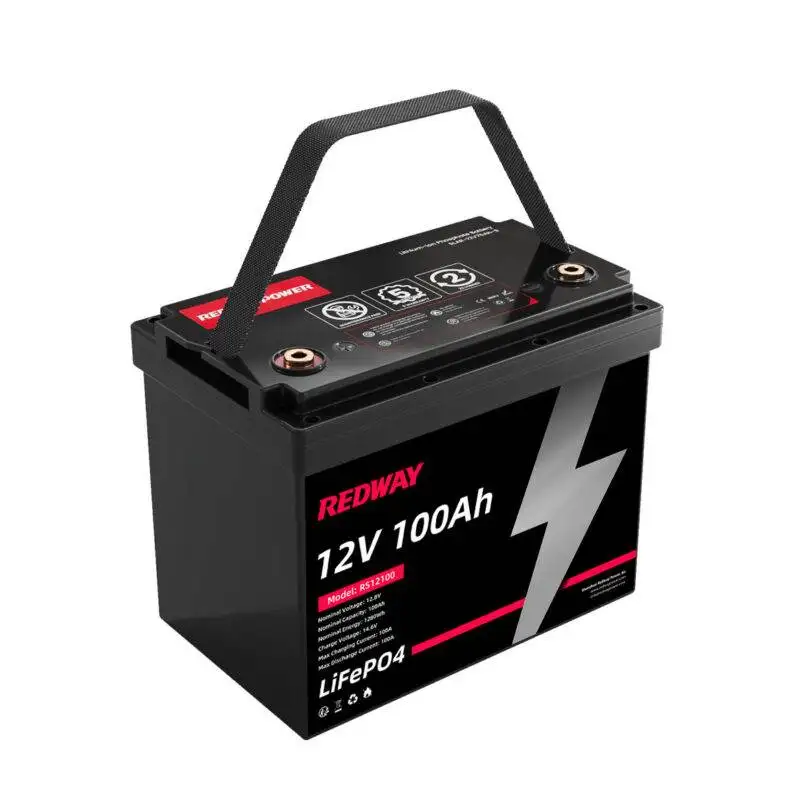
Worked examples. The 12V 100Ah page lists 12.8V nominal, 14.6V maximum charge and 10V cut-off. The 48V 100Ah golf cart battery lists 51.2V, 58.4V and 40V. The 36V 100Ah lists 38.4V, 43.8V and 30V. Our arithmetic: LiFePO4 cells are commonly rated at 3.2V nominal, so these correspond to 4, 16 and 12 cells in series, with 3.65V per cell at full charge and 2.5V per cell at cut-off.
Why “48V” can mean two things. The same site also lists a 48V 150Ah golf cart pack at 48V nominal, 54.75V maximum charge and 37.5V cut-off, and the PM-LV48100-3U rack battery at 48V, 54.75V and 37.5V. Those figures fit 15 cells rather than 16 (our arithmetic). A 15-cell and a 16-cell pack need different charger settings, so read the table, not the name. Our post on 48V vs 51.2V rack batteries applies the same check to inverters.
Energy. Nominal energy = nominal voltage × capacity: 51.2V × 100Ah = 5,120Wh, which matches the 5.12 kWh on the 48V page. Use this, not Ah alone, when comparing packs of different voltage.
Currents. “Standard charge current” is the routine rate (22A on the 48V and 36V 100Ah golf pages, with about 5 hours to full stated). “Maximum continuous charge current” is the upper limit (100A on both). Discharge currents are read the same way, with any peak value tied to the duration shown in brackets.
Temperatures and conditions. Charge temperature (0–60 °C on these pages) is narrower than discharge temperature (−20–65 °C). Cycle-life numbers carry conditions in brackets, such as 80% DOD; compare only like with like.
What to do with it: set the charger’s maximum at or below the charge voltage, set any device low-voltage cut-off above the battery cut-off, and confirm that your controller’s operating window covers the whole range.
↳ Replying to Redway Battery Editorial Team
Ask suppliers to quote nominal voltage, cell count, charge voltage and cut-off on every quote. Two “48V” offers can be 15-cell and 16-cell packs that are not interchangeable.
↳ Replying to Procurement perspective
Check that the device window fits the battery window: charger maximum below the charge voltage, controller or inverter cut-off above the battery cut-off, and controller rated for the full-charge voltage.
↳ Replying to Selection/Engineering perspective
Use the datasheet values to set chargers and check them with a meter at the battery terminals. Record the settings and the cell count on the asset tag.
Nominal voltage is the average working voltage used to name the battery and calculate energy (nominal voltage × Ah). Maximum charge voltage is the ceiling a charger must not exceed. Discharge cut-off is the lowest voltage before the battery protects itself. Together they set the window that your charger, inverter or motor controller must fit. Compare batteries on these values, not on the label name.
Verify before ordering: Cell counts are inferred from published voltages (our arithmetic); confirm the configuration of your exact model with Redway.
Editorial Q&A for battery selection and operations. Product figures cited from Redway product pages.
Related products
 12V 100Ah Lithium Battery (LiFePO4, Self-heating, OEM)
 48V 100Ah LiFePO4 Golf Cart Battery
 36V 100Ah LiFePO4 Golf Cart Battery
Related articles & discussions
- What is the Best Voltage for LiFePO4?
- What Are The Specs Of E45-70XN Datasheet?
- What voltage should a 12 volt battery read when fully charged?
- What Are The Specs Of E30-40HSD2 Datasheet?
- At What Voltage Should I Charge My 48V Lithium Battery?
- What voltage is a 48V LiFePO4 full charge?
- What voltage is 100Ah lithium battery?
- What Is 72V Battery Full Charge Voltage?
- What Is 72V Lithium Battery Full Charge Voltage?
- What is the charge voltage of a 16650 battery?
