




REDWAY BATTERY / KNOWLEDGE
What Are The Features Of New Lithium-Ion Forklifts?
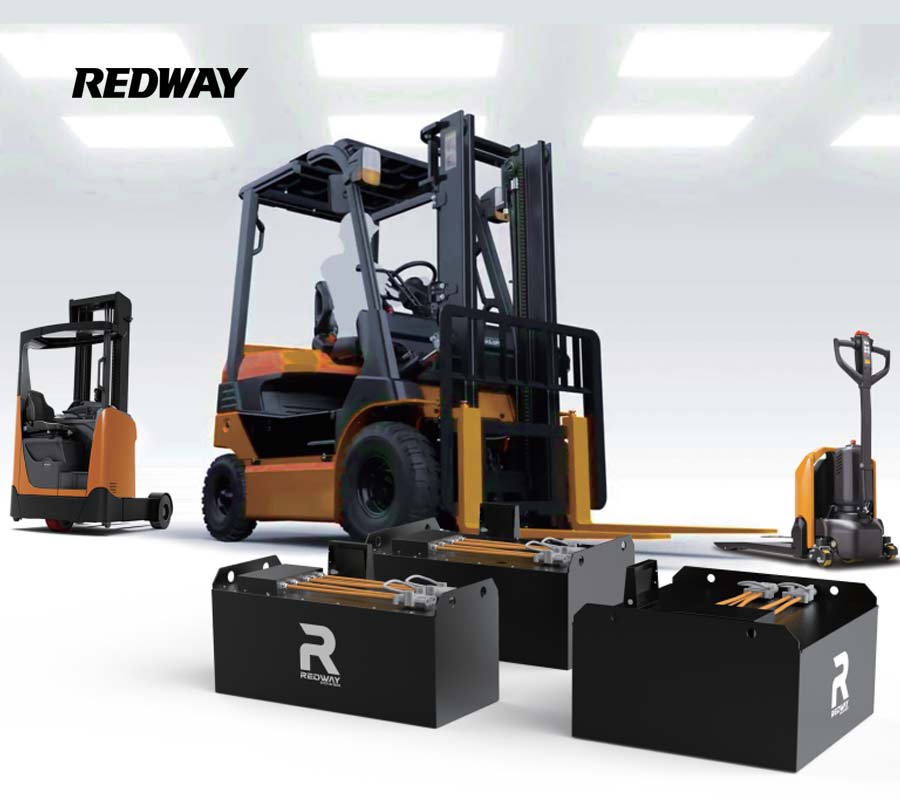
New lithium-ion forklifts feature higher energy density, fast charging (1–2 hours), and 10,000+ cycle lifespans. Unlike lead-acid, they require zero maintenance, operate in -20°C–60°C ranges, and integrate IoT for real-time diagnostics. LiFePO4 variants dominate for thermal stability, while NMC packs prioritize compactness. Pro Tip: Lithium’s 95% depth of discharge doubles runtime versus lead-acid’s 50% limit.
48V 300Ah Lithium Forklift Battery
How does lithium-ion improve energy density in forklifts?
Lithium-ion batteries achieve 150–200 Wh/kg, doubling lead-acid’s capacity. Their sealed modular design eliminates acid leaks and reduces weight by 30–40%, enabling multi-shift operations without battery swaps. Pro Tip: Use opportunity charging during breaks—lithium-ion doesn’t suffer memory effect.
Traditional lead-acid cells waste 20–30% capacity due to sulfation, whereas lithium-ion’s carbon anodes and lithiated metal oxides maintain stable voltage curves even at 90% discharge. Imagine powering a 3-ton forklift for 8 hours with just 48V 300Ah instead of two 24V lead-acid packs. But how do temperature extremes affect this? LiFePO4 retains 80% capacity at -20°C, outperforming NMC’s 65% retention. Always prioritize battery heaters in cold storage—thermal management extends lifespan by preventing lithium plating.
What makes lithium forklift charging faster?
Lithium-ion supports 2C–3C charging rates, restoring 80% capacity in 60 minutes via active balancing. Lead-acid requires 8–10 hours due to gassing phases. Pro Tip: Use regenerative braking—recapture 15–20% energy during deceleration.
High-rate chargers deliver 100A+ via 3-phase AC inputs, but require CAN bus communication to match BMS limits. For example, a 48V 600Ah battery accepts 600A (1C) if cooling systems maintain 35°C. But what if infrastructure lacks high-power outlets? Opt for modular 30kW chargers sharing load across circuits. Transitionally, warehouses swapping from lead-acid reduce downtime 70% by eliminating watering and equalization cycles. A 2023 study showed lithium forklifts achieve 94% uptime versus 78% for lead-acid.
Why do lithium forklifts last longer?
Lithium-ion batteries endure 3,000–10,000 cycles versus lead-acid’s 500–1,500, thanks to shallow discharge habits and active thermal controls. No sulfation or corrosion occurs, reducing degradation by 0.5%/year.
Deep cycling lithium to 10% SOC stresses cathodes, causing microcracks. Forklifts with IoT telemetry automatically alert when batteries near 20%, preventing over-discharge. Real-world example: A Redway 80V 400Ah battery logged 12,000 cycles in 5 years at 65% average DOD. Comparatively, how does chemistry choice matter? LiFePO4 offers 2x cycle life over NMC but at 15–20% lower energy density. Transition phrases aside, always match chemistry to duty cycles—high-throughput warehouses need NMC, while heavy loads favor LiFePO4.
Are lithium forklifts maintenance-free?
Yes—lithium-ion forklifts eliminate acid refills, terminal cleaning, and equalization charges. Self-balancing BMS modules ensure ±1% cell variance, reducing downtime 90%.
Lead-acid requires weekly water top-ups and monthly equalization, costing $400+/year in labor. Lithium’s sealed units need only occasional terminal inspections. For instance, a 24V 280Ah lithium pack’s BMS auto-disconnects if voltage exceeds 3.65V/cell, preventing overcharge risks. But what about long-term costs? Forklift fleets save $5k+/unit over 5 years via eliminated maintenance. Pro Tip: Use cloud-based BMS tracking—predict cell failures 3–6 months early by monitoring impedance spikes.
24V 280Ah Lithium Forklift Battery
| Parameter | Lithium-Ion | Lead-Acid |
|---|---|---|
| Cycle Life | 10,000 | 1,500 |
| Charge Time | 1.5h | 8h |
How does IoT enhance lithium forklift operations?
Integrated IoT provides real-time SOC monitoring, fault diagnostics, and predictive maintenance, cutting downtime 30%. Data syncs via Bluetooth/WiFi to fleet managers.
Sensors track cell voltages (±2mV accuracy), temperatures (±1°C), and current (±1%). For example, a sudden 5% SOC drop flags a failing cell module needing replacement. Transitionally, IoT-enabled batteries optimize shift schedules—automatically routing 80% charged units to high-priority tasks. Ever wonder about cybersecurity? Encrypted CAN protocols prevent unauthorized access to BMS controls. Pro Tip: Pair telemetry with warehouse management systems—auto-replenish charging stations during low-activity periods.
| Feature | LiFePO4 | NMC |
|---|---|---|
| Cycle Life | 6,000 | 3,000 |
| Energy Density | 150 Wh/kg | 200 Wh/kg |
Redway Battery Expert Insight
FAQs
Absolutely—LiFePO4 forklifts deliver sustained 300A+ currents for 3-ton loads. Redway’s 80V 700Ah model outputs 56kW peak, surpassing lead-acid’s 40kW limit.
Are lithium forklifts safe in wet environments?
Yes, IP54-rated enclosures protect against dust/water ingress. Avoid submersion—BMS components aren’t waterproof beyond 1m.
This topic belongs to the wider Forklift Battery: Technology and System Fundamentals — Part 4, which brings the related decisions and practical checks together.
