




REDWAY BATTERY / KNOWLEDGE
Why does a 12V lithium battery shut off when you start an inverter?

Redway Battery Editorial Team
Talk / Battery Q&A
An RV owner switches on a 2,000W inverter, or starts a microwave on it, and the 12V lithium battery shuts off instantly. After a while it comes back.
Direct answer: Usually the battery’s BMS is doing its job: the inverter’s start-up or the appliance’s inrush current exceeds the current the BMS allows, so it disconnects to protect the cells. Compare the inverter’s input current, including surge, with the battery’s continuous and peak discharge limits, check cables and connections, and either choose a battery variant with a higher limit, add batteries in parallel, or reduce the load.
Do the arithmetic. On a 12V system, current is power divided by voltage. A 2,000W inverter running at full load draws roughly 2,000 ÷ 12 ≈ 170A, and more once inverter losses are included (our estimate, not a product figure). Many inverters also draw a short charging pulse when switched on, and motors or compressors can start at several times their running power.
Compare with the page limits. The 12V 100Ah page lists maximum continuous discharge of 50A (0.5C) or 100A (1C) depending on version, with no peak figure. The 12V 200Ah and 12V 300Ah pages list versions at 100A, 150A or 200A continuous, with peaks of 110A, 160A or 210A for 10 seconds. A load that needs 170A continuous is above the 100A versions; a start-up spike above the peak value can trip even a larger version.
Check the wiring too. Undersized or long cables, loose lugs and corroded terminals cause voltage drop. Under heavy load the voltage at the inverter falls, the inverter draws more current for the same power and may trip on low voltage before the battery does. Feel for warm connections after a load test and check torque. Our post on cable and fuse sizing for a 12V 200Ah battery and 2,000W inverter works through that case.
Find out which device switched off. If the inverter shows a low-voltage or overload error but the battery stays on, the issue is on the inverter side. If the battery output disappears (no voltage at its terminals) and resets after a delay or a charge, the BMS tripped. A Bluetooth app or display, where fitted, may show the event.
Fixes, in order: confirm the battery variant you actually have (the limit is on the label or quote); reduce the start-up load, for example by not starting the inverter with appliances already on; use correctly sized cables and a fuse rated for the system; add a second identical battery in parallel to share the current (the pages allow up to four in parallel); or move to a 24V system for large inverters. Ask Redway how long the BMS tolerates the peak values and how it resets.
↳ Replying to Redway Battery Editorial Team
When buying for an inverter, quote the inverter’s rated power and surge to the supplier and ask which variant (100A, 150A or 200A) is needed. That avoids returns for a battery that works but trips.
↳ Replying to Procurement perspective
Size for the inverter’s maximum input current, including efficiency losses and surge, and compare with both the continuous and the 10-second peak values on the page. Ask Redway for the BMS response time to short spikes.
↳ Replying to Selection/Engineering perspective
Check terminal torque and cable condition after the first heavy load test, and note whether the trip repeats at the same load. A trip that starts happening at lower loads over time is worth reporting.
Usually the battery’s BMS is doing its job: the inverter’s start-up or the appliance’s inrush current exceeds the current the BMS allows, so it disconnects to protect the cells. Compare the inverter’s input current, including surge, with the battery’s continuous and peak discharge limits, check cables and connections, and either choose a battery variant with a higher limit, add batteries in parallel, or reduce the load.
Verify before ordering: BMS trip thresholds, peak duration tolerance and reset behaviour are not fully published; the 12V 100Ah page gives no peak figure. Confirm with Redway for your variant.
Editorial Q&A for battery selection and operations. Product figures cited from Redway product pages.
Related products
 12V 200Ah Lithium Battery
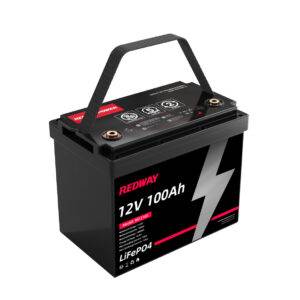 12V 100Ah Lithium Battery (LiFePO4, Self-heating, OEM)
 12V 300Ah Lithium Battery
Related articles & discussions
- What Is the Lifespan of a 12V Lithium Battery?
- How Do You Charge a 12V Lithium Ion Battery?
- What Temperature Should a 12V Lithium Battery Be?
- How Does an Inverter Communicate with a Battery?
- Can I Connect Two 12V Batteries in Parallel for a 12V Inverter?
- How Long to Charge 12V LiFePO4 Batteries?
- Can I Use LiFePO4 Battery for Inverter?
- How long will a 100Ah battery run a 1000W inverter?
- How Do You Test a LiFePO4 12V Battery?
- How do you store 12V lithium batteries?
