




REDWAY BATTERY / KNOWLEDGE
How should you mount and ventilate a lithium battery in an RV or boat compartment?

Redway Battery Editorial Team
Talk / Battery Q&A
A boat owner is replacing two flooded batteries in a locker near the engine with a 12V lithium battery and asks how it should be fixed and whether the locker still needs vents.
Direct answer: Secure the battery so it cannot move in any direction, cover the terminals, fuse the positive close to the battery, keep it inside its temperature limits and away from heat sources, keep it out of standing water, and give the compartment enough airflow to carry away heat. LiFePO4 batteries do not gas in normal use the way flooded batteries do, but a failing battery can release gases, so do not seal it into a living space. On boats, follow ABYC E-13 or your local rules.
Page values. The 12V 200Ah lists 501 × 185 × 242 mm and 18 kg; the 12V 150Ah lists 330 × 172 × 215 mm (BCI Group 31) and 14 kg; the 12V 150Ah EU thin size lists 552 × 110 × 288 mm and 12.8 kg. All list IP65, an ABS case, charge at 0–60 °C and discharge at −20–65 °C. Permitted mounting orientations are not published; ask Redway before mounting on a side or end.
Restraint. A battery in a vehicle or boat sees vibration, braking forces and, at sea, motion in every direction. Use a tray or bracket with straps that hold it down and stop it sliding or tipping; the case is plastic, so spread the load and avoid sharp edges. Check that straps cannot touch the terminals.
Terminals and protection. Fit terminal covers and route cables so they cannot chafe. Fit a main fuse or breaker in the positive cable close to the battery, and a disconnect switch where the vehicle or boat design calls for one. For cable and fuse sizing, see cable and fuse sizing for a 12V 200Ah.
Heat and airflow. Engine rooms and lockers near exhausts or heaters can exceed the 60 °C charge limit. Choose a location that stays inside the limits in summer and above 0 °C when charging in winter, or use a self-heating version if your model offers it. Leave space around the case for air, and keep an existing vent path open.
Water. IP65 means dust-tight and protected against water jets in the IEC test, not against immersion. Keep the battery above bilge water and away from spray.
Boats. ABYC E-13 is the US recreational-boat standard for lithium-ion battery installations, and surveyors and insurers often check against it. Obtain the current edition and follow its rules on location, securing, overcurrent protection and BMS integration, or your country’s equivalent. Our post on charging from an alternator covers the charging side of the same installation.
↳ Replying to Redway Battery Editorial Team
Include brackets, straps, terminal covers, fuse and disconnect in the quote. On boats, ask the insurer or surveyor which standard they check against before installation.
↳ Replying to Procurement perspective
Choose the location by temperature and water exposure first, then by space. Check the permitted orientation and the restraint method against the battery’s weight and case material.
↳ Replying to Selection/Engineering perspective
Inspect straps, terminal torque and cables for chafe every few months and after rough trips or passages. Look for heat marks and keep the vent path clear.
Secure the battery so it cannot move in any direction, cover the terminals, fuse the positive close to the battery, keep it inside its temperature limits and away from heat sources, keep it out of standing water, and give the compartment enough airflow to carry away heat. LiFePO4 batteries do not gas in normal use the way flooded batteries do, but a failing battery can release gases, so do not seal it into a living space. On boats, follow ABYC E-13 or your local rules.
Verify before ordering: Mounting orientation, bracket options and ABYC E-13 conformity are not stated on the pages; confirm with Redway and a qualified installer.
Editorial Q&A for battery selection and operations. Product figures cited from Redway product pages.
Related products
 12V 200Ah Lithium Battery
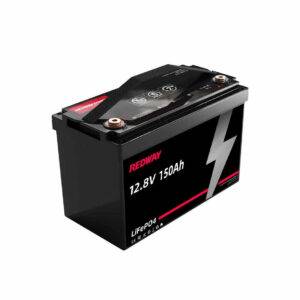 12V 150Ah Lithium Battery
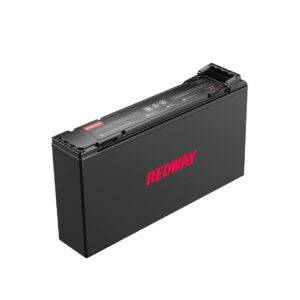 12V 150Ah EU Lithium Battery (Thin Size)
Related articles & discussions
- Can you use lithium-ion batteries in an RV?
- Are Lithium Batteries Suitable for Boats?
- Which Battery Is the Starting Battery on a Boat?
- Can I Mount My Lithium Battery on Its Side?
- How Many Lithium Batteries Do I Need for My Boat?
- Can You Use a Deep Cycle Battery for a Boat Motor?
- Can I Start a Boat with a Lithium Battery?
- Can You Use Lithium Boat Batteries in Cold Weather?
- What Are The Best Solar Ground Mount Options?
- How To Mount Panels On A Truck Roof Rack?
