




REDWAY BATTERY / KNOWLEDGE
Why must lithium batteries ship by air at reduced state of charge?
Redway Battery Editorial Team
Talk / Battery Q&A
A buyer in Europe wants sample 12V 100Ah, 12V 24Ah and golf-cart packs such as the 48V 100Ah (S51105) flown for a trade show and asks why the supplier insists on a low state of charge.
Direct answer: Air transport rules for lithium-ion cells and batteries (UN3480 and related entries) require packs to be offered at a reduced state of charge, commonly not exceeding 30% SOC for many Section IA/IB type shipments under the IATA Dangerous Goods Regulations packing instructions. The limit lowers the energy available in a thermal event and is a regulatory condition of carriage, not a quality defect. Agree the ship SOC on the paperwork, expect packs to arrive part-charged, and charge them with the correct lithium profile before storage or show use. Always check the current IATA DGR edition and your forwarder’s acceptance policy.
Why regulators care. Higher SOC means more stored energy and a more severe outcome if a cell fails in the cargo hold. Reduced SOC is one of several controls alongside UN38.3 testing, packaging, labelling and carrier limits; see sea and air shipping buyer guide.
What ‘about 30%’ means in practice. Suppliers typically discharge or ship after a controlled charge to the SOC window their dangerous-goods process allows. Do not ask them to top packs to 100% for air freight. Sea freight follows IMDG rules and may allow different SOC practice; mode choice should be explicit on the order.
Documents to align. The shipper’s declaration, packing instruction reference, net weight and UN number should match what you ordered. Ask the supplier to state the target SOC on the packing list so receiving staff do not treat a mid-SOC reading as damage.
On arrival. Measure voltage or read the display, photograph labels, then charge with a correct LiFePO4 charger before long storage or demonstration. Mid-SOC is normal after air freight; deep discharge or alarm codes are not.
Samples and small packs. Smaller modules such as a 12V 24Ah travel more often by air as samples; large forklift packs more often move by sea because of weight and acceptance limits. Plan show stock early.
Buyer checklist. Confirm mode (air or sea), UN3480 vs UN3481 (packed with or in equipment), SOC policy, and who files DG paperwork. Related document discipline appears in UN38.3 documents to request.
Do not bypass the limit. Instructing a freight forwarder to ‘just send them full’ risks rejection, fines or unsafe carriage.
After the show. Store at the supplier’s recommended storage SOC, not necessarily at the air-ship level or at 100%.
↳ Replying to Redway Battery Editorial Team
Put air-versus-sea mode and target ship SOC into the purchase order and packing-list requirements.
↳ Replying to Procurement perspective
Design acceptance tests around mid-SOC arrival; fail a shipment for damage or alarms, not for complying with the SOC limit.
↳ Replying to Selection/Engineering perspective
Charge and functionally test samples on arrival before storage or customer demos.
Air transport rules for lithium-ion cells and batteries (UN3480 and related entries) require packs to be offered at a reduced state of charge, commonly not exceeding 30% SOC for many Section IA/IB type shipments under the IATA Dangerous Goods Regulations packing instructions. The limit lowers the energy available in a thermal event and is a regulatory condition of carriage, not a quality defect. Agree the ship SOC on the paperwork, expect packs to arrive part-charged, and charge them with the correct lithium profile before storage or show use. Always check the current IATA DGR edition and your forwarder’s acceptance policy.
Verify before ordering: Packing instruction limits and SOC caps depend on the current IATA DGR edition, battery type and section; confirm with the shipper and forwarder for each consignment.
Sources checked: IATA Lithium Batteries.
Editorial Q&A for battery selection and operations. Product figures cited from Redway product pages.
Related products
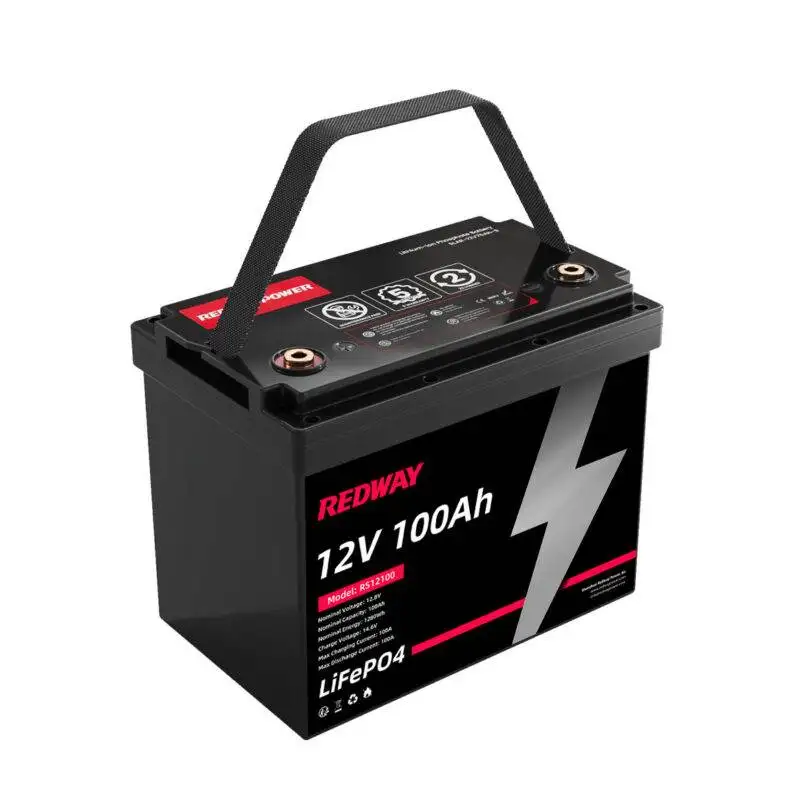
 12V 100Ah Lithium Battery (LiFePO4, Self-heating, OEM)
 12V 24Ah Lithium Battery
 48V 100Ah LiFePO4 Golf Cart Battery
Related articles & discussions
- How Do You Charge a 48V LiFePO4 Battery?
- What Is Battery Equalization Charge?
- Why You Should Consider Partial Charges for Your LiFePO4 Battery
- How to Safely Charge Lithium Iron Phosphate (LiFePO4) Batteries
- How do you charge a 48 volt lithium-ion battery?
- How Many Charge Cycles Do Batteries Last?
- How Long Does It Need to Charge a 48V 100Ah Lithium Battery?
- How to Properly Charge Lithium Iron Phosphate (LiFePO4) Batteries
- Can I Charge LiFePO4 Batteries with Solar?
- How Do You Equalize Charge Forklift Battery?
