




REDWAY BATTERY / KNOWLEDGE
Which lithium battery suits a 6-seat shuttle golf cart?

Redway Battery Editorial Team
Talk / Battery Q&A
A resort runs six-seat shuttle carts between villas and the main building all day and wants to replace tired lead-acid sets without running out of charge before evening.
Direct answer: Start from the cart, not the battery catalogue. Keep the system voltage the controller and motor are built for, size energy (kWh) to the measured daily route with passengers plus a reserve, and check that the battery’s continuous and peak current cover the controller limit on hills. Then confirm the tray dimensions, weight and charger. For many six-seat carts that means a higher-capacity 48V or 72V pack; the right one comes from your measured route.
Voltage first. A 48V cart needs a 48V (51.2V nominal) pack such as the 48V 200Ah long-size pack (10.24 kWh); a 72V cart needs a 72V pack such as the 72V 160Ah (12.288 kWh) or 72V 200Ah (15.36 kWh). Changing voltage means changing controller and possibly motor; see 60V vs 72V for utility vehicles.
Energy from the route. Log a full day with a typical passenger load: distance, number of trips, grades and idle time. Convert to kWh by metering a charge or using the BMS app, then add a reserve so the pack is not finishing the day near empty. The method is in estimating energy use; for loaded duty see sizing for heavy loads.
Current. Six passengers on a ramp is the highest current moment. The 72V 160Ah lists 160A continuous and 315A peak (30 s); the 72V 200Ah lists 200A continuous and 315A peak; the 48V 200Ah long size lists 200A continuous. Compare with the controller’s current limit, not only motor power.
Fit and weight. Listed sizes are 960 × 446 × 217 mm (88 kg) for the 72V 160Ah, 1138 × 410 × 253 mm (125 kg) for the 72V 200Ah and 940 × 340 × 250 mm (90 kg) for the 48V 200Ah long size. Measure the tray first; see measuring the tray.
Charging pattern. Shuttles often charge at lunch and overnight. Confirm the charger voltage and current suit the pack and the barn circuit.
Comparing sizes. For a side-by-side view of 72V options, read 72V 100/160/200Ah for utility carts.
Duty cycle detail. Shuttle routes include many short stops with doors, lights and sometimes audio or fans running. Count those accessory loads and the idle time between trips, because they add to daily energy use even when the cart is not moving. A daily meter log for one week gives a far better basis than a single test lap.
↳ Replying to Redway Battery Editorial Team
Buy on measured route energy plus reserve; range figures on product pages depend on load and terrain.
↳ Replying to Procurement perspective
Match controller current limits and peak demand on the steepest loaded ramp before choosing Ah.
↳ Replying to Selection/Engineering perspective
Plan weight distribution and a check of tray mounts when a heavier long pack replaces several lead batteries.
Start from the cart, not the battery catalogue. Keep the system voltage the controller and motor are built for, size energy (kWh) to the measured daily route with passengers plus a reserve, and check that the battery’s continuous and peak current cover the controller limit on hills. Then confirm the tray dimensions, weight and charger. For many six-seat carts that means a higher-capacity 48V or 72V pack; the right one comes from your measured route.
Verify before ordering: Range per charge on product pages is indicative; six-seat shuttle consumption varies with passengers, grades and speed. Confirm controller compatibility with Redway before ordering.
Editorial Q&A for battery selection and operations. Product figures cited from Redway product pages.
Related products
 72V 160Ah LiFePO4 Golf Cart Battery (S72160P)
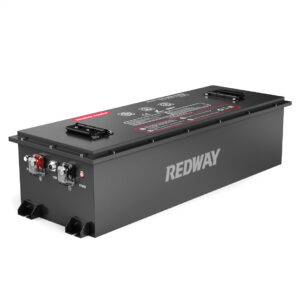 48V 200Ah LiFePO4 Golf Cart Battery (S51200B, Long Size)
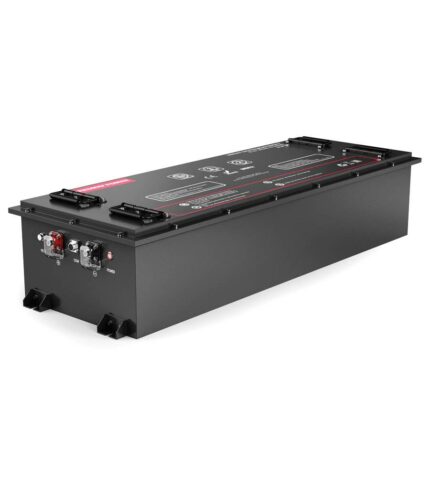 72V 200Ah LiFePO4 Golf Cart Battery (S72210P)
Related articles & discussions
- How Reliable Are 48V Golf Cart Batteries?
- How to Choose the Best 72V Lithium Golf Cart Battery?
- Understanding Battery Capacity: How Many kWh is 100Ah in a 48V System?
- Why Choose 48V LiFePO4 for Golf Carts?
- Why do some golf carts have 4 batteries and some have 6?
- What Are 48V Lithium Golf Cart Batteries?
- What Battery Should I Use for a 72V Golf Cart?
- What Makes 48V Lithium-Ion Golf Cart Batteries Superior?
- What Are 48V Golf Cart Batteries and Their Benefits
- How Many Lithium Batteries Do I Need for a 48V Golf Cart?
