




REDWAY BATTERY / KNOWLEDGE
Can you parallel PM-LV rack batteries of different ages or capacities?
Redway Battery Editorial Team
Talk / Battery Q&A
A data closet has PM-LV48100-3U modules and wants to add PM-LV51200-5U packs on the same DC bus to grow runtime.
Direct answer: Not as a casual mix. Keep parallel groups matched in voltage class, capacity, and preferably age/firmware. The PM-LV51200-5U offers 51.2V 200Ah (~10.24 kWh) with long cycle-life messaging; pair like with like, or expand as separate groups per Redway parallel guidance.
Operators expanding a rack ESS sometimes want to parallel a new PM-LV51200-5U 51.2V 200Ah module with older PM-LV48100-3U 48V 100Ah modules. Mixed-age and mixed-capacity paralleling is a common request—and a common source of imbalance if done casually.
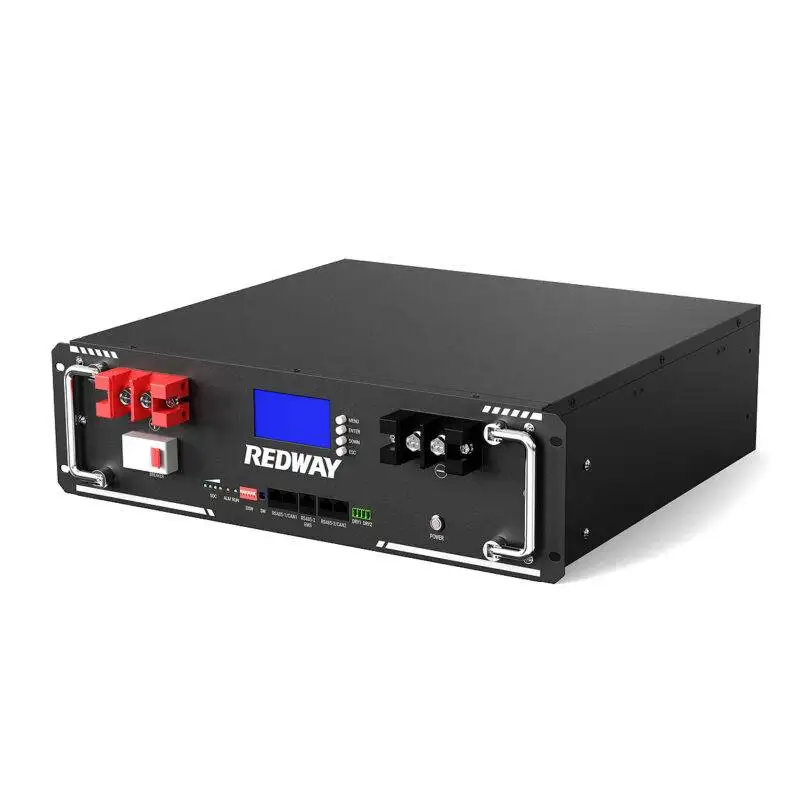
What the product pages support: the PM-LV51200-5U is a 51.2V 200Ah LiFePO4 rack battery with about 10.24 kWh class energy messaging, operation called out from about −20°C to 60°C, and longevity messaging over 8000 cycles at 80% DoD at 0.5C on that page. The PM-LV48100-3U is positioned as a 48V 100Ah server rack battery for uptime-focused storage. Both are modular rack form factors intended for scalable energy storage, but “modular” does not automatically mean any ages and capacities can share one DC bus without following the manufacturer’s parallel rules.
Best practice for paralleling: keep identical nominal voltage classes, prefer identical capacity and firmware generation on a parallel group, and bring modules to a similar state of charge before closing parallel contactors. Mixed capacities (100Ah beside 200Ah) can work in some architectures with proper BMS master/slave or inverter configuration, but current sharing will not split perfectly—wiring resistance and BMS limits matter. Mixed calendar age increases the risk that weaker modules hit voltage limits first, shrinking usable pack capacity.
If you must expand an older string, safer patterns include: adding a new parallel group on a separate inverter MPPT/battery port, or replacing a whole parallel set together. Always follow Redway’s current parallel wiring guide for the PM-LV series (communication cables, addressing, and maximum modules per group). Do not invent series strings across different firmware without documentation.
Direct answer: avoid casually paralleling mixed-age, mixed-capacity PM-LV modules on one bus. Prefer matched modules; if expansion is required, isolate groups or refresh the set so BMS current sharing stays within published design intent.
Commissioning checks should include verifying each module’s reported voltage and temperature before enabling high charge rates, confirming that the inverter’s battery profile matches 51.2V LiFePO4, and documenting module serial numbers by rack position. When a single module in a parallel group repeatedly shows higher internal resistance or earlier current limiting, plan a targeted replacement rather than forcing higher charge voltage to “keep up.” That habit overstresses healthier modules and shortens the string’s useful life even if nameplate cycle life remains high on paper.
↳ Replying to Redway Battery Editorial Team
When expanding capacity, price a matched module set against the labor of troubleshooting an imbalanced mixed string. Spare modules should match the installed generation.
↳ Replying to Procurement perspective
Design parallel counts within the PM-LV communication limits. Set inverter charge/discharge currents assuming imperfect sharing if any mix remains. Prefer separate battery ports over mixed parallel for unlike capacities.
↳ Replying to Selection/Engineering perspective
Quarterly, compare module voltages at rest. Divergence that grows over months is a signal to re-group or replace, not to raise charge voltage.
Not as a casual mix. Keep parallel groups matched in voltage class, capacity, and preferably age/firmware. The PM-LV51200-5U offers 51.2V 200Ah (~10.24 kWh) with long cycle-life messaging; pair like with like, or expand as separate groups per Redway parallel guidance.
Editorial Q&A for battery selection and operations. Product figures cited from Redway product pages.
Related products
 PM-LV48100-3U 48V 100Ah Server Rack Battery
 PM-LV51200-5U 51.2V 200Ah Rack Battery
Related articles & discussions
- Understanding 51.2V 100Ah Server Rack Batteries: A Comprehensive Guide
- What Are 51.2V 100Ah Server Rack Battery Specs?
- How to Extend Server Rack Battery Lifespan?
- Comprehensive Guide to Redway Battery 48V 50Ah Server Rack Batteries
- Why Choose 100Ah LiFePO4 Batteries for Server Racks?
- How Do Discharge Rates Affect 51.2V 100Ah Server Batteries?
- How Do You Maintain Lithium Server Batteries?
- What are the key specifications and advantages of Redway rack mounted lithium battery modules?
- What Are Redway Rack Mounted Module Specs?
- How to Choose a 12 Volt 300Ah Lithium Deep Cycle Battery with Heater for B2B Buyers?
