




REDWAY BATTERY / KNOWLEDGE
How do you set a solar charge controller for a LiFePO4 battery?
Redway Battery Editorial Team
Talk / Battery Q&A
A cabin owner has a 12V LiFePO4 battery, a few solar panels and an MPPT controller with a long settings menu, and wants to know which values to change from the default.
Direct answer: Select a lithium or user-defined battery type; keep the charge (boost/absorption) voltage at or below the battery’s published maximum, 14.6V for the Redway 12V models and 29.2V for the 24V 200Ah; turn off equalisation and temperature compensation; set the charge current within both the controller and the battery limits; set the load cut-off above the battery’s discharge cut-off; and stop charging below 0 °C unless the battery has self-heating. Then check the result with a meter.
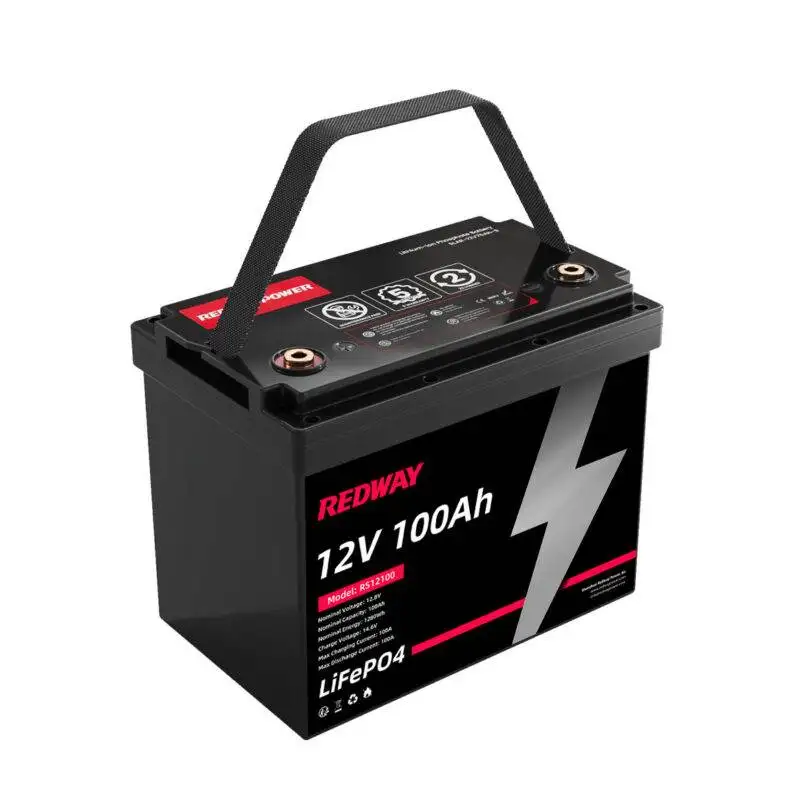
Page values to work from: the 12V 100Ah lists 14.6V maximum charge, 10V discharge cut-off, 0–60 °C charge temperature and maximum continuous charge of 50A or 100A by version. The 12V 200Ah lists 14.6V, 10V and 100A, 150A or 200A by version. The 24V 200Ah lists 29.2V maximum charge and 20V cut-off. These are limits, not targets.
Battery type. Many controllers have a LiFePO4 preset; check what voltages it uses, because presets differ. A user or custom mode lets you set each value. Avoid lead-acid presets such as flooded, sealed or gel.
Charge and float. Set the boost or absorption voltage at or below the maximum above. Some installers choose a little lower to reduce time spent at full charge; ask Redway for its preferred value for your model. A lithium battery does not need a lead-acid style float; if the controller insists on one, set it below the charge voltage, at a value Redway confirms. Disable equalisation, and set temperature compensation to zero, since lead-acid compensation would raise the voltage in cold weather.
Current. A controller can only deliver its rated output current. Check that this is within the battery’s maximum continuous charge current (for example 50A on the lower 12V 100Ah version). If the array can deliver more than the battery or controller allows, the controller limits it; set a charge-current limit where the menu offers one.
Load output and cold. If loads run from the controller’s load terminals, set the low-voltage disconnect above 10V (12V) or 20V (24V) so the controller switches off loads before the BMS does. For winter, use a controller with a battery temperature sensor that stops charging below 0 °C, or check whether your battery version has self-heating (listed as “Yes” on the 12V 100Ah page). Our posts on mains charger settings for a 12V 100Ah and cold-weather charging cover the related cases.
Verify: on a sunny day, measure the voltage at the battery terminals when the controller reports full. It should not exceed the value you set.
↳ Replying to Redway Battery Editorial Team
Budget for a controller with a real lithium or custom mode and, for cold sites, a temperature sensor. A cheap controller with fixed lead-acid stages is a false saving.
↳ Replying to Procurement perspective
Write down each setting: charge voltage, float or none, equalisation off, temperature compensation zero, current limit, load disconnect. Ask Redway to confirm the values for your exact model.
↳ Replying to Selection/Engineering perspective
Check battery-terminal voltage against the controller display once after setup and again each season. Re-enter settings after a controller reset or firmware update.
Select a lithium or user-defined battery type; keep the charge (boost/absorption) voltage at or below the battery’s published maximum, 14.6V for the Redway 12V models and 29.2V for the 24V 200Ah; turn off equalisation and temperature compensation; set the charge current within both the controller and the battery limits; set the load cut-off above the battery’s discharge cut-off; and stop charging below 0 °C unless the battery has self-heating. Then check the result with a meter.
Verify before ordering: Preferred absorption and float values are not published; confirm with Redway. Controller menus differ; follow the controller maker’s manual.
Editorial Q&A for battery selection and operations. Product figures cited from Redway product pages.
Related products
 12V 100Ah Lithium Battery (LiFePO4, Self-heating, OEM)
 12V 200Ah Lithium Battery
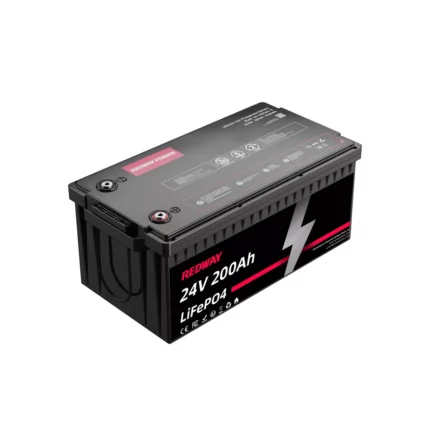 24V 200Ah Lithium Battery
Related articles & discussions
- Can You Charge a Lithium Battery with a PWM Controller?
- Can You Use Any Solar Controller on Lithium Batteries?
- Can I Charge LiFePO4 Batteries with Solar?
- What is the Best Charge Setting for a LiFePO4 Battery?
- Choosing the Best Solar Controller for a 72V 200Ah Battery: A Comprehensive Guide
- What voltage do you charge a lithium battery?
- Which MPPT Controller Do I Need?
- What Are the Factors to Consider When Choosing a Charge Controller?
- Which Type of Charge Controller is the Most Efficient?
- PWM vs MPPT: Do I Need a PWM or MPPT Solar Charge Controller?
