




REDWAY BATTERY / KNOWLEDGE
Why does a rack battery’s breaker trip when the inverter is switched on?

Redway Battery Editorial Team
Talk / Battery Q&A
An installer switches on a new 51.2V rack battery, then closes the inverter’s DC isolator, and the battery breaker trips with a loud click every time.
Direct answer: Usually because the inverter’s DC input capacitors are empty and draw a very large current for a few milliseconds when connected. That surge can trip the battery’s breaker or its BMS short-circuit protection. The fix is to pre-charge the capacitors before full connection, by the inverter’s own start-up function, a battery pre-charge feature or a pre-charge procedure, and to follow the start-up order in the manuals. If it still trips, look for a wiring fault.
Why the surge happens. Large inverters have big capacitor banks on the DC side. Connecting them to a low-resistance lithium battery is close to a short circuit until they charge. The battery’s protection cannot tell this from a real fault.
What the batteries list. The 51.2V 100Ah 3U lists a circuit breaker, 100A continuous, and peak currents of 110A for 10 seconds and 150A for 0.5 seconds. The 51.2V 150Ah 4U and 51.2V 200Ah 5U list 100A continuous and a circuit breaker. A capacitor inrush can exceed these peaks briefly, so protection may act.
Start-up order. Many hybrid inverters pre-charge their capacitors from PV or AC, or from an internal circuit, before closing to the battery. Others expect the battery to provide pre-charge. Read both manuals: some say turn on the battery, then the inverter; others say power the inverter first. Ask Redway whether these models have a built-in pre-charge function.
Pre-charge procedure. Where neither device pre-charges, installers use a pre-charge resistor across the isolator for a few seconds before closing it, with a suitable resistor and safe handling. This is specialised work; follow the inverter maker’s method.
When it is not inrush. If the breaker trips after the inverter is running, check for reversed polarity, damaged insulation, a short in a parallel cable, a loose busbar or a load above the battery rating. Reverse polarity can destroy equipment; check with a meter before connecting. See commissioning parallel rack batteries.
Parallel banks. With several modules, the inrush is shared, but only if all are on; switching on one module first can trip it. Follow the maker’s sequence.
Compatibility. Confirm that the inverter is on the battery’s compatible list and the protocol is set; see checking inverter compatibility.
↳ Replying to Redway Battery Editorial Team
Ask for start-up and pre-charge procedures as part of the installation documents before booking the commissioning visit.
↳ Replying to Procurement perspective
Check whether inverter or battery provides pre-charge, and size the external isolator and fuse for the system, not one module.
↳ Replying to Selection/Engineering perspective
Log any trip with time and conditions; repeated trips under normal running are a fault to investigate, not a reset routine.
Usually because the inverter’s DC input capacitors are empty and draw a very large current for a few milliseconds when connected. That surge can trip the battery’s breaker or its BMS short-circuit protection. The fix is to pre-charge the capacitors before full connection, by the inverter’s own start-up function, a battery pre-charge feature or a pre-charge procedure, and to follow the start-up order in the manuals. If it still trips, look for a wiring fault.
Verify before ordering: Pre-charge capability of these models is not stated on the pages; confirm with Redway and follow the inverter maker’s start-up instructions.
Editorial Q&A for battery selection and operations. Product figures cited from Redway product pages.
Related products
 51.2V 100Ah Server Rack Battery
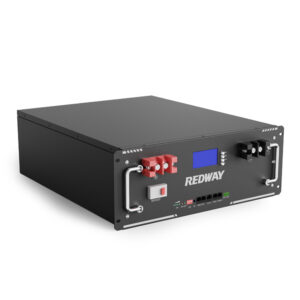 51.2V 150Ah 7kWh Server Rack Battery (4U)
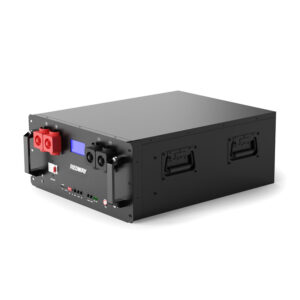 51.2V 200Ah 10kWh Server Rack Battery (5U)
Related articles & discussions
- Why Fusing Between Battery and Inverter is Crucial for Solar Systems
- How Do I Manage My Battery with an Inverter?
- What Is a Golf Cart Inverter and Its Use?
- What You Need to Know About the Best Solar Inverters with Battery Backup
- What Size Inverter Do I Need for a 400Ah Battery?
- Can a 750-Watt Inverter Power a Microwave?
- Can You Use a 48V Inverter for Your Golf Cart Setup?
- Can a Lithium Battery Be Charged by an Inverter?
- How to Make Distilled Water for Your Inverter Battery: Methods and Tips
- What Are Portable And Compact Server Racks?
