




REDWAY BATTERY / KNOWLEDGE
How do you choose the location, clearance and cable size for a rack battery?

Redway Battery Editorial Team
Talk / Battery Q&A
A homeowner wants a 10 kWh rack battery in a garage beside the inverter. The installer must decide where it goes, how much space to leave and what cable to run.
Direct answer: Pick a dry indoor location within the battery’s temperature limits, away from heat sources, water and vehicle impact, with space to work on the front and to route cables. Size DC cables and overcurrent protection for the bank’s maximum continuous current, including temperature and bundling derating, and keep voltage drop low. Follow the battery and inverter manuals and local electrical code; this is work for a qualified installer.
Temperature and enclosure. The PM-LV51100-3U and PM-LV48100-3U list charging from 0°C to 60°C, discharging from -20°C to 60°C and an IP21 rating; the PM-LV51200-5U lists the same temperature ranges and IP21. Under IEC 60529, IP21 means protection against solid objects of 12.5 mm and larger and against vertically dripping water, so these modules are for indoor, dry locations. A garage that drops below freezing in winter will stop charging unless the space is heated.
Location. Keep the battery off the floor if flooding is possible, away from fuel, solvents and direct sun, and outside vehicle paths or behind a barrier. Indoor energy-storage rules vary by jurisdiction; our post on indoor installation and fire-code questions lists what to ask the local authority and insurer.
Clearance. Leave space in front to read the display, operate the breaker and remove a module, and behind or beside it for cables with a gentle bend radius. Follow the clearances in the battery and inverter manuals; for electrical equipment, working-space rules in the electrical code (NFPA 70 in the United States) also apply.
Cable and protection. Each module above lists 100A maximum continuous charge and discharge, with a peak of 110A for 10 seconds on the 3U models. A bank’s design current is set by the inverter’s maximum DC current and the number of modules in parallel. Choose cable whose rated ampacity, after derating for temperature and bundling, exceeds that current, and check voltage drop over the run length. Fit DC-rated overcurrent protection at the battery end sized to protect the cable. The modules have a built-in breaker, but that does not replace protection for the bank cable.
Labels and records. Label polarity, the disconnect and the emergency shutdown, and record the cable size, breaker rating and torque values at commissioning. For bank sizing see sizing a rack bank for daily load.
↳ Replying to Redway Battery Editorial Team
Quote cable, DC breaker, busbars, wall or cabinet hardware and labour separately so the customer sees the full installed cost, not just the battery.
↳ Replying to Procurement perspective
Set design current from the inverter’s maximum DC current, size cable ampacity with derating and voltage drop, then protect the cable with DC-rated overcurrent devices.
↳ Replying to Selection/Engineering perspective
Keep the area dry and clear, check terminal torque and look for heat marks at each visit, and keep the front clear so the display and breaker stay accessible.
Pick a dry indoor location within the battery’s temperature limits, away from heat sources, water and vehicle impact, with space to work on the front and to route cables. Size DC cables and overcurrent protection for the bank’s maximum continuous current, including temperature and bundling derating, and keep voltage drop low. Follow the battery and inverter manuals and local electrical code; this is work for a qualified installer.
Verify before ordering: Clearances, recommended cable sizes and torque values are in the product manuals; request them from Redway for the model ordered and confirm local code with the authority having jurisdiction.
Sources checked: IEC 60529 (IEC webstore); NFPA 70 (NFPA).
Editorial Q&A for battery selection and operations. Product figures cited from Redway product pages.
Related products
 51.2V 100Ah Server Rack Battery
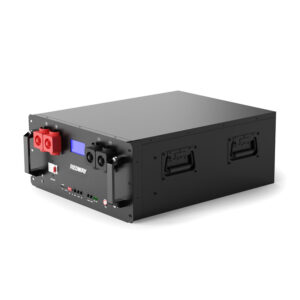 51.2V 200Ah 10kWh Server Rack Battery (5U)
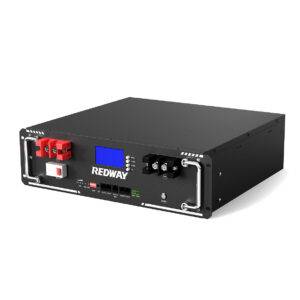 48V 100Ah Server Rack Battery
Related articles & discussions
- Why Choose 100Ah LiFePO4 Batteries for Server Racks?
- How to Choose a High Voltage Server Rack Lithium Battery from a Chinese Factory?
- Why Choose Redway for Lithium Server Rack Batteries?
- What Are Redway Forklift Battery Installation Requirements?
- How To Choose The Right Server Rack Battery?
- How to Choose the Right Server Rack LiFePO4 Battery
- Where To Buy 48V LiFePO4 Rack Battery?
- How to Choose the Best Lithium-Ion Rack Battery System OEMs
- Where should power go on the rack?
- How to Evaluate the Efficiency and Performance of a Rack Battery System
