REDWAY BATTERY / KNOWLEDGE
What belongs on an annual inspection of a rack battery installation?

Redway Battery Editorial Team
Talk / Battery Q&A
A facility has run a bank of PM-LV rack batteries with a hybrid inverter for a year. The service contract says “annual inspection”, and the manager wants to know what that should include.
Direct answer: Cover six areas: physical condition (cases, swelling, dust, mounting), connections (terminal and busbar condition, cable heat marks, grounding), protection devices (breakers and fuses), BMS data (state of charge, cell-voltage spread, temperatures, alarm history), system communication and settings (inverter link, DIP addresses, firmware, charge limits), and the room (temperature, clearances, cleanliness, detection). Record readings so next year can be compared. Intervals and torque values should come from Redway’s manual.
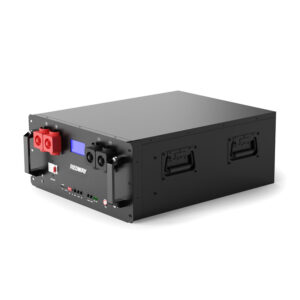
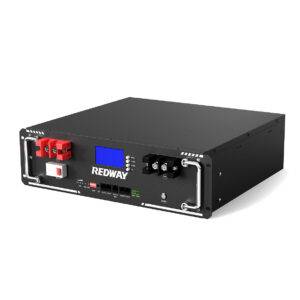
Page basics. The PM-LV51100-3U and PM-LV48100-3U list a metal shell, IP21, circuit breaker, LCD screen, RS485 / RS232 / CAN-bus, manual DIP switch, charge at 0–60 °C and discharge at −20–60 °C, and “Dry Indoor Space, Server Room, Data Center” as usage locations. The PM-LV51200-5U lists M6 terminals, a JBD BMS, circuit breaker and LCD display. IP21 is an indoor, dry-location rating.
Physical. Look for dents, swelling, discoloration, liquid, corrosion or dust build-up on vents and fans. Check rack mounting and that modules are secured. Clean dust with the system safe to work on, following the manual.
Connections. Check power cables, busbars and lugs for heat marks or discoloration, and terminals for tightness to the torque value in Redway’s manual (not published on the pages). Check the grounding wire and the communication and parallel cables for damage. Thermal imaging under load, if available, finds hot joints quickly.
Protection. Operate each battery breaker as the manual allows, check fuses and the DC isolator, and confirm labels are legible.
BMS data. On each module’s display or the monitoring software, record state of charge, pack voltage, highest and lowest cell voltage, temperatures and alarm history. Compare modules with each other and with last year. A module with a wider cell spread, a lower capacity or repeated alarms needs follow-up with Redway; ask for the acceptable spread. See paralleling batteries of different ages if replacements are planned.
System and room. Confirm the inverter still reads battery state of charge and limits, DIP addresses are unchanged, and firmware versions are recorded. Check room temperature against the limits, clearances, housekeeping and that any detection system was tested on its schedule. For the 51.2V vs 48V settings, see our voltage comparison.
↳ Replying to Redway Battery Editorial Team
Write the inspection scope into the service contract: the six areas above, the readings to be recorded, and who acts on findings. “Annual inspection” alone is not a scope.
↳ Replying to Procurement perspective
The useful data is the trend: cell spread, module capacity and alarm counts year on year. Ask Redway for the acceptable limits so findings can be judged against numbers.
↳ Replying to Selection/Engineering perspective
Use a fixed checklist, photograph terminals and settings, store the readings per module serial number, and repeat in the same season each year.
Cover six areas: physical condition (cases, swelling, dust, mounting), connections (terminal and busbar condition, cable heat marks, grounding), protection devices (breakers and fuses), BMS data (state of charge, cell-voltage spread, temperatures, alarm history), system communication and settings (inverter link, DIP addresses, firmware, charge limits), and the room (temperature, clearances, cleanliness, detection). Record readings so next year can be compared. Intervals and torque values should come from Redway’s manual.
Verify before ordering: Inspection intervals, terminal torque values and acceptable cell-voltage spread are not published; take them from Redway’s manual or written guidance.
Editorial Q&A for battery selection and operations. Product figures cited from Redway product pages.
Related products
 51.2V 100Ah Server Rack Battery
 51.2V 200Ah 10kWh Server Rack Battery (5U)
 48V 100Ah Server Rack Battery
Related articles & discussions
- What Is A LiFePO4 Server Rack Battery Series?
- How Can I Perform a Visual Inspection to Check for a Failing Golf Cart Battery?
- Understanding Redway Battery Server Rack Lithium Solutions: A Complete Guide
- What You Need to Know About Server Rack Batteries
- Why Select Redway Lithium Server Rack Batteries for High Efficiency?
- How to Choose the Right Server Rack Battery System?
- What Is A 48V Server Rack Battery Used For?
- Why Use Server Rack Batteries in Data Centers?
- Where To Buy Server Rack Batteries Online?
- How Can LiFePO4 Batteries Last Longer in Server Racks?