




REDWAY BATTERY / KNOWLEDGE
When should an RV or boat move from a 12V to a 24V lithium house bank?

Redway Battery Editorial Team
Talk / Battery Q&A
A boat owner is adding a 3,000W inverter and a larger battery bank, and the installer asks whether to stay at 12V or rebuild the house system at 24V.
Direct answer: Move to 24V when the high-power loads, mainly a large inverter, start to make 12V currents and cables hard to manage, typically somewhere around 2,000 to 3,000W of continuous inverter load or where cable runs are long. At 24V the current for the same power is roughly halved, so cables, fuses and voltage drop all get easier. Stay at 12V when most loads are 12V devices, the inverter is small and the vehicle charging system is 12V, because every 12V device on a 24V bank needs a converter. This is a rule of thumb, not a standard.
Why current matters. Power equals voltage times current. A 3,000W inverter running near full output draws roughly 250A or more from a 12.8V battery once inverter losses are added, but only about half that from a 25.6V battery. Heat lost in a cable rises with the square of the current, so the same cable at half the current loses about a quarter as much. That is the whole case for 24V.
What the products offer. The 24V 200Ah lists 25.6V, 5,120 Wh, BCI Group 8D size (523 × 269 × 218 mm), 40 kg and versions with 100A, 150A or 200A continuous discharge. The 24V 100Ah lists 2,560 Wh, 501 × 185 × 242 mm, 19 kg, 100A continuous and 200A peak for 3 seconds. For comparison, the 12V 200Ah lists about 2,500 Wh in the same 501 × 185 × 242 mm case at 18 kg, with up to four in series or parallel. Check which current version you are quoted.
What a 24V change costs. You need a 24V inverter-charger, a 24V-rated solar controller setting, and a way to charge from the engine: most vehicle and outboard alternators are 12V, so a 12V-to-24V DC-DC charger is the usual answer. 12V loads such as lights, pumps, electronics and the fridge need a 24V-to-12V converter sized for their combined current. Some boats already have 24V for thrusters or trolling motors, which tips the decision.
Series of two 12V or one 24V. Two 12V batteries in series give 24V but need matched batteries and balanced charging. A single 24V battery avoids that. See two 12V batteries in series vs one 24V.
A simple decision rule. List every load with its voltage and watts. If the inverter and other high-power loads dominate, and 12V loads total only a few tens of amps, 24V is usually worth it. If many 12V devices run for long hours and the inverter is under about 1,500W, stay at 12V and size cables properly; see cable size and fuse for a 2,000W inverter.
Risk boundaries. Never take 12V from one battery in a 24V series string; that unbalances the batteries. Fuse every source close to the battery, and follow the boat or RV builder’s wiring rules and your marine standard for the installation.
↳ Replying to Redway Battery Editorial Team
Price the full change, not just the battery: inverter-charger, DC-DC charger, step-down converter and new fusing. If those add up to more than the cable savings, staying at 12V may be cheaper.
↳ Replying to Procurement perspective
Estimate the peak DC current at each voltage from inverter watts divided by battery voltage and efficiency, then check it against the battery’s continuous rating and the cable’s ampacity.
↳ Replying to Selection/Engineering perspective
After a 24V conversion, label every circuit with its voltage and check the 12V converter output under load; mixed-voltage systems cause most service mistakes.
Move to 24V when the high-power loads, mainly a large inverter, start to make 12V currents and cables hard to manage, typically somewhere around 2,000 to 3,000W of continuous inverter load or where cable runs are long. At 24V the current for the same power is roughly halved, so cables, fuses and voltage drop all get easier. Stay at 12V when most loads are 12V devices, the inverter is small and the vehicle charging system is 12V, because every 12V device on a 24V bank needs a converter. This is a rule of thumb, not a standard.
Verify before ordering: Inverter efficiency and the 2,000 to 3,000W threshold are typical industry practice, not a rule; confirm current ratings and series/parallel limits per battery with Redway.
Editorial Q&A for battery selection and operations. Product figures cited from Redway product pages.
Related products
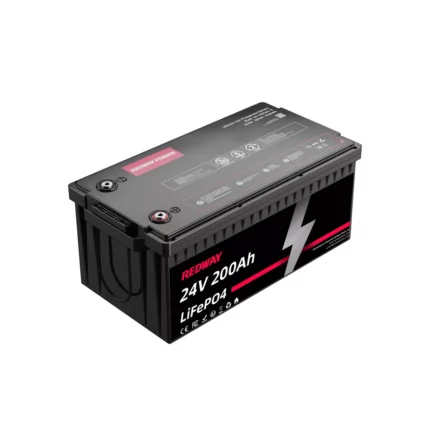 24V 200Ah Lithium Battery
 24V 100Ah Lithium Battery
 12V 200Ah Lithium Battery
Related articles & discussions
- What is the Problem with Lithium Batteries in Boats?
- Are Lithium Batteries Suitable for Boats?
- Which Battery Is the Starting Battery on a Boat?
- How Many Lithium Batteries Do I Need for My Boat?
- What Is a 24V Forklift Battery?
- Can I charge 2 12V batteries in series with a 24v charger?
- Why Choose 24V LiFePO4 Batteries?
- What Are The Best 12V And 24V Lithium Batteries For Golf Carts?
- Can I Start a Boat with a Lithium Battery?
- How Many Amps Does It Take to Start a Boat?
