




REDWAY BATTERY / KNOWLEDGE
Can one lithium battery be moved between two different forklift models?
Redway Battery Editorial Team
Talk / Battery Q&A
A fleet with two 48V sit-down trucks of different brands wants one spare lithium battery that can swap into either truck during charger downtime.
Direct answer: Only when both trucks share the same nominal voltage class, accept the battery’s dimensions and weight in the compartment, use a compatible connector and polarity, and can run with the same BMS or charger communication. Swapping a 24V pack into a 48V truck, or a tall pack into a short compartment, is unsafe. Treat each truck as its own fitment case and get the truck maker’s approval before making a battery a shared spare.
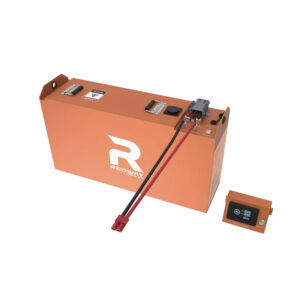
Voltage first. A 48V 300Ah (51.2V) and a 48V 280Ah both sit in the 48V class, but a 24V 230Ah (25.6V) belongs only on 24V trucks. Mixing classes risks controller damage and BMS faults. Energy also differs: the 48V 300Ah page lists about 15.56 kWh and the 48V 280Ah about 14.33 kWh, while the 24V 230Ah lists about 5.88 kWh.
Compartment and weight. The 48V 300Ah lists about 940 × 260 × 520 mm and 164 kg; the 48V 280Ah about 680 × 408 × 450 mm and 120 kg; the 24V 230Ah about 630 × 251 × 450 mm and 63 kg. Even two 48V packs can fail on one truck if length, width, height or roller clearances differ. Confirm against both truck data plates and see compartment and counterweight checks. Lithium packs are often lighter than the lead-acid they replace, so ballast rules may differ by truck.
Connectors and polarity. SB, REMA and OEM plugs are not interchangeable without a correctly keyed adapter. Wrong polarity or a loose high-current joint can arc. Keep one connector standard per shared spare, or kit a labelled adapter that both sites understand. See also SB and REMA charging connectors.
Communication and truck settings. Many lithium packs use RS485 or CAN with the charger or truck. A battery that talks to truck A’s charger may not wake truck B’s charger. Discharge indicators and lift cut-outs also need lithium settings per truck; see BDI and lift cut-out and charger profile and communication.
Operational rules. If you do share a pack, write a swap checklist: isolate power, inspect connectors, verify voltage and SOC, confirm no active alarms, seat and latch the battery, then verify charger handshake before the shift. Record the serial number against the truck hours.
When not to share. Different voltage classes, sealed custom trays, ballast requirements that only one truck meets, or OEM warranties that forbid third-party swaps. In those cases buy a dedicated spare; see choosing a 24V forklift model and 48V capacity choices.
Documentation. Record which serial numbers are approved for which trucks, and keep the truck manuals with the battery paperwork for audits and warranty claims.
↳ Replying to Redway Battery Editorial Team
Decide whether fleet flexibility is worth the engineering review; a wrongly shared spare can idle two trucks instead of one.
↳ Replying to Procurement perspective
Compare voltage, tray drawings, weight plate limits, connector type and CAN/RS485 needs for both trucks before approving a shared serial.
↳ Replying to Selection/Engineering perspective
Train operators on the swap checklist and log every move with voltage, SOC and alarm status.
Only when both trucks share the same nominal voltage class, accept the battery’s dimensions and weight in the compartment, use a compatible connector and polarity, and can run with the same BMS or charger communication. Swapping a 24V pack into a 48V truck, or a tall pack into a short compartment, is unsafe. Treat each truck as its own fitment case and get the truck maker’s approval before making a battery a shared spare.
Verify before ordering: Truck maker approval and exact tray, connector and communication settings must be confirmed for each model; Redway can confirm pack options for a stated truck list.
Editorial Q&A for battery selection and operations. Product figures cited from Redway product pages.
Related products
 48V 300Ah (51.2V 304Ah) Lithium Forklift Battery
 48V 280Ah (51.2V 280Ah) Lithium Forklift Battery
 24V 230Ah (25.6V 230Ah) Lithium Forklift Battery
Related articles & discussions
- How To Find Your Forklift Model And Serial Number?
- What Are the Different Types of Lithium Battery Cells and Their Designs?
- What is the difference between lithium-ion and deep cycle batteries?
- Is it better to have two 100Ah lithium batteries or one 200Ah lithium battery?
- How do you charge two lithium batteries?
- What Is The H1.6-2.0a Forklift Model?
- What Is the Difference Between Lithium Batteries and Marine Batteries?
- What Is The H8-18XD High Capacity Forklift Model?
- What are the detailed technical specifications for each voltage model?
- What Is The Difference Between Forklift And Pallet Jack?
