REDWAY BATTERY / KNOWLEDGE
Which charging connector does a lithium forklift battery need, and who should change it?
Redway Battery Editorial Team
Talk / Battery Q&A
A distribution centre is replacing lead-acid batteries in a mixed fleet and finds that the trucks use two different battery plug styles.
Direct answer: Use a connector that mates with the truck’s existing plug and the charger’s plug, is rated for the highest current it will carry, and is keyed to the battery voltage so a wrong charger cannot be connected. Most sites keep the truck-side connector and specify it on the battery order. Changing a connector is electrical work for a trained forklift or battery technician, following the truck maker’s instructions.
Common types. Two families dominate: DIN-style connectors made by REMA and others, common in Europe and Asia, and Anderson SB-style connectors, common in North America. Both come in different current sizes, and both use coding, by colour, shape or keying pins, to separate voltages. Coding schemes vary by maker, so check the maker’s chart rather than relying on colour alone.
What Redway pages list. The 24V 230Ah (25.6V 230Ah) lists REMA charge and discharge connectors, 150A maximum continuous charge, 160A continuous discharge and 800A peak for 5 seconds. The 48V 300Ah (51.2V 304Ah) lists a REMA connector, 150A charge, 300A continuous and 600A peak. The 80V 400Ah (83.2V 420Ah) lists 200A charge and 300A continuous but no connector type, so specify it on the order.
Size it for current. The connector and its cable must carry the battery’s continuous discharge and the charger’s current without overheating. Lithium batteries are often charged at higher currents than lead-acid, so a plug that was adequate for overnight charging may run hot at fast or opportunity charging. Peak current matters less than continuous current for contact heating, but the rating must still cover it.
Keying and communication. A voltage-keyed connector stops a 48V charger being plugged into a 24V or 80V battery. Some lithium systems also need a communication or enable line between battery and charger; this may use auxiliary pins in the main connector or a separate plug. Confirm the arrangement with the charger supplier; see CAN bus and RS485 on forklift batteries.
Who changes it. Have the battery supplier fit the agreed connector at the factory where possible. On site, a trained technician should crimp with the correct die, check polarity, torque and pull-test, and label the voltage. Under OSHA 1910.178 in the US, charging installations and battery handling are part of the truck safety rules; follow the truck and charger makers’ instructions.
Charging area. For layout and safety, see charging-area rules when moving to lithium.
↳ Replying to Redway Battery Editorial Team
Write connector make, size, coding and cable length on the purchase order for each truck model, so batteries arrive ready to plug in.
↳ Replying to Procurement perspective
Check connector current rating against the charger output and the battery’s continuous discharge, and confirm any communication pins.
↳ Replying to Selection/Engineering perspective
Inspect contacts monthly for heat marks, loose crimps and cracked housings; replace worn contacts in pairs with the mating half.
Use a connector that mates with the truck’s existing plug and the charger’s plug, is rated for the highest current it will carry, and is keyed to the battery voltage so a wrong charger cannot be connected. Most sites keep the truck-side connector and specify it on the battery order. Changing a connector is electrical work for a trained forklift or battery technician, following the truck maker’s instructions.
Verify before ordering: Connector type for some models is not listed; confirm connector make, size and coding with Redway and the truck dealer for each order.
Sources checked: OSHA 29 CFR 1910.178.
Editorial Q&A for battery selection and operations. Product figures cited from Redway product pages.
Related products
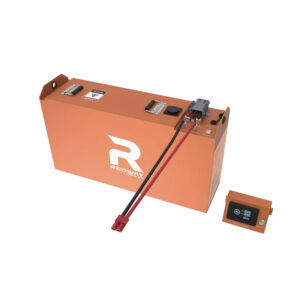 48V 300Ah (51.2V 304Ah) Lithium Forklift Battery
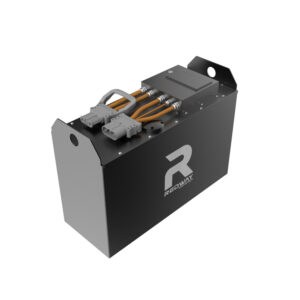 24V 230Ah (25.6V 230Ah) Lithium Forklift Battery
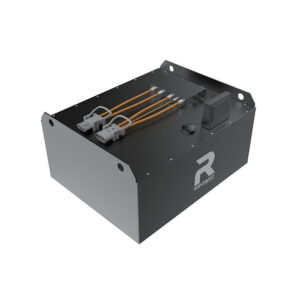 80V 400Ah (83.2V 420Ah) Forklift Lithium Battery
Related articles & discussions
- What are the main battery charger connector types?
- How Do Lithium Batteries with Euro Connectors Improve Forklift Safety?
- How to Change Forklift Tires: A Step-by-Step Guide
- How to Change Hydraulic Fluid in Forklifts?
- What Are Battery Connectors And Contact Tips?
- How To Change Ep25-35cn Forklift Battery?
- What Are Fork Truck Battery Connectors and Why Are They Important?
- How Can You Safely Change a Forklift Propane Tank?
- What Are the Most Common Battery Charger Connector Types and Standards?
- What Charging Setup Do Redway Lithium Batteries Need?