




REDWAY BATTERY / KNOWLEDGE
Is opportunity charging safe for lithium forklift batteries across multiple shifts?
Redway Battery Editorial Team
Talk / Battery Q&A
A three-shift distribution center wants to stop changing lead-acid packs and charge LiFePO4 batteries during breaks instead.
Direct answer: Yes—when using properly sized LiFePO4 forklift packs and matched chargers. Redway examples list roughly 150A-class maximum continuous charge on several 24/36/48V models; design break duration, connectors, and thermal checks around those published limits rather than continuous 100% SOC hammering.
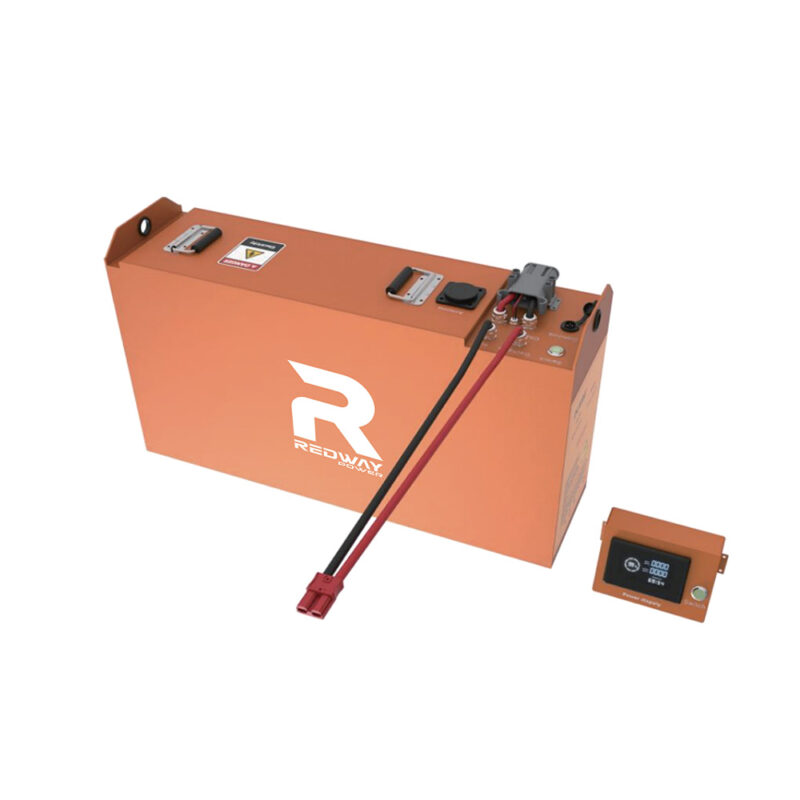
Multi-shift warehouses often ask whether LiFePO4 forklift batteries can be opportunity-charged during breaks instead of swapping lead-acid packs. For Redway industrial packs such as the 24V 280Ah, 48V 300Ah-class, and 36V 700Ah-class models, the product data supports relatively high charge acceptance compared with traditional flooded lead-acid practices—when chargers and thermal limits are respected.
Published anchors: the 24V 280Ah pack is specified at 25.6V nominal, 280Ah, about 5.88 kWh, max continuous discharge 160A, peak 800A for 5 seconds, max continuous charge about 150A, roughly 630 × 251 × 450 mm and ~65 kg, with cycle-life messaging up to about 5 years or 3500 cycles at 70% DOD. The 48V 304Ah page lists 51.2V, about 15.56 kWh, 300A continuous discharge, 600A peak for 3 seconds, ~150A max continuous charge, ~164 kg. The 36V 690Ah page lists 38.4V, about 26.5 kWh, 320A continuous discharge, 480A peak for 5 seconds, ~150A max continuous charge, ~330 kg, over 3500 cycles at 70% DOD.
Opportunity charging works when break windows can deliver meaningful kWh at the allowed charge current without overheating connectors. Example math: at 150A into a 51.2V-class pack, power is on the order of 7–8 kW; a 20-minute break might return a few kWh depending on charge curve stage—useful, not magical. Partial state-of-charge cycling is generally acceptable for LiFePO4 relative to lead-acid, which is why lithium enables fewer battery swaps. Still follow manufacturer charge temperature guidance and avoid repeated charge at the extreme top of SOC if the BMS or charger documentation advises tapering.
Operationally, standardize plugs, train operators to connect every break, and monitor pack temperatures across summer peaks. If trucks are oversized on energy (e.g., 26.5 kWh on lighter duty), opportunity charging can be lighter; if packs are tightly sized, break charging becomes essential to finish the third shift.
Answer: yes—opportunity charging across shifts is a primary reason to move to these LiFePO4 forklift packs, provided charger current matches the ~150A-class continuous charge figures above, connectors are rated, and BMS temperature limits are observed.
↳ Replying to Redway Battery Editorial Team
Budget chargers and cable drops at break areas, not only batteries. Opportunity charging ROI disappears if operators queue for a single charger. Ask vendors to state max continuous charge current on the PO line.
↳ Replying to Procurement perspective
Pair truck average kW with pack kWh and charger amps. A 15.56 kWh 48V pack with ~150A charge support suits different break math than a 5.88 kWh 24V pack. Confirm communication (CAN/RS485 where used) with the charger profile.
↳ Replying to Selection/Engineering perspective
Weekly infrared spot-checks on connectors during the first month catch undersized plugs. Clear dust from pack vents/fans if present. Track BMS over-temp events by shift to adjust charging discipline.
Yes—when using properly sized LiFePO4 forklift packs and matched chargers. Redway examples list roughly 150A-class maximum continuous charge on several 24/36/48V models; design break duration, connectors, and thermal checks around those published limits rather than continuous 100% SOC hammering.
Editorial Q&A for battery selection and operations. Product figures cited from Redway product pages.
Related products
 24V 280Ah Lithium Forklift Battery
 48V 300Ah-class Lithium Forklift Battery
 36V 700Ah-class Lithium Forklift Battery
Related articles & discussions
- How can lithium batteries be optimized for frequent charge and discharge cycles?
- Best LiFePO4 Battery for Forklifts in Germany?
- How Do Discharge Rates Affect 51.2V 100Ah Server Batteries?
- Why Are High Discharge Rate LiFePO4 Batteries the Best Choice for Electric Carts?
- How Can Rapid Recharge Lithium Batteries Ensure Continuous Golf Cart Operation?
- How to Choose a 12 Volt 300Ah Lithium Deep Cycle Battery with Heater for B2B Buyers?
- Understanding 48V 200Ah LiFePO4 Golf Cart Batteries: Performance, Design, and Real-World Value
- Comprehensive Guide to Redway Battery 48V 50Ah Server Rack Batteries
- Understanding 51.2V 100Ah Server Rack Batteries: A Comprehensive Guide
- What are the key specifications and advantages of Redway rack mounted lithium battery modules?
