REDWAY BATTERY / KNOWLEDGE
How do you size a lithium forklift battery from an old lead-acid Ah rating?
Redway Battery Editorial Team
Talk / Battery Q&A
A warehouse wants to replace 48V lead-acid forklift batteries and only has the old Ah labels and charger logs.
Direct answer: Translate shift energy into kWh, then choose a Redway lithium pack by voltage class, compartment fit, kWh, and charge/discharge current. Example anchors: 48V 420Ah ≈ 21.5 kWh; 48V 560Ah ≈ 28.67 kWh; 83.2V 420Ah ≈ 34.94 kWh on Redway’s product pages—not a blind Ah-for-Ah swap.
Sizing a lithium forklift battery from an old lead-acid nameplate is a translation exercise. Lead-acid packs are often oversized in Ah because operators only use a fraction of rated capacity before voltage collapse. LiFePO4 delivers a flatter voltage curve and typically allows deeper usable discharge, so a lithium pack with similar or sometimes lower Ah can still complete the shift—but you should verify with energy (kWh) and current, not Ah folklore alone.
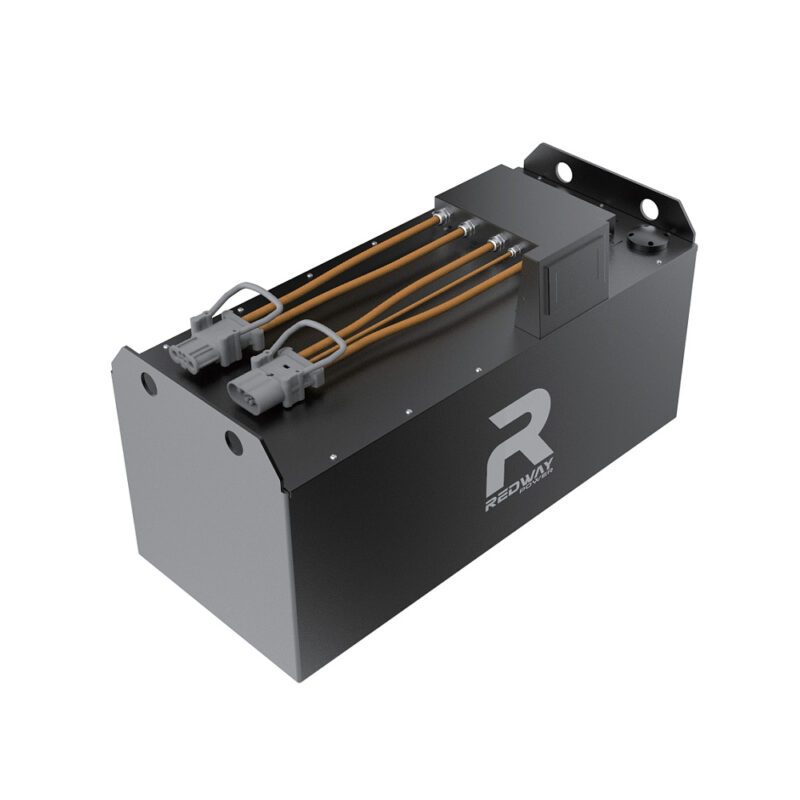
Redway’s industrial pages publish clear energy figures. The 48V 420Ah forklift battery is described as 51.2V / 420Ah with about 21.5 kWh, peak discharge 1000A for short bursts, max continuous charge about 200A, roughly 950 × 421 × 450 mm and ~190 kg, with RS485/CAN options. The 48V 550Ah-class page lists a 51.2V 560Ah pack at about 28.67 kWh, similar peak 1000A bursts, ~210 kg, 950 × 592 × 450 mm. The 80V-class 400Ah page describes an 83.2V 420Ah LiFePO4 pack at about 34.94 kWh, with 300A continuous discharge and 1000A peak (5s), up to about 3500 cycles at 70% DoD.
Method: (1) note truck voltage class and compartment dimensions, (2) estimate kWh used per shift from charger logs or amp-hour meters on the old pack, (3) pick a lithium kWh at or above that use with reserve, (4) confirm continuous discharge and charge rates for opportunity charging plans, (5) confirm weight distribution and connector standards. Do not assume a 1:1 Ah swap if the lead-acid pack was routinely returned at 40% indicated charge—the lithium usable window differs.
If multiple shifts share one truck, prioritize charge rate and thermal behavior as much as nameplate Ah. If compartment height limits the 560Ah footprint, the 420Ah / 21.5 kWh pack may be the feasible choice with mid-shift charging.
Answer in brief: convert lead-acid history into kWh/shift, then select a Redway lithium SKU by matching voltage class, compartment size, kWh, and published charge/discharge currents—not by copying Ah alone.
Also reconcile runtime expectations with charger infrastructure. A lithium pack sized perfectly on kWh still fails the operation if depot chargers cannot deliver the published charge current (for example, the ~200A maximum continuous charge called out on several Redway 48V forklift pages) or if break times are too short for the chosen charge rate. Opportunity charging only works when both battery and charger are specified together. Finally, involve safety and facilities early for ventilation assumptions left over from lead-acid rooms; LiFePO4 changes hydrogen gassing behavior, but cable routing, emergency disconnects, and spill plans still need an updated SOP.
↳ Replying to Redway Battery Editorial Team
Request kWh, dimensions, weight, and communication options on the quote. Compare 21.5 kWh vs 28.67 kWh packs against overtime charging labor costs. Include connector adaptation and any required truck OEM approvals in the commercial package.
↳ Replying to Procurement perspective
Match truck voltage (48V vs 80V class) exactly. Use continuous discharge (e.g., 300A on the 83.2V page) and peak (1000A class where stated) against hydraulic pump surges. Validate charger current (pages cite up to ~200A charge on several 48V models) for the intended opportunity-charge plan.
↳ Replying to Selection/Engineering perspective
After swap, weigh or check truck data plates if counterweight depends on battery mass (~190–210 kg on the 48V examples). Train operators that lithium gauges behave differently from lead-acid “voltage sag” intuition.
Translate shift energy into kWh, then choose a Redway lithium pack by voltage class, compartment fit, kWh, and charge/discharge current. Example anchors: 48V 420Ah ≈ 21.5 kWh; 48V 560Ah ≈ 28.67 kWh; 83.2V 420Ah ≈ 34.94 kWh on Redway’s product pages—not a blind Ah-for-Ah swap.
Editorial Q&A for battery selection and operations. Product figures cited from Redway product pages.
Related products
 48V 420Ah Lithium Forklift Battery
 48V 550Ah-class (560Ah) Lithium Forklift Battery
 80V-class 400Ah (83.2V 420Ah) Forklift Lithium Battery
Related articles & discussions
- How can a heavy‑duty lithium battery transform utility and shuttle cart performance?
- Best LiFePO4 Battery for Forklifts in Germany?
- Why Electric Vehicles Still Need Lead-Acid Batteries
- How Can Maintenance-Free Lithium Batteries Replace Lead-Acid Units in Golf Carts?
- How Can Sustainable Lithium Batteries Replace Traditional Lead-Acid Systems?
- How to Choose a 12 Volt 300Ah Lithium Deep Cycle Battery with Heater for B2B Buyers?
- Understanding 48V 200Ah LiFePO4 Golf Cart Batteries: Performance, Design, and Real-World Value
- Comprehensive Guide to Redway Battery 48V 50Ah Server Rack Batteries
- Understanding 51.2V 100Ah Server Rack Batteries: A Comprehensive Guide
- What are the key specifications and advantages of Redway rack mounted lithium battery modules?