




REDWAY BATTERY / KNOWLEDGE
How does a lithium battery work with a forklift’s discharge indicator and lift cut-off?
Redway Battery Editorial Team
Talk / Battery Q&A
After a lithium pack was fitted, a forklift’s battery discharge indicator shows nearly full for most of the shift, then the truck locks out lifting with little warning.
Direct answer: Many trucks estimate charge from battery voltage with a lead-acid curve and use that estimate to trigger a lift interrupt at low charge. A LiFePO4 pack holds a flat voltage, so the indicator reads high and then drops quickly, and the lift cut-off can arrive late or early. Ask the truck dealer to set the indicator and lift interrupt for lithium, or to take state of charge from the battery over CAN bus if the truck and battery support it, and test the setting before full use.
What the battery provides. The 48V 280Ah and 48V 400Ah (51.2V 420Ah) pages list an operating window of 40V to 58.4V, state of charge (SoC) and state of health (SoH), an on-the-shell LCD display and RS485, CAN bus and 4G. The 24V 280Ah lists 20V to 29.2V with the same features. The battery’s own SoC reading is a better guide than truck voltage.
Why the truck gets it wrong. A lead-acid indicator assumes voltage falls steadily as charge is used. Under heavy lift current, lithium pack voltage sags briefly and recovers, which can trip a voltage-based lift interrupt during a lift even with charge left. Near empty, the voltage falls quickly, so the indicator may go from comfortable to empty in a short time.
Setting it up. Options depend on the truck maker: reprogramming the indicator for lithium, setting a lift interrupt threshold the battery supplier agrees with, or using a CAN link so the truck reads the battery’s SoC directly. A CAN link only works if the truck accepts the battery’s protocol; see CAN bus and RS485 communication. Get the settings from the truck dealer, not by trial and error on the floor.
Safety interlocks. The lift interrupt protects the battery and stops operators from running a truck into a deep discharge. It should still work after a lithium change. Truck design standards in the ANSI/ITSDF B56 series apply to the truck as built; ask the truck maker whether a battery change affects any listed function.
Test and train. After the change, run a shift with the battery display visible, note the SoC when the lift interrupt triggers, and adjust with the dealer if needed. Tell operators which reading to trust. For sizing and charge planning, see sizing from lead-acid Ah and opportunity charging.
↳ Replying to Redway Battery Editorial Team
Ask, before ordering, whether the truck needs indicator or controller reprogramming for lithium and who does it. Dealer time belongs in the project cost.
↳ Replying to Procurement perspective
Voltage-based indicators misread LiFePO4’s flat curve and load sag. Prefer SoC over CAN where supported, or a lift-interrupt threshold agreed with the supplier.
↳ Replying to Selection/Engineering perspective
After installation, compare the truck indicator with the battery display over a full shift, record the lift-interrupt point and recheck after software updates.
Many trucks estimate charge from battery voltage with a lead-acid curve and use that estimate to trigger a lift interrupt at low charge. A LiFePO4 pack holds a flat voltage, so the indicator reads high and then drops quickly, and the lift cut-off can arrive late or early. Ask the truck dealer to set the indicator and lift interrupt for lithium, or to take state of charge from the battery over CAN bus if the truck and battery support it, and test the setting before full use.
Verify before ordering: Indicator and lift-interrupt settings, and CAN compatibility, are truck-specific; confirm with the truck maker and Redway for the exact model.
Sources checked: ITSDF (ANSI/ITSDF B56 standards).
Editorial Q&A for battery selection and operations. Product figures cited from Redway product pages.
Related products
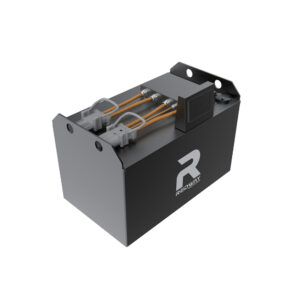 48V 280Ah (51.2V 280Ah) Lithium Forklift Battery
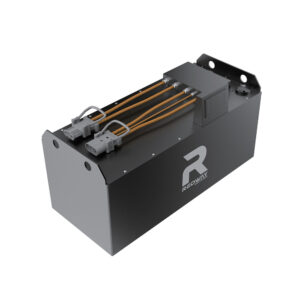 48V 400Ah (51.2V 420Ah) Lithium Forklift Battery
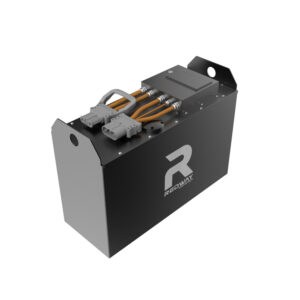 24V 280Ah (25.6V 280Ah) Lithium Forklift Battery
Related articles & discussions
- What is the Cut Off Voltage for a Lithium-Ion Battery?
- Which Forklifts Work with Redway Batteries?
- How Does a Sit Down Forklift Counterbalanced Lift Truck Work?
- Is It OK to Fully Discharge a Lithium-Ion Battery?
- When Should Electric Lift Truck Batteries Be Charged?
- Should Electric Lift Truck Batteries Be Charged?
- What is the Discharge Rate of LiFePO4 32650?
- Understanding Charge and Discharge Temperature Ranges for LiFePO4 Batteries
- What is the cut-off voltage for a 72V battery?
- What is the Maximum Discharge Current for a 72V 100Ah Battery?
