REDWAY BATTERY / KNOWLEDGE
How do you plan rack space and weight for 2U, 3U, 4U and 5U battery modules?

Redway Battery Editorial Team
Talk / Battery Q&A
An installer is fitting 20 kWh of 51.2V rack batteries into a standard 19-inch cabinet that also holds an inverter shelf, and wants to know how many units and how much weight to plan for.
Direct answer: Plan from the spec sheets, not the module count. Add up rack units, depth and weight for every module plus spacing, breakers and cable management, and check the cabinet’s and the rails’ load ratings and the floor beneath. Redway’s 51.2V modules range from about 2.56 kWh in 2U at 23 kg to 10.24 kWh in 5U at about 77 kg, so the same energy can need very different space, weight per shelf and handling effort.
Page figures. PM-LV5150-2U-PRO: 51.2V 50Ah, 2.56 kWh, 410 × 440 × 88 mm, 23 kg. PM-LV51100-3U: 51.2V 100Ah, 5.12 kWh, 420 × 440 × 136 mm, 42 kg. PM-LV51150-4U: 51.2V 150Ah, 7.68 kWh, 550 × 440 × 178 mm, about 55 kg. PM-LV51200-5U: 51.2V 200Ah, 10.24 kWh, 570 × 440 × 222 mm, about 77 kg. Check the current page before ordering because figures can change.
Worked example. About 20 kWh is eight 2U modules (16U, about 184 kg), four 3U modules (12U, about 168 kg), three 4U modules (12U, about 165 kg, 23 kWh) or two 5U modules (10U, about 154 kg). These totals exclude shelves, rails, breakers and cables. More modules also mean more parallel cables and more communication addresses.
Depth and rails. The 4U and 5U modules are 550–570 mm deep, so confirm the cabinet’s usable depth with rear cable space and door clearance. Heavy modules usually need shelves or rails rated for their weight; cage-nut ears alone may not carry them. Ask the cabinet maker for static load ratings and Redway whether a cabinet option is offered for your model.
Weight and floor. Put the heaviest modules low to keep the centre of gravity down and the cabinet stable, anchor the cabinet if required, and check the floor rating for the full loaded weight. Use two people or a lift for modules near 40–77 kg.
Space for work. Leave room to read displays, operate breakers and route cables with a sensible bend radius. Plan where the busbar or parallel cables run so a module can be removed without dismantling the bank. For the electrical side, see indoor installation and fire-code questions and sizing a bank for daily load.
↳ Replying to Redway Battery Editorial Team
Compare total cost per kWh including cabinet, shelves and labour: fewer large modules may cut cabling and cabinet cost but need lifting help.
↳ Replying to Procurement perspective
Add up U-height, depth and weight per module, then check rail, shelf, cabinet and floor ratings. Leave depth for rear cables and breakers.
↳ Replying to Selection/Engineering perspective
Keep displays and breakers reachable, label each module’s position and address, and leave space to remove one module without moving the rest.
Plan from the spec sheets, not the module count. Add up rack units, depth and weight for every module plus spacing, breakers and cable management, and check the cabinet’s and the rails’ load ratings and the floor beneath. Redway’s 51.2V modules range from about 2.56 kWh in 2U at 23 kg to 10.24 kWh in 5U at about 77 kg, so the same energy can need very different space, weight per shelf and handling effort.
Verify before ordering: Cabinet compatibility, rail kits and exact module weights should be confirmed with Redway for the ordered version.
Editorial Q&A for battery selection and operations. Product figures cited from Redway product pages.
Related products
 51.2V 50Ah Server Rack Battery PRO
 51.2V 100Ah Server Rack Battery
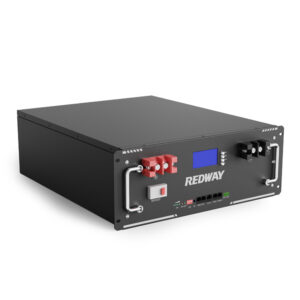 51.2V 150Ah 7kWh Server Rack Battery (4U)
Related articles & discussions
- What Are Redway Rack Mounted Module Specs?
- Why Choose the PM-LV51100-3U-PRO Rack Battery by Redway Battery?
- How to Source Premium PM-LV5150-3U Lithium Battery Modules Wholesale
- Why Choose PM-LV5150-2U-PRO Lithium Battery Modules for Wholesale in Turkey?
- What are the key specifications and advantages of Redway rack mounted lithium battery modules?
- How Lithium Battery Modules Are Transforming Energy Storage Projects
- How Lithium-Ion and LiFePO4 Batteries are Shaping the Future of Energy Storage: The Role of Battery Module Suppliers
- Understanding the Power and Specifications of a 48V 100Ah Battery Module
- What Are Lithium Battery Modules and How Do They Work?
- How to Choose a Cabinet-Type 48V 150Ah LiFePO4 Battery for Your Business Needs?