




REDWAY BATTERY / KNOWLEDGE
Is a battery isolator or voltage-sensitive relay safe with a lithium house battery?
Redway Battery Editorial Team
Talk / Battery Q&A
A boat has a voltage-sensitive relay linking the engine start battery and an AGM house bank, and the owner is replacing the AGM with a 12V lithium battery.
Direct answer: Often not as installed. A diode isolator drops voltage, so a lithium battery may never reach full charge. A voltage-sensitive relay connects the alternator directly to the lithium battery, which can draw much more current than lead-acid and overheat the alternator, and if the BMS disconnects while charging, the alternator can see a voltage spike. Many installers replace these with a DC-DC charger; if a relay stays, it must be lithium-rated and the alternator protected.
Diode isolators. These let charge flow to each battery but drop roughly 0.5 to 1V across the diode. With LiFePO4 needing about 14.2 to 14.6V for a full charge, the house battery often stays part-charged. Low-loss FET isolators reduce the drop, but still give the battery whatever the alternator provides.
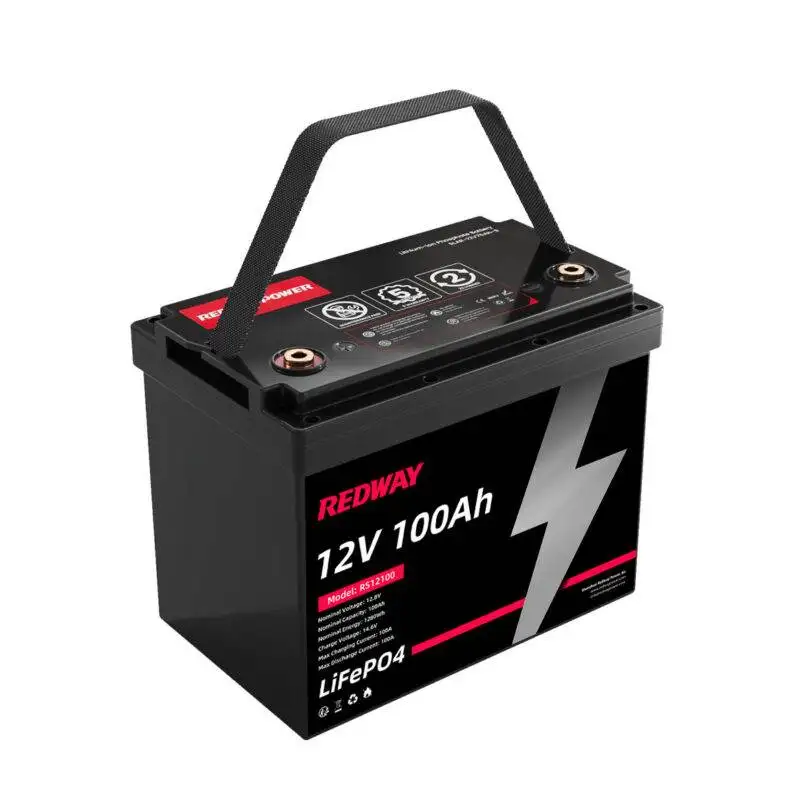
Voltage-sensitive relays. A VSR closes when the start battery voltage rises, joining the batteries. A lithium battery has low internal resistance, so it accepts high current over a long time; the 12V 100Ah lists 50A or 100A maximum charge and the 12V 200Ah 100A to 200A. An alternator not designed for continuous full output can overheat, especially at low engine speed.
BMS disconnect. If the lithium BMS opens at full charge or high temperature while the alternator is charging hard, the sudden load loss can cause a voltage spike that may damage the alternator or electronics. Alternator protection devices or a DC-DC charger avoid this.
Smart alternators. Many modern vehicles vary alternator voltage, sometimes well below what lithium needs. A DC-DC charger with a lithium profile works regardless; see alternator charging with a DC-DC charger.
When a relay can stay. A lithium-rated VSR or combiner can work with an alternator designed for continuous output, a regulator with temperature sensing and current limit, and protection against BMS disconnect. Follow the boat or vehicle maker and your marine standard, such as ABYC E-13 in the US.
24V systems. The same principles apply to a 24V bank such as the 24V 100Ah (29.2V maximum charge, 100A). See mounting and ventilation for installation.
Check after any change. Measure battery voltage and alternator temperature during a long run at cruise and at idle.
↳ Replying to Redway Battery Editorial Team
Budget a DC-DC charger with the lithium upgrade; it costs less than an alternator replacement.
↳ Replying to Procurement perspective
Check alternator continuous rating, regulator type and the battery’s charge limit, and plan for BMS disconnect.
↳ Replying to Selection/Engineering perspective
On first long runs, check alternator and cable temperatures and the battery’s end-of-day voltage.
Often not as installed. A diode isolator drops voltage, so a lithium battery may never reach full charge. A voltage-sensitive relay connects the alternator directly to the lithium battery, which can draw much more current than lead-acid and overheat the alternator, and if the BMS disconnects while charging, the alternator can see a voltage spike. Many installers replace these with a DC-DC charger; if a relay stays, it must be lithium-rated and the alternator protected.
Verify before ordering: Alternator behaviour and suitable relays depend on the vehicle or boat; follow the maker’s guidance and ABYC E-13 where applicable.
Editorial Q&A for battery selection and operations. Product figures cited from Redway product pages.
Related products
 12V 100Ah Lithium Battery (LiFePO4, Self-heating, OEM)
 12V 200Ah Lithium Battery
 24V 100Ah Lithium Battery
Related articles & discussions
- What Voltage is a Fully Charged Lithium Battery?
- At what voltage is a 24v lithium ion battery dead?
- Understanding the Maximum Voltage for 72V Lithium-Ion Batteries
- What voltage is 100Ah lithium battery?
- How to Protect Your Home from Lithium-Ion Battery Fire Risks
- Understanding the Minimum and Maximum Voltage for Lithium Batteries
- What is the Lowest Voltage for a Lithium Iron Phosphate Battery?
- What Is the Minimum Voltage for a 3.7V Lithium Battery?
- At what voltage is a 48v lithium battery dead?
- What is the maximum voltage for a 24V lithium battery?
