REDWAY BATTERY / KNOWLEDGE
What do C-rate and continuous vs peak discharge mean on a lithium battery spec sheet?
Redway Battery Editorial Team
Talk / Battery Q&A
An engineer compares three lithium battery datasheets for a vehicle project. One lists 230A continuous, another 1000A peak, a third 1C, and the numbers do not line up.
Direct answer: C-rate is current relative to capacity: 1C on a 100Ah battery is 100A, 0.5C is 50A. Maximum continuous discharge is the current the battery (usually its BMS) allows without a time limit under stated conditions. Peak discharge is a higher current allowed only for the time shown in brackets, such as 5s or 10s. Compare continuous with continuous, and peaks only when the durations match.
Worked examples from Redway pages (our arithmetic for the C-rates). The 48V 100Ah high-current golf cart battery lists 230A maximum continuous discharge, about 2.3C, and 250A peak for 10s. The 48V 420Ah forklift battery lists 300A continuous, about 0.7C, and 1000A peak for 5s. The 12V 100Ah lists continuous discharge of “50A (0.5C) or 100A (1C)”, meaning two versions, and no peak figure.
Why duration matters. Other pages show peaks of 720A for 3s (36V 250Ah forklift), 200A for 10s (48V 100Ah standard golf cart), 315A for 30s (72V golf cart models) and 700A for 30s (80V 690Ah forklift). A 30-second peak and a 3-second peak describe very different capabilities, even at the same current, so do not rank batteries by peak current alone.
What drives each number. Continuous limits come from the cells, the busbars and, often decisively, the BMS and its switching components, plus heat. Peak limits allow for short events such as starting, accelerating, climbing or lifting. If a load needs high current for longer than the peak duration, the BMS may cut out.
How to match a load. Find the load’s continuous current (motor controller limit, inverter input current) and its short-term demand and duration. The continuous need should sit below the battery’s continuous rating with margin; the short-term need should sit below the peak rating for no longer than the stated time. Ask the supplier how the BMS reacts just above each limit: delay, warning or immediate cut-off.
Charge rates use the same idea. The 48V 420Ah page lists 200A maximum continuous charge at 10–45 °C, roughly 0.5C. Charge limits often depend on temperature, so read the brackets. For a golf-cart case, see standard vs high-current 48V golf cart batteries.
↳ Replying to Redway Battery Editorial Team
Ask every supplier to fill in the same table: continuous discharge, peak discharge with duration, continuous charge, and the conditions. Quotes that give only “peak” are not comparable.
↳ Replying to Procurement perspective
Size from the load side: controller current limit, inverter input, duty cycle. Keep margin on continuous current and check the peak duration against the event length.
↳ Replying to Selection/Engineering perspective
Signs of running near the limit: warm cables or terminals, BMS cut-outs on hills or lifts, and voltage sag that grows with age. Log when they happen and under what load.
C-rate is current relative to capacity: 1C on a 100Ah battery is 100A, 0.5C is 50A. Maximum continuous discharge is the current the battery (usually its BMS) allows without a time limit under stated conditions. Peak discharge is a higher current allowed only for the time shown in brackets, such as 5s or 10s. Compare continuous with continuous, and peaks only when the durations match.
Verify before ordering: BMS behaviour just above the continuous and peak limits is not published; confirm with Redway for the model you buy.
Editorial Q&A for battery selection and operations. Product figures cited from Redway product pages.
Related products
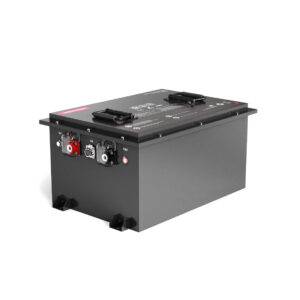 48V 100Ah LiFePO4 Golf Cart Battery (S51105L)
 48V 400Ah (51.2V 420Ah) Lithium Forklift Battery
 12V 100Ah Lithium Battery (LiFePO4, Self-heating, OEM)
Related articles & discussions
- How Do Discharge Rates Affect 51.2V 100Ah Server Batteries?
- Understanding the Self-Discharge Rate of Batteries Over 90 Days at 25℃
- Understanding the Efficiency of Charge and Discharge in LiFePO4 Batteries
- Is It OK to Fully Discharge a LiFePO4 Battery?
- Is It OK to Fully Discharge a Lithium-Ion Battery?
- Understanding Charge and Discharge Temperature Ranges for LiFePO4 Batteries
- How Can Rapid Recharge Lithium Batteries Ensure Continuous Golf Cart Operation?
- How can lithium batteries be optimized for frequent charge and discharge cycles?
- Is It Bad to Fully Discharge a LiFePO4 Battery? Understanding the Impacts and Best Practices
- What is the Current of a 16340 Battery?