




REDWAY BATTERY / KNOWLEDGE
Can 15-cell 48V and 16-cell 51.2V rack modules share one battery bank?
Redway Battery Editorial Team
Talk / Battery Q&A
A site with four 48V rack modules wants to add two 51.2V modules because they are in stock, and asks whether they can go in the same parallel bank.
Direct answer: No. A 48V LiFePO4 module typically has 15 cells in series and a 51.2V module 16, so their full-charge and cut-off voltages differ. Any charge voltage that fills the 16-cell modules would overcharge the 15-cell ones, and a voltage safe for the 15-cell modules leaves the 16-cell ones undercharged. They also usually cannot share a BMS communication bus. Keep each bank to one cell configuration.
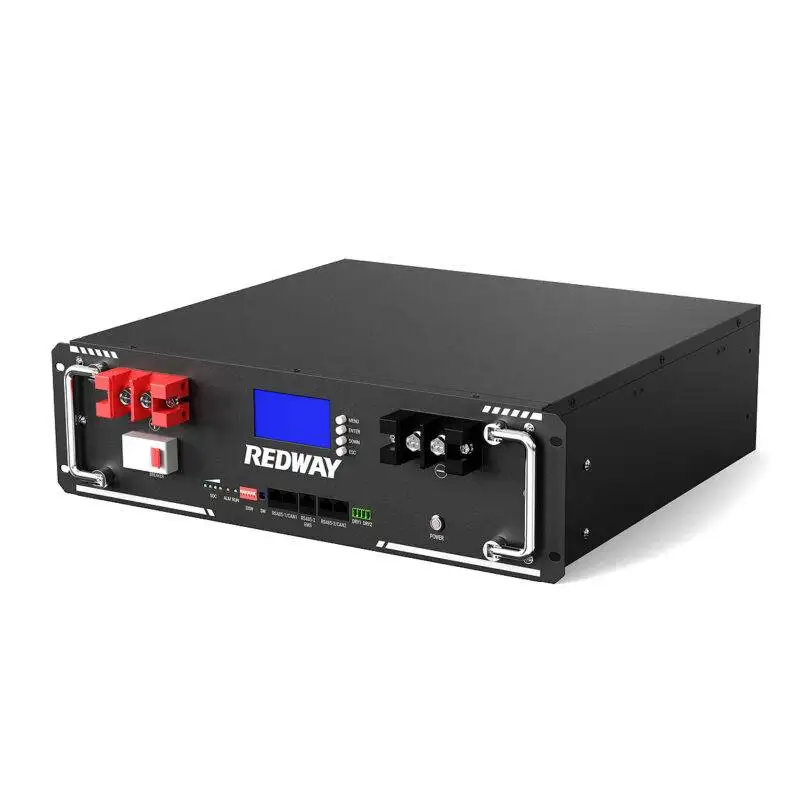
Voltage windows. The 48V 100Ah (PM-LV48100-3U) lists 54.75V maximum charge and 37.5V cut-off, and the 48V 200Ah 5U the same window. The 51.2V 100Ah (PM-LV51100-3U) lists 58.4V and 40V. Those figures correspond to 15 and 16 cells at about 3.65V full and 2.5V empty per cell; confirm cell counts with the datasheets.
What goes wrong in parallel. At the same terminal voltage, 15-cell modules sit at a higher state of charge per cell than 16-cell modules. Current flows between them until voltages equalise, and during charging the 15-cell modules hit their limit first and their BMS stops charging, while the 16-cell modules are still filling. Discharge ends early for the opposite reason. The result is reduced usable capacity and frequent protection events.
Communication. Rack modules in one bank normally use a master-slave link to report to the inverter. Modules with different configurations or firmware may not be recognised as one bank, so the inverter gets inconsistent limits.
What to do instead. Keep the two types as separate banks, each with its own inverter or a system that supports two independent battery inputs, or use the 51.2V modules on another project. If capacity is needed now, add more modules of the existing type. For adding same-type modules of different ages, see paralleling batteries of different ages.
Choosing for new sites. Pick one configuration that matches the inverter and stock it consistently; see 48V or 51.2V for your inverter.
Labelling. On mixed-stock sites, label modules clearly with nominal voltage and cell count, and keep them on separate shelves so installers do not combine them by mistake.
Check before ordering expansions. Ask the supplier to confirm the model, cell count and firmware of existing modules from their serial numbers before quoting additions.
↳ Replying to Redway Battery Editorial Team
Order expansion modules by exact model and cell count, not by ‘about 48V’; the cheaper stock item may be the wrong configuration.
↳ Replying to Procurement perspective
Compare maximum charge and cut-off voltages on both datasheets; if they differ, the modules belong in separate banks.
↳ Replying to Selection/Engineering perspective
Keep a register of module serials, cell configuration and firmware for each bank.
No. A 48V LiFePO4 module typically has 15 cells in series and a 51.2V module 16, so their full-charge and cut-off voltages differ. Any charge voltage that fills the 16-cell modules would overcharge the 15-cell ones, and a voltage safe for the 15-cell modules leaves the 16-cell ones undercharged. They also usually cannot share a BMS communication bus. Keep each bank to one cell configuration.
Verify before ordering: Cell counts are inferred from listed charge and cut-off voltages; confirm with Redway datasheets.
Editorial Q&A for battery selection and operations. Product figures cited from Redway product pages.
Related products
 48V 100Ah Server Rack Battery
 51.2V 100Ah Server Rack Battery
 48V 200Ah 10kWh Server Rack Battery (5U)
Related articles & discussions
- How Many Cells in a 48V Lithium Battery?
- How Many Cells in a 48V 100Ah Lithium Battery?
- Understanding the Power and Specifications of a 48V 100Ah Battery Module
- What Are Redway Rack Mounted Module Specs?
- Can you charge two lithium batteries in parallel with one charger?
- What are the key specifications and advantages of Redway rack mounted lithium battery modules?
- How many cells are in 48V 20Ah battery?
- Can One Solar Panel Charge Two Batteries in Parallel?
- How the 48V All-In-One EOH Solar/Energy Power Storage System Works
- Can I Connect Two 48V Banks for a 96V Setup?
