




REDWAY BATTERY / KNOWLEDGE
Closed-loop or open-loop: should a rack battery communicate with the inverter?

Redway Battery Editorial Team
Talk / Battery Q&A
An installer is fitting a hybrid inverter with two 51.2V rack batteries and can either connect the communication cable or set voltages manually.
Direct answer: Use closed loop whenever the inverter and battery support a common protocol. The BMS then sends the inverter its charge voltage and current limits, discharge limit, state of charge and alarms, so the inverter adjusts as the battery changes. Open loop, with voltages set by hand, works but relies on settings staying correct and gives the inverter only a rough state of charge.
What closed loop provides. Over CAN or RS485, the BMS typically shares charge voltage limit, charge current limit, discharge current limit, state of charge, state of health and alarm flags. The inverter tapers charging when a cell is high, reduces current when cold and shows a true battery SOC. Exact data depends on the protocol and firmware.
What open loop means. The inverter uses programmed charge, float and cut-off voltages and its own SOC estimate. LiFePO4’s flat voltage curve makes voltage-based SOC imprecise, and the BMS has to protect the battery by disconnecting if limits are exceeded, which can cut power unexpectedly.
Product support. The 51.2V 100Ah (PM-LV51100-3U) lists RS485, RS232 and CAN-bus, manual DIP-switch addressing (automatic DIP optional) and a long list of compatible inverter brands. The 51.2V 200Ah 5U lists RS485 and CAN and inverter brands including Deye, Victron, GoodWe, Sol-Ark and Growatt. The PRO version lists the same interfaces with a quick-plug connector. Brand names are not proof of compatibility with every model or firmware; confirm the exact inverter model and protocol.
Setting up closed loop. Use the cable and pin-out for your inverter, set the master battery address and protocol by DIP switch as the manual describes, select the matching battery type in the inverter, and confirm the inverter reads SOC and limits. See connecting a rack battery over CAN or RS485.
When open loop is reasonable. If the inverter has no supported protocol, set charge voltage, float and cut-off inside the battery’s window (for these 51.2V models, 58.4V maximum charge and 40V cut-off listed), with margins, and add a battery monitor for SOC. Ask Redway for recommended open-loop values.
Failure mode. If communication drops in closed loop, many inverters stop charging or raise an alarm; see ‘battery communication lost’.
↳ Replying to Redway Battery Editorial Team
Specify inverter model and firmware on the order so the right communication cable and protocol settings ship with the batteries.
↳ Replying to Procurement perspective
Check which values the inverter actually reads over the protocol; some read only SOC and alarms, not dynamic current limits.
↳ Replying to Selection/Engineering perspective
After firmware updates on either device, confirm that communication, SOC and alarms still show correctly.
Use closed loop whenever the inverter and battery support a common protocol. The BMS then sends the inverter its charge voltage and current limits, discharge limit, state of charge and alarms, so the inverter adjusts as the battery changes. Open loop, with voltages set by hand, works but relies on settings staying correct and gives the inverter only a rough state of charge.
Verify before ordering: Protocol support by inverter model and firmware is not listed per model; confirm with Redway and the inverter maker. Open-loop setpoints should come from Redway.
Editorial Q&A for battery selection and operations. Product figures cited from Redway product pages.
Related products
 51.2V 100Ah Server Rack Battery
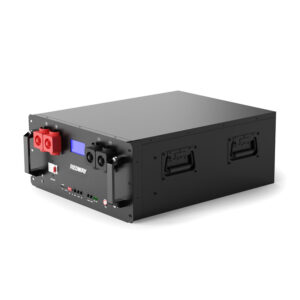 51.2V 200Ah 10kWh Server Rack Battery (5U)
 51.2V 100Ah Server Rack Battery PRO
Related articles & discussions
- How long will a 100Ah battery last with a 1000W inverter?
- Can I connect an inverter directly to a battery?
- Does Powerwall 2 come with an inverter?
- Do I Need a Special Inverter for a Lithium Battery?
- Do power inverters drain battery?
- How to Choose the Right Inverter Size for Your Refrigerator
- What is Better: Inverter or Power Station?
- How to Choose the Right Inverter and Energy Storage Solutions for Your Needs
- What Size Inverter Do I Need for a 200Ah Battery?
- How Big of a Battery Do I Need for a 2000 Watt Inverter?
