REDWAY BATTERY / KNOWLEDGE
Why do parallel rack battery modules show different SOC readings?

Redway Battery Editorial Team
Talk / Battery Q&A
A four-module rack bank shows SOC values a few percent apart on the module displays even though the modules share one bus.
Direct answer: Small SOC differences between parallel rack modules are common because each BMS estimates SOC from its own coulomb count and voltage model, while tiny cable-resistance and timing differences change the current each module sees. Large or growing gaps, however, point to poor cabling, a weak module, or a bank that has not had a full charge calibration for a long time. Commission parallel banks carefully, keep cable lengths matched, and use periodic full charges so estimates reconverge before you replace hardware.
Why estimates diverge. Parallel modules such as PM-LV51100-3U, PM-LV48100-3U or PM-LV51200-5U share terminal voltage but not identical current. Longer or thinner cables to one module reduce its share of charge and discharge, so its Ah counter drifts relative to the others.
Master and slave. In many racks one module speaks to the inverter while others follow. The inverter may show the master’s SOC while local screens show each module. A few percent spread with stable operation can be normal; confirm expected behaviour with Redway. Display interpretation basics are in SOC/SOH and alarms.
Commissioning habits. Modules should be at similar SOC before paralleling, with equal cable lengths to a common busbar, as in commissioning parallel rack batteries. Skipping that step embeds permanent imbalance.
Calibration. A full charge to the controlled end-of-charge point lets each BMS reset its full mark. Packs that live forever between 40% and 70% may slowly disagree until a deliberate full cycle is allowed.
When it is a fault. Spreads that widen every day, one module much hotter, repeated protect events on one address, or large voltage gaps under load need investigation. Check torque, fuse resistance and communication address DIP switches.
Do not mix chemistries or cell counts. 15-cell 48V and 16-cell 51.2V modules must not share a parallel bank.
Operations tip. Record module SOC weekly for the first month after expansion; stable small offsets can be accepted, widening offsets cannot.
Inverter view. Prefer closed-loop CAN/RS485 so the inverter uses coordinated limits rather than fighting module-level estimates.
Practical tolerance. Agree with the supplier what spread is acceptable at rest and under charge—for example a few percent—so technicians do not chase noise. Escalate when one module repeatedly leads or lags by a wide margin after a full calibration charge.
↳ Replying to Redway Battery Editorial Team
Know the SOC spread your supplier considers normal so small differences do not trigger unnecessary module swaps.
↳ Replying to Procurement perspective
Design equal cable lengths and verify master/slave addressing when paralleling rack modules.
↳ Replying to Selection/Engineering perspective
Schedule an occasional full charge to recalibrate coulomb counters on banks that rarely reach 100%.
Small SOC differences between parallel rack modules are common because each BMS estimates SOC from its own coulomb count and voltage model, while tiny cable-resistance and timing differences change the current each module sees. Large or growing gaps, however, point to poor cabling, a weak module, or a bank that has not had a full charge calibration for a long time. Commission parallel banks carefully, keep cable lengths matched, and use periodic full charges so estimates reconverge before you replace hardware.
Verify before ordering: Acceptable SOC spread and calibration behaviour are BMS- and firmware-specific; confirm with Redway for your module revision.
Editorial Q&A for battery selection and operations. Product figures cited from Redway product pages.
Related products
 51.2V 100Ah Server Rack Battery
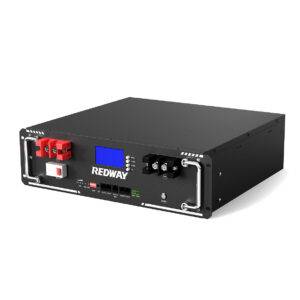 48V 100Ah Server Rack Battery
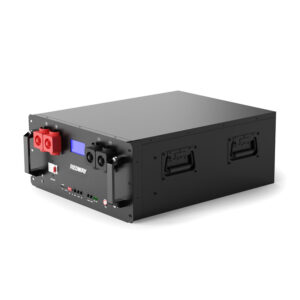 51.2V 200Ah 10kWh Server Rack Battery (5U)
Related articles & discussions
- Is It Better to Connect Lithium Batteries in Series or Parallel?
- How Lithium Battery Modules Are Transforming Energy Storage Projects
- Can All LiFePO4 Batteries Be Connected in Parallel?
- How to Connect Batteries in Parallel: Key Considerations
- How to Increase Battery Capacity with Parallel Connections: Key Insights
- How Many LiFePO4 Batteries Can I Put in Parallel? Key Insights
- Why not put batteries in parallel?
- LiFePO4 Batteries: Series vs. Parallel Connection for Optimal Performance
- How Do Lithium Battery Series and Parallel Connections Work?
- How Many LiFePO4 Cells Can You Connect in Parallel Safely?