




REDWAY BATTERY / KNOWLEDGE
Which battery terminal torque and lugs suit a 12V lithium battery?
Redway Battery Editorial Team
Talk / Battery Q&A
An RV installer keeps finding warm terminals on 12V lithium banks and wants a standard for lugs, stacking order and torque.
Direct answer: Use a ring lug whose hole fits the battery stud and whose barrel matches the cable cross-section, crimp it with the correct tool, and seat the lug flat directly against the terminal face. Washers and nuts go on top, never between lug and terminal. Tighten to the torque in the battery manual, mark the nut, and re-check after the first weeks of use. Warm terminals usually point to a loose, mismatched or poorly crimped connection rather than a battery fault.
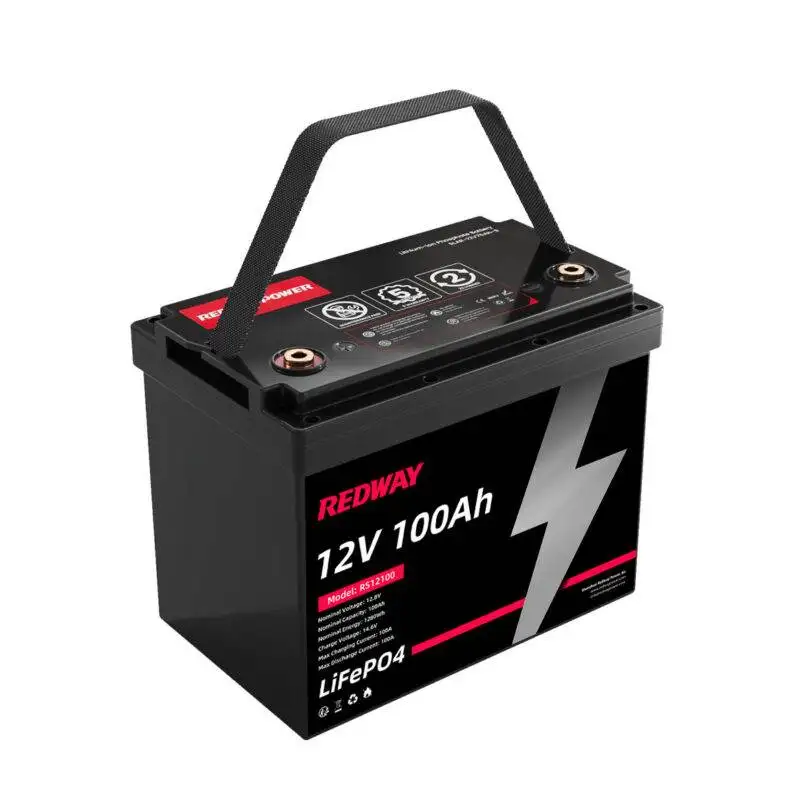
Stud size. The 12V 100Ah page lists M8 terminals, and the 12V 200Ah and 12V 300Ah pages list M8 with T8–T20 options. Use lugs with an 8 mm (or 5/16 in) hole for M8 so the lug cannot shift; an oversized hole reduces contact area.
Cable and lug match. Choose cable size for current, length and voltage drop first, then a lug made for that exact size. A lug crimped onto a thinner cable leaves strands loose and creates heat. Sizing examples are in cable and fuse for a 2000W inverter.
Crimp quality. Use a crimper made for the lug size, tug-test each crimp and seal with adhesive heat-shrink in damp spaces. Avoid solder-only joints on high-current cables in vehicles because vibration can crack them.
Stack order. Battery terminal face, cable lug, then flat washer, spring or lock washer and nut. If you add a shunt lead, fuse or busbar, keep the highest-current lug closest to the terminal and avoid stacking so many items that the nut barely engages the thread.
Torque. Use the figure in the Redway manual for the battery model; overtightening can strip an insert and undertightening causes heating. A torque wrench is cheap compared with a melted terminal.
Re-check. Mark nuts with paint after torqueing, then check them after the first few weeks and at every service. Thermal cycling and vibration can relax joints. A monitor shunt also needs solid connections; see installing a shunt.
Multiple batteries. Use equal-length cables in parallel banks; see wiring a 2S2P bank.
Covers and protection. Fit insulating terminal covers or boots after torqueing so a dropped tool cannot bridge the posts, and keep a fuse or breaker close to the positive terminal as the wiring standard requires. On boats, follow the ABYC guidance your surveyor uses; on RVs and vans follow the applicable electrical code and the vehicle maker’s instructions.
↳ Replying to Redway Battery Editorial Team
Buy lugs, crimp tool and heat-shrink sized to the cable as one kit so installers do not improvise.
↳ Replying to Procurement perspective
M8 studs need matched lugs and the manual torque; the stack order decides where current flows.
↳ Replying to Selection/Engineering perspective
Paint-mark nuts and re-check torque after the first weeks; warm terminals are a loose-joint warning.
Use a ring lug whose hole fits the battery stud and whose barrel matches the cable cross-section, crimp it with the correct tool, and seat the lug flat directly against the terminal face. Washers and nuts go on top, never between lug and terminal. Tighten to the torque in the battery manual, mark the nut, and re-check after the first weeks of use. Warm terminals usually point to a loose, mismatched or poorly crimped connection rather than a battery fault.
Verify before ordering: Terminal torque values are model-specific and given in the user manual, not on the product pages; ask Redway for the figure (available on request).
Sources checked: ABYC (American Boat & Yacht Council).
Editorial Q&A for battery selection and operations. Product figures cited from Redway product pages.
Related products
 12V 100Ah Lithium Battery (LiFePO4, Self-heating, OEM)
 12V 200Ah Lithium Battery
 12V 300Ah Lithium Battery
Related articles & discussions
- Can a 36V Battery Boost a 12V System Effectively?
- The Lifespan of 12V LiFePO4 Batteries: Understanding Longevity and Reliability
- Why Choose a 12V 54Ah Lithium Iron Phosphate Battery?
- How do I know if my 12v lithium-ion battery is bad?
- Can You Overcharge a 12V Lithium Battery?
- Is 13V Too High for a 12V Battery?
- Where Can I Find 12V Golf Cart Batteries Near Me?
- How Reliable Is a 12V 120Ah LiFePO4 Battery for B2B Applications?
- How Does Overcharging a 12V Battery Impact Its Lifespan?
- What to Know About the 12V 180Ah-M Lithium Battery from Redway Battery: A Comprehensive Review
