




REDWAY BATTERY / KNOWLEDGE
Should you choose a 48V 100Ah or 150Ah lithium golf cart battery for range?
Redway Battery Editorial Team
Talk / Battery Q&A
A golf club is upgrading lead-acid fleets and must pick between Redway 48V 100Ah and 48V 150Ah LiFePO4 packs for an 18-hole loop with optional twilight rounds.
Direct answer: Pick the 48V 100Ah (~5.12 kWh) pack when daily routes fit with a mid-day charge; pick the 48V 150Ah (~7.2 kWh) pack when you need roughly 40% more energy for longer days or shallower daily discharge. Confirm tray size and LiFePO4 charger match either way.
When a club or resort compares a 48V 100Ah LiFePO4 golf cart battery with a 48V 150Ah pack, the useful question is not “which is better” but “how many usable kilowatt-hours do we need between charges.”
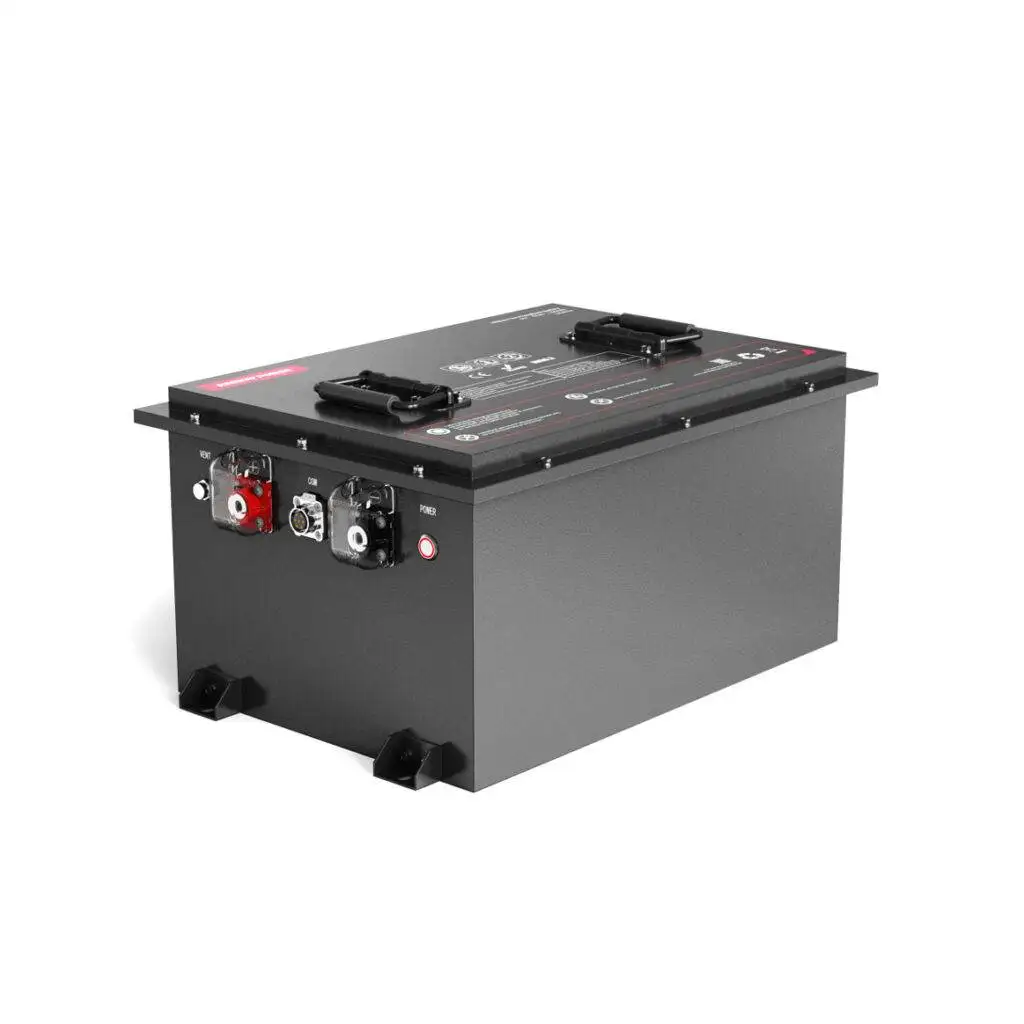
Redway’s 48V 100Ah golf cart pack (S51105) is specified around a 51.2V nominal voltage and about 100Ah, or roughly 5.12 kWh of energy. The 48V 150Ah pack is described with about 7.2 kWh. That is roughly a 40% energy step-up, not a small option bump. Both families are LiFePO4 with BMS protection; the 100Ah unit lists an approximate weight near 50 kg (110 lbs) and dimensions around 17.5×12×9.5 inches, with typical continuous discharge in the 150–200A range on the product page. Cycle-life messaging on these pages commonly references 6,000+ cycles at 80% DOD for LiFePO4 golf cart packs.
Range scales with usable energy and with how hard the cart is driven. Hills, passenger load, turf resistance, and accessory loads (lights, coolers, GPS) all raise average amps. As a planning approach—not a guarantee—estimate daily energy as average pack current × hours × voltage, then add a reserve. Example: a cart that averages 40A at ~48–51V for 2.5 hours uses on the order of 5 kWh. That sits near the full usable window of a 100Ah pack if you regularly approach deep discharge, and leaves more headroom on a 150Ah / 7.2 kWh pack. Fleet operators who want to keep depth of discharge shallower for longevity often prefer the larger pack even when a 100Ah unit “almost” finishes the day.
Form factor and controller limits still matter. Confirm tray length, cable reach, and that the charger matches LiFePO4 charge voltages for a 51.2V class pack. If the cart already runs cool on 100Ah with midday top-ups, staying on 100Ah can be the lower-cost choice. If carts return drained, or routes lengthened after a layout change, the 150Ah option is the more direct capacity fix than chasing aggressive charging schedules.
Bottom line: choose 100Ah (~5.12 kWh) for shorter loops and predictable mid-day charging; choose 150Ah (~7.2 kWh) when a full day without opportunity charging is the requirement. Verify tray fit and charger compatibility on the exact SKU before ordering.
↳ Replying to Redway Battery Editorial Team
Buy against measured route energy, not catalog Ah alone. Quote tray dimensions and charger model in the PO so the ~50 kg / 17.5×12×9.5 in class 100Ah pack or the larger 150Ah unit actually fits. Ask for cycle-life and warranty terms stated on the product page (commonly 6,000+ cycles at 80% DOD for these LiFePO4 golf cart lines) and total cost of ownership versus lead-acid replacement cadence.
↳ Replying to Procurement perspective
Map continuous current demand to the pack’s stated discharge capability (the 100Ah S51105 page cites roughly 150–200A continuous). If peak loads from hills or lifted carts approach those limits, evaluate a high-current 48V variant rather than only adding Ah. Keep system voltage at the cart’s designed 48V class unless the controller and motor are part of a planned conversion.
↳ Replying to Selection/Engineering perspective
After install, log state-of-charge at return-to-barn for two weeks. If 100Ah packs regularly finish below a healthy reserve, schedule either mid-day charging or a move to 150Ah. Keep firmware/Bluetooth or CAN monitoring (where equipped) enabled so BMS alerts are visible before a no-start event.
Pick the 48V 100Ah (~5.12 kWh) pack when daily routes fit with a mid-day charge; pick the 48V 150Ah (~7.2 kWh) pack when you need roughly 40% more energy for longer days or shallower daily discharge. Confirm tray size and LiFePO4 charger match either way.
Editorial Q&A for battery selection and operations. Product figures cited from Redway product pages.
Related products
 48V 100Ah LiFePO4 Golf Cart Battery
 48V 150Ah LiFePO4 Golf Cart Battery
Related articles & discussions
- How can high capacity 100Ah–200Ah golf cart lithium batteries transform fleet performance and ROI?
- Understanding 48V 200Ah LiFePO4 Golf Cart Batteries: Performance, Design, and Real-World Value
- How Can 36V, 48V, and 72V Lithium Golf Cart Batteries Redefine the Future of Electric Mobility?
- How Can a Golf Cart Lithium Battery with a Wide Operating Temperature Range Redefine Outdoor Mobility Efficiency?
- What Is the Best Zero‑Maintenance Lithium Battery for a Golf Cart Fleet?
- How can lithium golf cart batteries designed for 8–10 years of service life transform fleet performance and total cost of ownership?
- How can a lithium battery pack engineered for electric mobility vehicles unlock safer, longer-range and more profitable fleets?
- How Can Long Range Lithium Golf Cart Batteries Extend Your Runtime Significantly?
- Comprehensive Guide to Redway Battery 48V 50Ah Server Rack Batteries
- Understanding 51.2V 100Ah Server Rack Batteries: A Comprehensive Guide
